Culinary legend
Anthony Bourdain
- Discipline
- Culinary legend
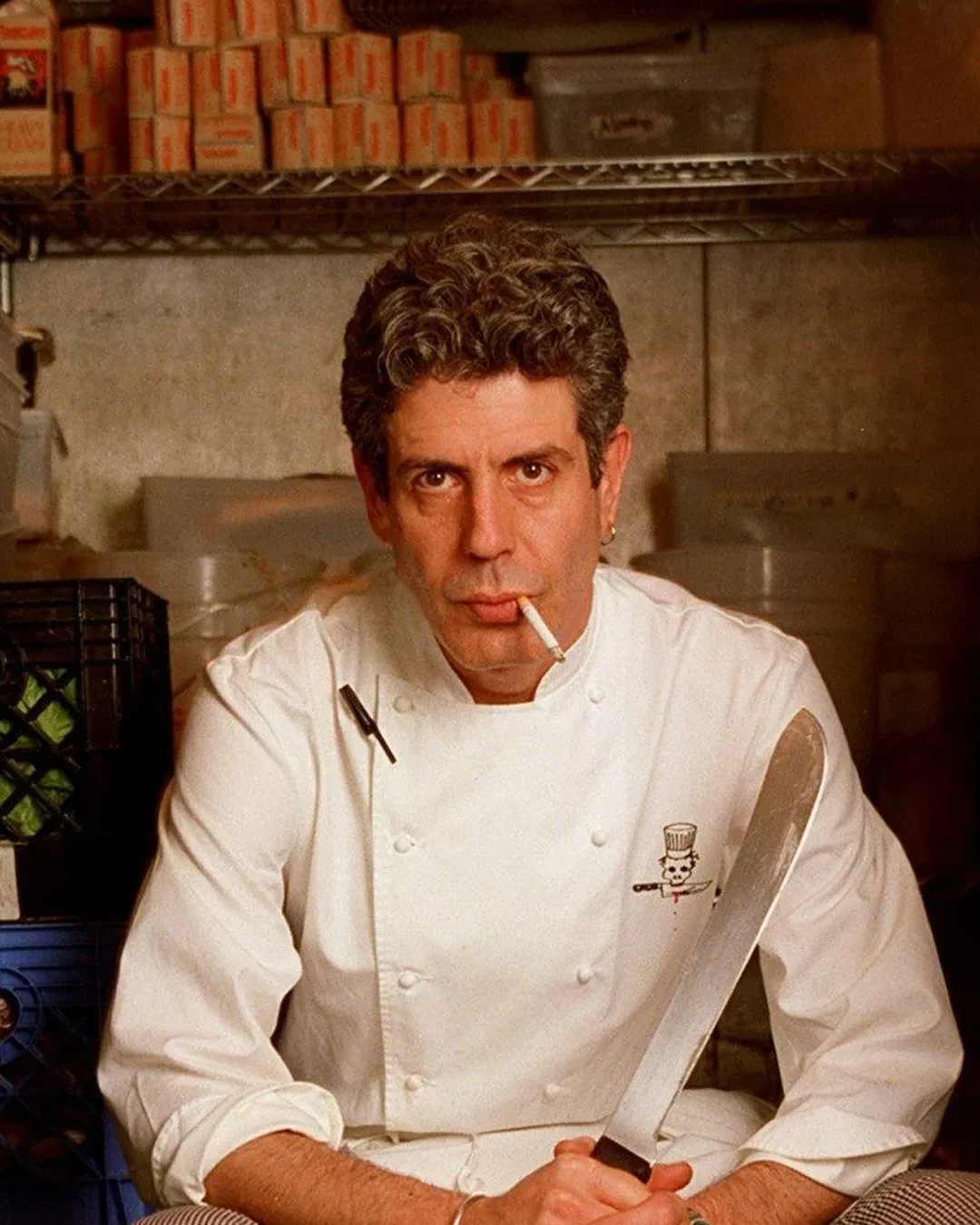
Portrait of Anthony Bourdain
i. Biography
Anthony Bourdain was an American chef whose defining restaurant post was executive chef at Brasserie Les Halles in Manhattan from 1998. He built his career on precision, stamina, and consistency, treating food as a trade shaped by labor, context, and the people behind it. Training at Dwight-Englewood School, Vassar College, and the Culinary Institute of America gave him a formal base before he entered professional kitchens at Supper Club, One Fifth Avenue, and Sullivan's in New York City from 1978. Those early rooms demanded pace, repetition, service, and the discipline needed to keep standards intact under pressure. By 1995, writing for Random House, The New Yorker, and HarperCollins extended that discipline onto the page, turning the same directness and appetite into prose about restaurant life. His work then moved into broadcast. He became host at Food Network from 2002 to 2003, then host at Travel Channel from 2005 to 2013, where his focus widened from the pass to the places that shape a table. With The Mind of a Chef from 2012 to 2017, he served as narrator and executive producer, and on ABC's The Taste from 2013 to 2015 he worked as judge and mentor. He was also host at CNN from 2013 to 2018, sole investor and editor-at-large at Roads & Kingdoms from 2015 to 2018, and host at Raw Craft from 2015 to 2017. Across kitchens, books, and television, Bourdain approached food with a practical attention to context. He was most interested in who was cooking and why they cooked that way in a particular place. That outlook shaped the food he chose to foreground, especially everyday food that was simple, pretense-free, authentic, and good. For him, cuisine did not stand alone. It carried the conditions of its place, the hands that made it, and the reasons it was made that way. His perspective favored clarity, restraint, and directness over display. His signature works include Kitchen Confidential: Adventures in the Culinary Underbelly, Parts Unknown, No Reservations, and A Cook’s Tour. Taken together, they map the worlds he opened to readers and viewers, from the kitchen underbelly to the road, the unscripted encounter, and the appetite for places where food and identity meet. He also received a Primetime Emmy Award for Outstanding Short Form Nonfiction or Reality Series.
The Sunday letter
Read Made By's new profiles every Sunday.
Meet the chefs, winemakers and sommeliers behind the places we cover. See a sample below before you subscribe.
See a sample of the Sunday emailOne email a week. Unsubscribe from any issue.
Explore

The Sunday letter
Get the next Made By profile in your inbox.
We send one email every Sunday morning with the people we profiled that week.
See a sample of the Sunday emailOne email a week. Unsubscribe from any issue.