Chef
Hidetoshi Nakamura
- Discipline
- Chef
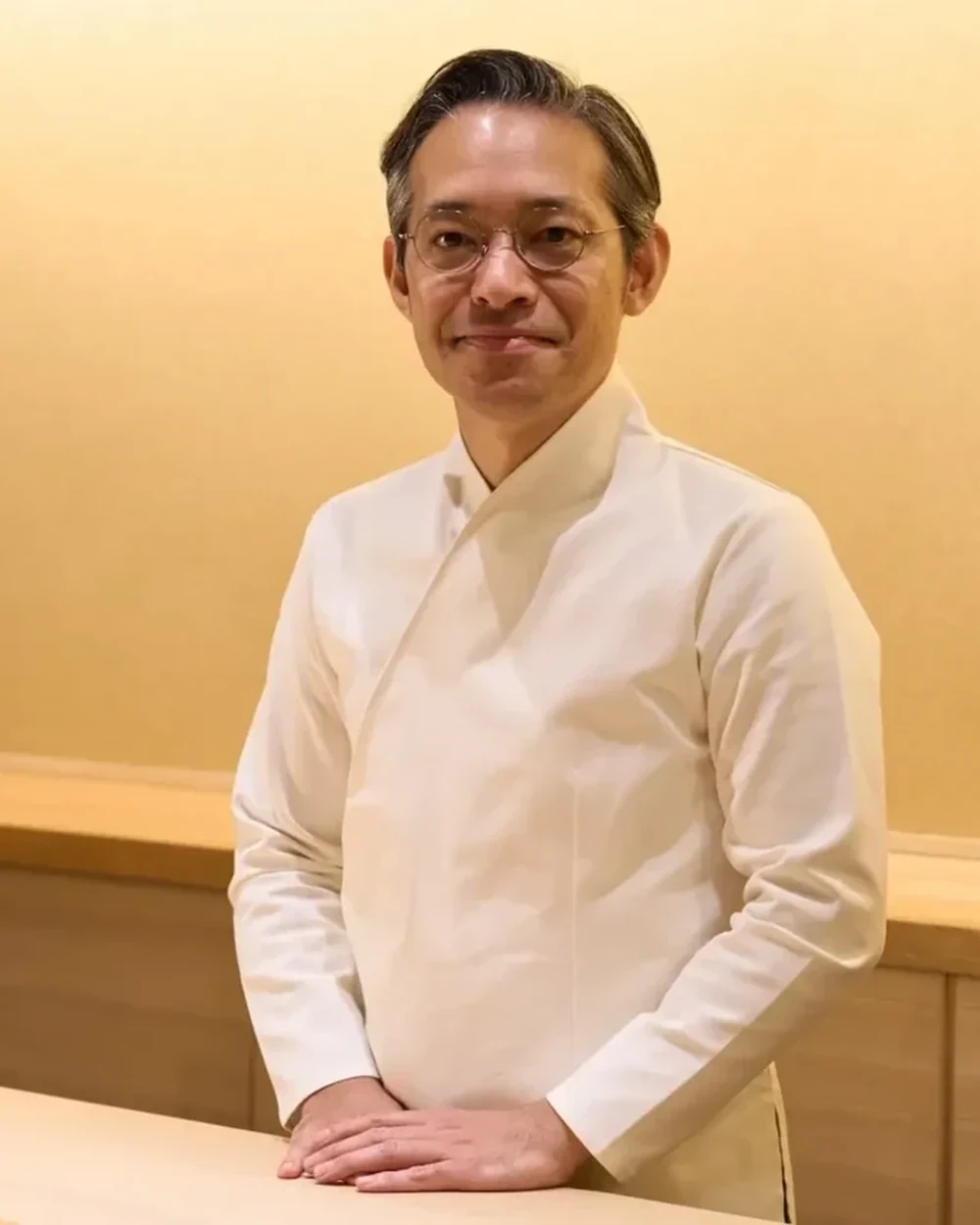
Portrait of Hidetoshi Nakamura
i. Biography
Before the Executive Chef role at Myojaku in Tokyo, the work had already passed through the discipline of Japanese restaurants including Kyoto’s Maruta, with Hidetoshi Nakamura as the cook carrying that training forward. The relevant inheritance is not decorative. It shows in control of reduction, attention to water, and a preference for clarity over display. At Myojaku, the meal is built through restraint: ingredient, aroma, texture, season, and the force of water are treated as primary materials rather than background conditions.
The Sunday letter
Read Made By's new profiles every Sunday.
Meet the chefs, winemakers and sommeliers behind the places we cover. See a sample below before you subscribe.
See a sample of the Sunday emailOne email a week. Unsubscribe from any issue.
Coming Up
Training in Japanese cuisine at Kyoto and Tokushima establishments in Kyoto and Tokushima, Japan, gave the craft its base through repetition, precision, and discipline, with Hidetoshi Nakamura formed inside that register. Technique here means more than correct execution. It means reading how heat changes a vegetable, how aroma lifts from broth, and how restraint can increase flavor rather than reduce it. High-level service widened that foundation before an independent restaurant entered the picture. The Executive Chef role at One-Michelin-starred Tokyo restaurant in Tokyo, Japan, placed Nakamura inside a demanding professional frame, after regional Japanese traditions had already shaped his hand. His current role as Executive Chef of Myojaku (since 2022) gathers that earlier training into cooking that is spare, personal, and tightly controlled.
Where They Are Now
The current work is based at Myojaku in Tokyo, where Hidetoshi Nakamura is Executive Chef. The restaurant works by subtraction: not austerity for its own sake, but removal of distraction until flavor, scent, and texture carry the meal. Minimalist Japanese cuisine is the operating language, with ingredient purity and pristine submarine spring water used instead of traditional dashi. In a cuisine where dashi often supplies the foundation, Nakamura’s choice changes the structure of the meal. At times the method is reduced to water and salt, used to draw out the purest flavors from a single ingredient. The emphasis is on what careful handling makes legible: sweetness released by heat, minerality carried by water, and aroma left unforced. The format is a 14-course French-leaning omakase shaped by Kanto restraint, Kansai-style sensitivity to water and aroma, and a minimalist approach. Its rhythm is calibrated rather than abundant. One opening tasting-menu dish presents vegetables boiled in water from three different sources, finished with only a pinch of salt, making water part of the flavor comparison rather than a neutral medium. Another signature seasonal-fish dish pairs the fish with Japanese spelt, which guests wrap in an impossibly thin white omelet, relying on delicacy, tactility, and balance. Buckwheat soba noodles are made using mother water from a brewery in Kanazawa, extending the same water-led method into another course. The cooking sits inside Japanese cuisine while using the architecture of a 14-course French-leaning omakase. Its minimalism is not emptiness, and its restraint is not severity. In Nakamura’s work, purity functions as method: small, exact decisions accumulate across the meal.
Career - Executive Chef — Myojaku, Nishiazabu, Tokyo, Japan (2022–present) - Training in Japanese cuisine — Kyoto and Tokushima establishments, Kyoto and Tokushima, Japan - Executive Chef — One-Michelin-starred Tokyo restaurant, Tokyo, Japan
Honors
Recognition for the restaurant centers on Myojaku’s rapid critical standing: Three Michelin stars for Myojaku (2026), Asia's 50 Best Restaurants: No. 45 for Myojaku (2025), Two Michelin stars for Myojaku (2023), 2026 OAD ranking for Myojaku (2026), and Tabelog Silver recognition for Myojaku.
FAQ What is Hidetoshi Nakamura's current role? Hidetoshi Nakamura is Executive Chef at Myojaku. Where did Hidetoshi Nakamura work before? Earlier in their career, Hidetoshi Nakamura worked at Kyoto and Tokushima establishments and One-Michelin-starred Tokyo restaurant. What recognition has
Explore

The Sunday letter
Get the next Made By profile in your inbox.
We send one email every Sunday morning with the people we profiled that week.
See a sample of the Sunday emailOne email a week. Unsubscribe from any issue.