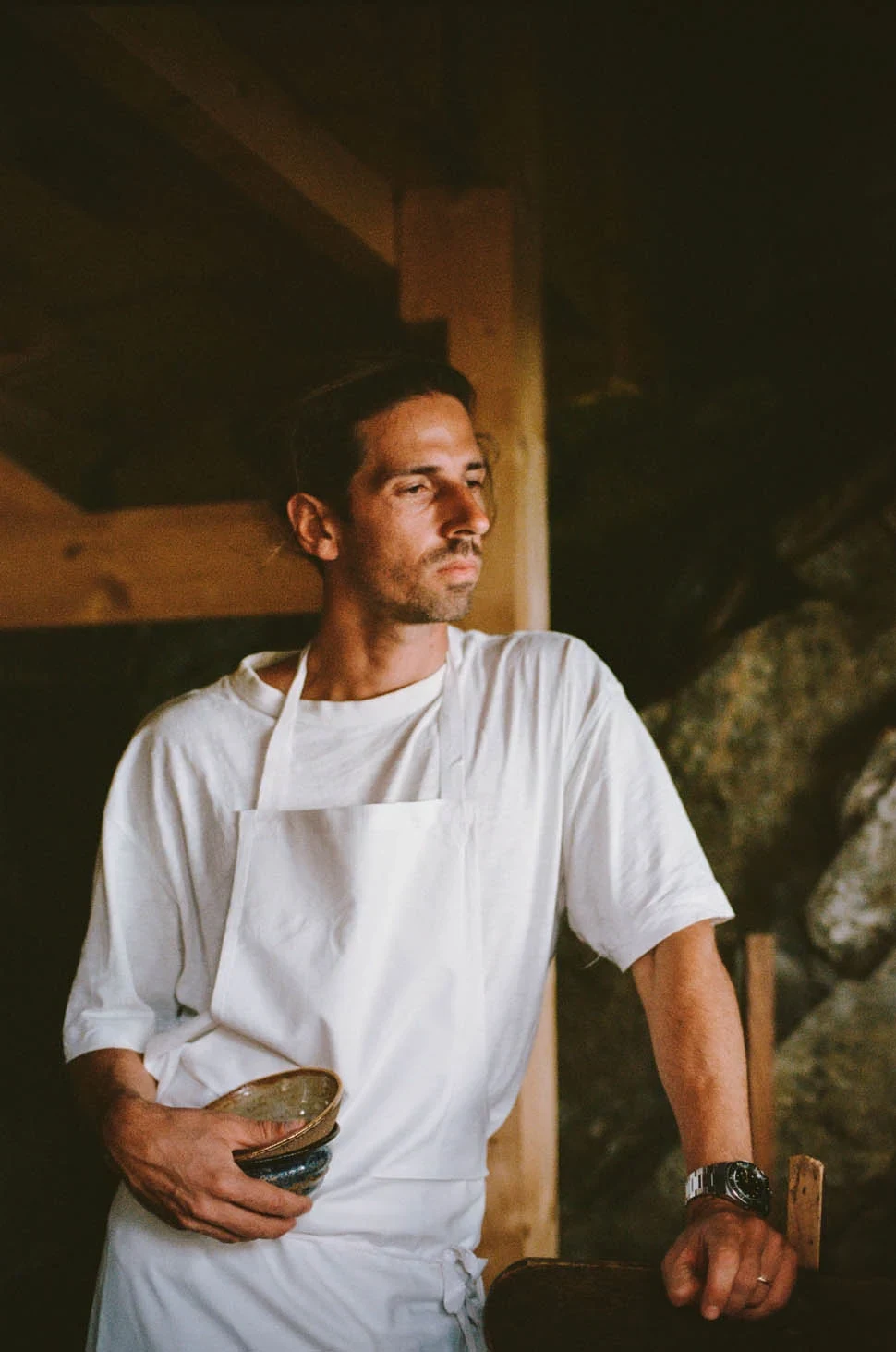
Portrait of Hugo Roellinger
i. Biography
“From this ‘marine water,’ I create my cuisine.” In the cooking of Le Coquillage in Saint-Méloir-des-Ondes, France, where Hugo Roellinger leads the kitchen, that statement defines the working material. Breton seafood is the base: fish, shellfish, seaweed and vegetables sourced through small local supply chains. The register is contemporary, but the pressure comes from place rather than novelty. Meat is absent from the menu, leaving salinity, vegetal structure and spice to carry the plate.
The Sunday letter
Read Made By's new profiles every Sunday.
Meet the chefs, winemakers and sommeliers behind the places we cover. See a sample below before you subscribe.
See a sample of the Sunday emailOne email a week. Unsubscribe from any issue.
The Path
Work at sea is part of the technical background to this cuisine. Early in his career, Hugo Roellinger worked as a merchant navy worker at Merchant navy, before the restaurant discipline took over. That experience does not need to be treated as mythology; it gives practical weight to a kitchen built around tides, salinity, horizon and the marine world as a primary source. Restaurant formation came through the stove. As a culinary trainee at Kitchens of Michel Bras, Michel Troisgros, Pierre Gagnaire, and Michel Guérard, Hugo Roellinger entered a demanding French lineage of precision, sensitivity and control.
The Work Today
The present cooking at Le Coquillage is based on sea and garden products, seaweed and spices. With meat absent, the kitchen narrows its field and gains clarity. Fish, shellfish, vegetables and seaweed carry the structure; spices add warmth, depth and distance without displacing the Breton base. The result depends on alignment between product, sourcing and restraint. The menu *Au Gré du Vent et de la Lune* is described as a poetic tale between sea and land where each dish reflects seasonality and precision. For a working kitchen, that means the title is not decoration: wind, moon, fishing, growing and gathering all point back to timing. The craft sits in choosing when to intervene and when to leave the product legible. Eau de Vie, a cold seaweed infusion served as a prelude, is described as the opening note in an operatic score. Its function is practical as much as symbolic: it sets the palate in a marine register before fish, shellfish, vegetables and seaweed take over. Cold infusion, salinity and seaweed establish the vocabulary of the meal before the sequence develops.
Career - Chef leading Le Coquillage — Le Coquillage, Saint-Méloir-des-Ondes, Ille-et-Vilaine, France (2014–present) - Merchant navy worker — Merchant navy - Culinary trainee — Kitchens of Michel Bras, Michel Troisgros, Pierre Gagnaire, and Michel Guérard
Signature
The signature work includes homard au cacao, vin xérès et trois piments, translucent langoustine tartlet with morels, lobster served in two textures, and lobster with cocoa and a trio of Mexican peppers. Across those named dishes, the craft is clear: shellfish sweetness is set against bitterness, acidity, spice and texture. Breton crustacean cookery is not left plain, but neither is it buried; cocoa, vin xérès and peppers are used as structural counterpoints.
In Their Words “From this ‘marine water,’ I create my cuisine.”
Acclaim
Recognition has followed the restaurant’s defined line of work: Three Michelin stars for Le Coquillage (2025), Green star for Le Coquillage (2020), Two Michelin stars for Le Coquillage (2019), and Cuisinier de l'année (2022). The awards mark a cuisine built from sea, garden, spice, season and sustainability, with Hugo Roellinger’s role evidenced through the consistency of that frame at Le Coquillage.
FAQ What is Hugo Roellinger's current role? Hugo Roellinger is chef leading Le Coquillage. Where did Hugo Roellinger work before? Earlier in their career, Hugo Roellinger worked at Merchant navy and Kitchens of Michel Bras, Michel Troisgros, Pierre Gagnaire, and Michel Guérard. What recognition has Hugo Roellinger received? Three Michelin stars for Le Coquillage (2025).
The Sunday letter
Get the next Made By profile in your inbox.
We send one email every Sunday morning with the people we profiled that week.
See a sample of the Sunday emailOne email a week. Unsubscribe from any issue.