Amber

In Residence
Richard Ekkebus
Chef
- 01CuisineContemporary French Fine Dining
- 02CityHong Kong, Hong Kong
- 03RecognitionThree Michelin Stars
- 3 Michelin Stars · Michelin Guide
- World's 50 Best · #20 · World's 50 Best Restaurants
- Wine Spectator · Tier 2
- Michelin 3 Stars · 2026
- La Liste Top Restaurants: 97pts · 2026
- Opinionated About Dining Top Restaurants in Asia Ranked #66 · 2026
- Black Pearl 2 Diamond · 2026
- Wine Spectator Best of Award of Excellence · 2026
- World's 50 Best Asia's Best Restaurants #90 · 2026
- Forbes 5-Star · 2026
- Les Grandes Tables du Monde Member · 2026
- Star Wine List · 2026
- Cathay Members’ Choice Awards Hong Kong’s Top Fine-Dining Restaurant Winner: 50pts · 2026
- SCMP 100 Top Tables Restaurants · 2026
- Forbes 5-Star · 2025
The Structure of the Meal Is the Point
French Contemporary dining in Asia has split into two camps over the past decade. One side maintains the classical architecture of grand French cooking, importing it largely intact. The other uses French technique as a grammatical framework, inserting Japanese product, Asian fermentation logic, and regional sourcing as the actual vocabulary. Amber is a restaurant in Central, Hong Kong, with three Michelin stars, a #20 ranking on the World's 50 Best Restaurants list, and a menu built around Contemporary French Fine Dining.
That consistency matters more than any single ranking. In a city where French fine dining options at this price tier also include Caprice and L'Envol, Amber's sustained positioning across multiple independent rating systems is notable.
The Sunday letter
Find new places through the people who run them.
Our Sunday email brings you the chefs, winemakers and hoteliers behind our newest stories. See a sample before you subscribe.
See a sample of the Sunday emailOne email a week. Unsubscribe from any issue.
Entering the Room
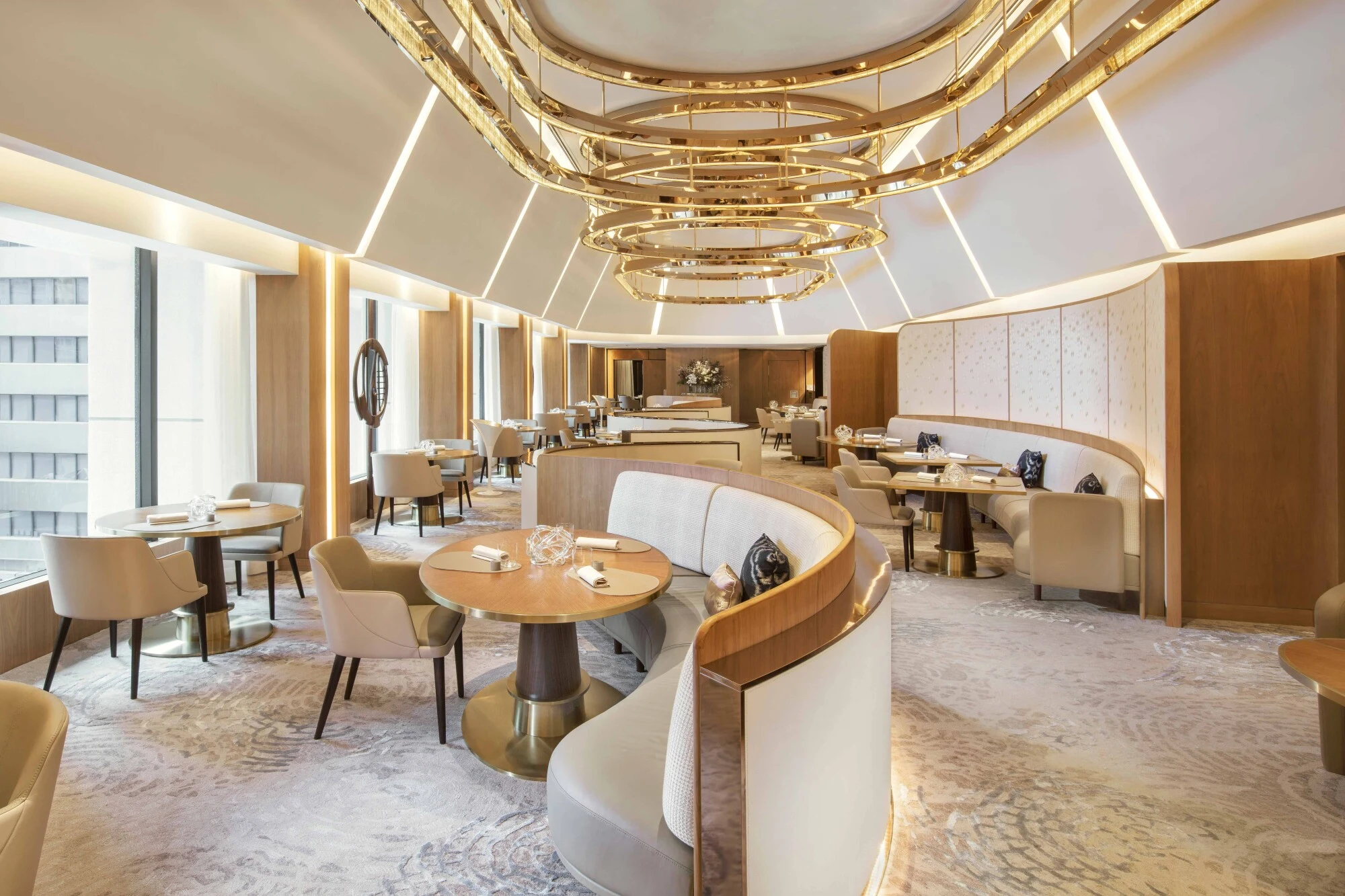
An opaque door on the seventh floor slides open to reveal the dining room, a design decision that frames arrival as a deliberate threshold. Adam Tihany's post-renovation interior reads as warm rather than cold, sophisticated without the clinical stillness that burdens many rooms at this price level. The atmosphere functions as a counterweight to the density of Central below, which runs at full pace through the day and well into the evening. Inside, the pace is different.
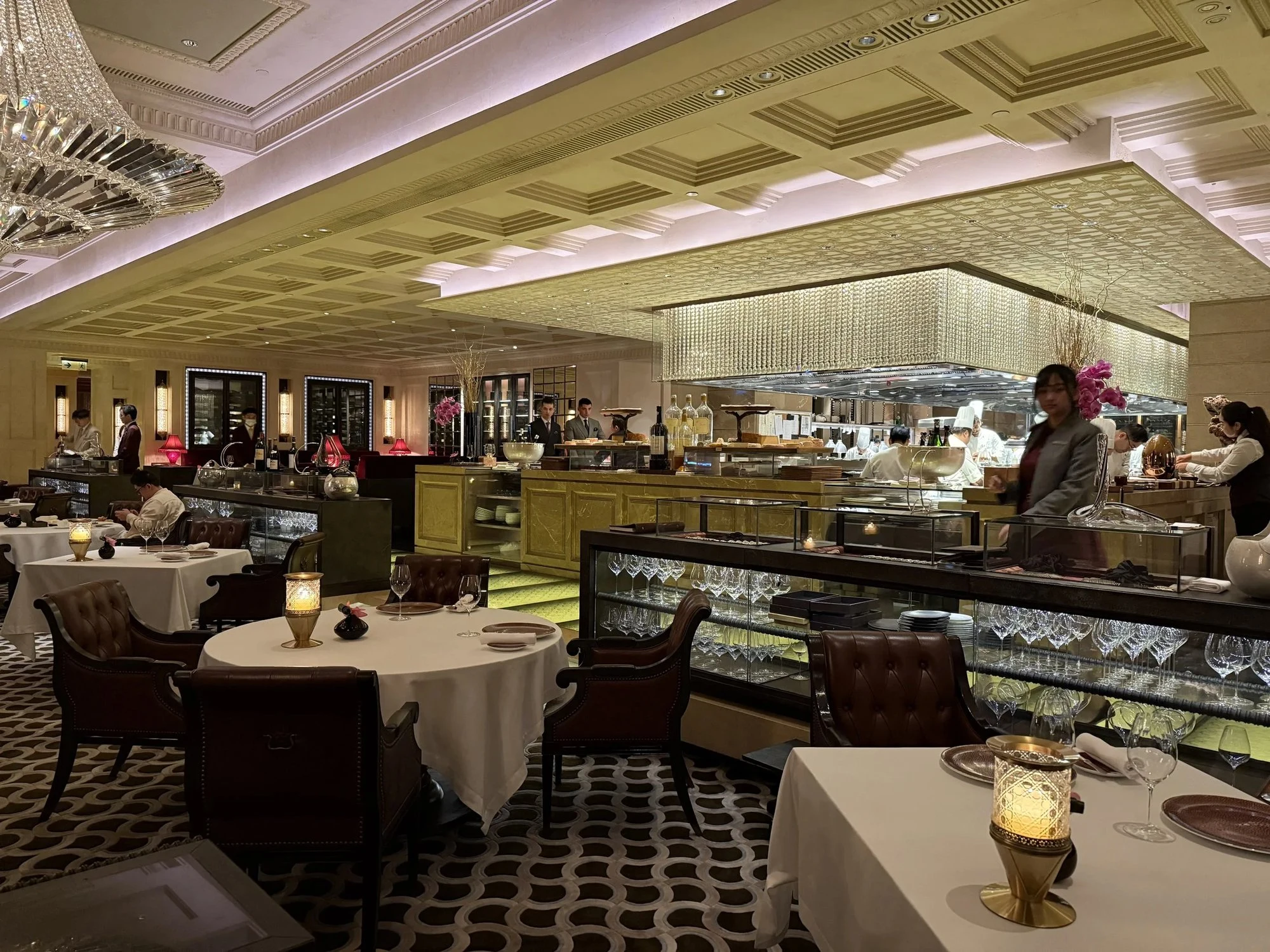
Every table at some point during service gains a sightline into the kitchen through a chef's table-style format, which is less a theatrical gesture and more a statement about transparency. The kitchen is the argument; letting the room see it is part of how Amber makes that argument.
The Logic of a Multi-Course Meal Here
The structured meal at Amber operates across two formats at dinner: the Amber Experience at five courses and the Full Amber Experience at seven. The sequencing is not decorative. Chef Richard Ekkebus removed dairy cream and milk from the kitchen and replaced them with nut milks, soy preparations, and fermentation-built textures, a shift that restructures how courses read across a long meal. Without cream as a default binding and enriching agent, each plate needs to generate weight and satisfaction through other means: fermentation provides umami depth, sodium from seaweed reads in place of added salt, and sweetness comes from agave, maple, and raw honey rather than refined sugar.
The result is a style of French Contemporary cooking that feels lighter across a multi-course format than its classical counterpart, which matters when you are eating seven courses. Across those systems, the consistent signal is technical precision applied to restraint rather than abundance.
Signature dishes remain available as additions to either set menu. The Miyazaki wagyu beef strip loin with pepper berry emulsion is the most frequently cited. Ingredients sourced by Ekkebus include Kristal Schrenki caviar, black truffles, Okinawa corn, Fukuoka tomatoes, cuttlefish, and Camargue rice. Japanese sourcing runs through the list without being foregrounded as a marketing category; it appears because it produces the specific quality standard the kitchen requires.
Pastry Chef Michael Pretet handles desserts with the same framework: sake lees sorbet with raspberry and puffed rice, and gluten-free madeleines made with buckwheat and coconut oil paired with Burlat cherries. The meal ends with dark Burlat cherry-adjacent grenadine chocolate chosen for its minerality and berry character. These are not afterthoughts. At a seven-course dinner in this price tier, the final twenty minutes carry as much weight as the opening, and the dessert sequence at Amber holds that standard.
For diners with dietary restrictions, the kitchen's dairy-free and reduced-sugar architecture means adaptations are built in rather than bolted on. The kitchen is noted as adaptable, which at this level means the logistics are handled without disrupting the sequencing of the meal.
The Wine Program
Wine Director Dirk Chen oversees a list of 1,800 selections across an inventory of 11,000 bottles. The program's documented strengths are Burgundy, Bordeaux, Rhône, Champagne, Italy, California, and Germany, with pricing that reflects the $100-and-above tier. Corkage is set at $130 for those bringing their own bottles.
The non-alcoholic option is less of an afterthought than at most comparable rooms. Housemade juices, including a tart German cherry juice, and a mocktail program offer a structured alternative path through the meal. At a seven-course dinner, the pairing sequence matters regardless of whether alcohol is involved, and the kitchen supports both paths.
Sustainability as Kitchen Discipline, Not Brand Strategy
Amber takes a practical approach to sustainability. At Amber, the implementation is specific and operational. The kitchen filters its own water, bans plastic straws, grows herbs on a rooftop garden, and operates a sustainable sourcing policy that extends to using whole ingredients to minimise waste. The dairy elimination described above also connects to this framework: removing cream reduces supply chain dependency and forces the kitchen toward fermentation and plant-based fat alternatives that carry lower environmental load.
Amber's position across those different evaluation systems suggests the sustainability program is running alongside technical excellence rather than substituting for it.
Where Amber Sits in Hong Kong's French Scene
Hong Kong's French Contemporary tier is more populated than any comparable Asian city outside Tokyo. Feuille operates at a lower price point within the same cuisine category, while Ami and Cristal Room by Anne-Sophie Pic represent additional formats within the broader French dining bracket. Plaisance by Mauro Colagreco brings another internationally credentialed name into the set.
In the regional French Contemporary category, comparable reference points include Odette in Singapore and Chef's Table in Bangkok, both of which operate at the intersection of French technique and local sourcing in the same way Amber does. Across a wider geography, Robuchon au Dôme in Macau and Alain Ducasse at Morpheus in Macau represent the more classically anchored end of the French fine dining spectrum in the region. Amber occupies a specific middle position: rigorous classical training as the foundation, Japanese product and dairy-free technique as the active variables. That combination has been consistent enough to sustain three Michelin stars across multiple years.
Further afield in the French Contemporary category, Saint Pierre in Singapore, L'Atelier Robuchon in Geneva, Bagatelle in Trier, and 1890 by Gordon Ramsay in London each represent different national inflections of the same broad culinary tradition.
Planning Your Visit
Amber is located on the seventh floor of The Landmark Mandarin Oriental at 15 Queen's Road Central, a building that sits at the centre of Central's commercial and retail district. The dress code is listed as smart casual, though the room's formality tends to push guests toward dressing more formally in practice. Lunch and dinner are both available. For a seven-course dinner with wine pairing, factor the evening accordingly; the Full Amber Experience is not a short booking.
Guests with dietary restrictions should note that the kitchen's existing framework, dairy-free, reduced sugar, gluten-free options available in the dessert sequence, makes accommodation more seamless than at most comparable rooms.
Questions
Frequently asked
What recognition does Amber hold?
Amber holds 3 Michelin stars and a place on the World's 50 Best list at number 20.
Who works at Amber?
Made By profiles Richard Ekkebus (Chef) at Amber.
How expensive is Amber?
Amber is listed at a price level of $$$$.
Where is Amber and what does it serve?
Amber is in Central, Hong Kong, serving Contemporary French Fine Dining.
The field
How it compares
| Place | Awards | Cuisine | Notes |
|---|---|---|---|
| Amber | Michelin 3 Stars, World's 50 Best #20 | Contemporary French Fine Dining | Central, $$$$ |
| 8 1/2 Otto e Mezzo Bombana (Hong Kong) | Michelin 3 Stars, World's 50 Best | 3 Michelin-Star Italian Fine Dining | Hong Kong |
| Caprice | Michelin 3 Stars, World's 50 Best | Contemporary French Fine Dining | Hong Kong |
| Ta Vie | Michelin 3 Stars, World's 50 Best | Modern French-Japanese Fine Dining | Hong Kong |
| The Chairman | Michelin 1 Star, World's 50 Best | Traditional Cantonese | Hong Kong |
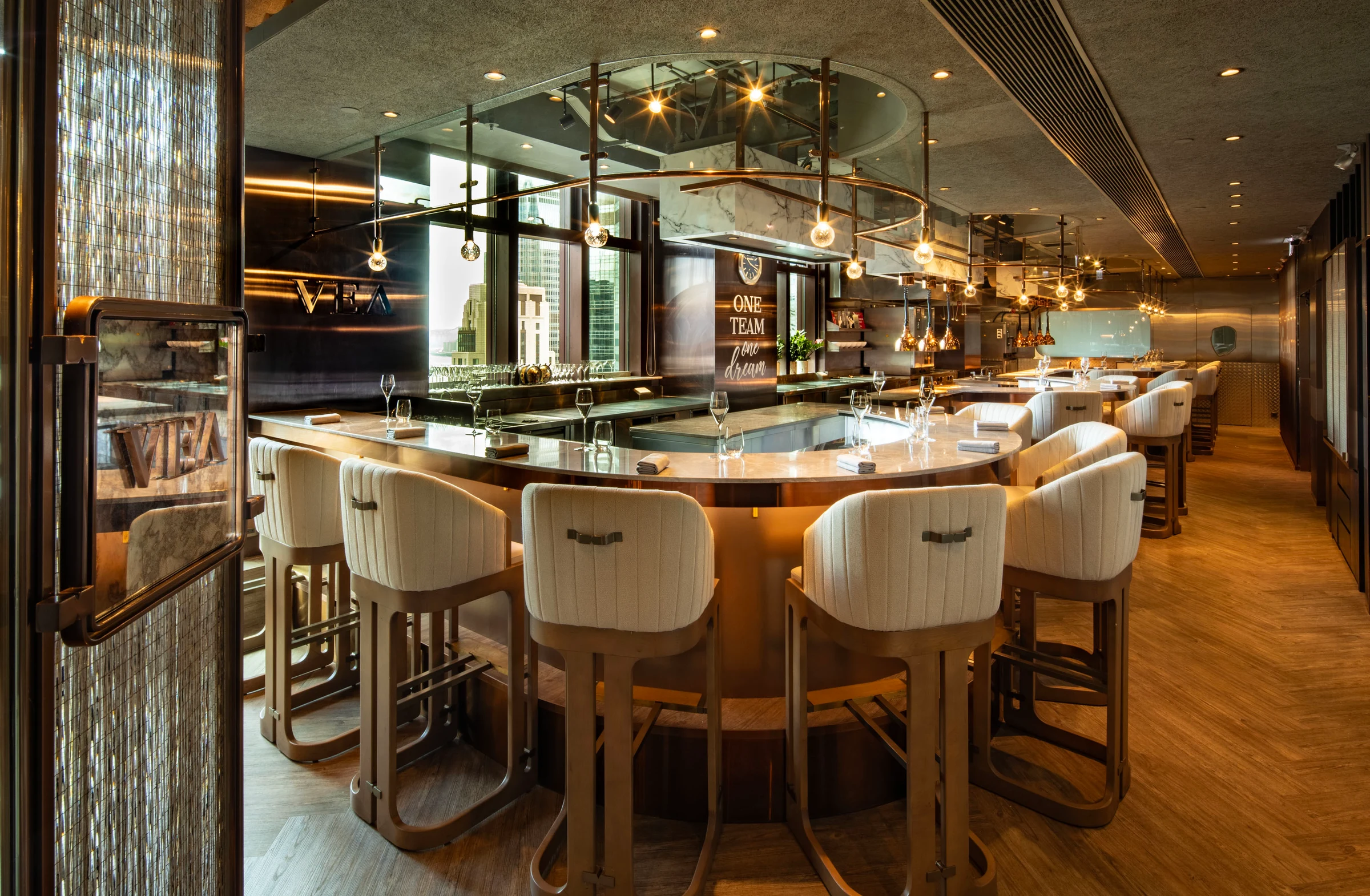
| Vea | Michelin 1 Star, World's 50 Best | Modern Chinese-French Fusion | Hong Kong |
| WING Restaurant | World's 50 Best | Modern Chinese Fine Dining | Hong Kong |
In residence
Similar places
3 Michelin-Star Italian Fine Dining
8 1/2 Otto e Mezzo Bombana (Hong Kong)
Hong Kong, Hong Kong
★★★ · 50 Best
Contemporary French Fine Dining
Caprice
Hong Kong, Hong Kong
★★★ · 50 Best
Modern French-Japanese Fine Dining
Ta Vie
Hong Kong, Hong Kong
★★★ · 50 Best
Traditional Cantonese
The Chairman
Hong Kong, Hong Kong
★ · 50 Best
Modern Chinese-French Fusion
Vea
Hong Kong, Hong Kong
★ · 50 Best
Modern Chinese Fine Dining
WING Restaurant
Hong Kong, Hong Kong
50 Best
The Sunday letter
Get the next Made By story in your inbox.
We send one email every Sunday morning with the places and people we covered that week.
See a sample of the Sunday emailOne email a week. Unsubscribe from any issue.