Aoyama SUSHI KANESAKA
- 01CuisineEdomae Sushi Omakase
- 02CityTokyo, Japan
From the people index
Recommended by
One trusted voice points here.
- Opinionated About Dining Top Restaurants in Japan Recommended · 2026
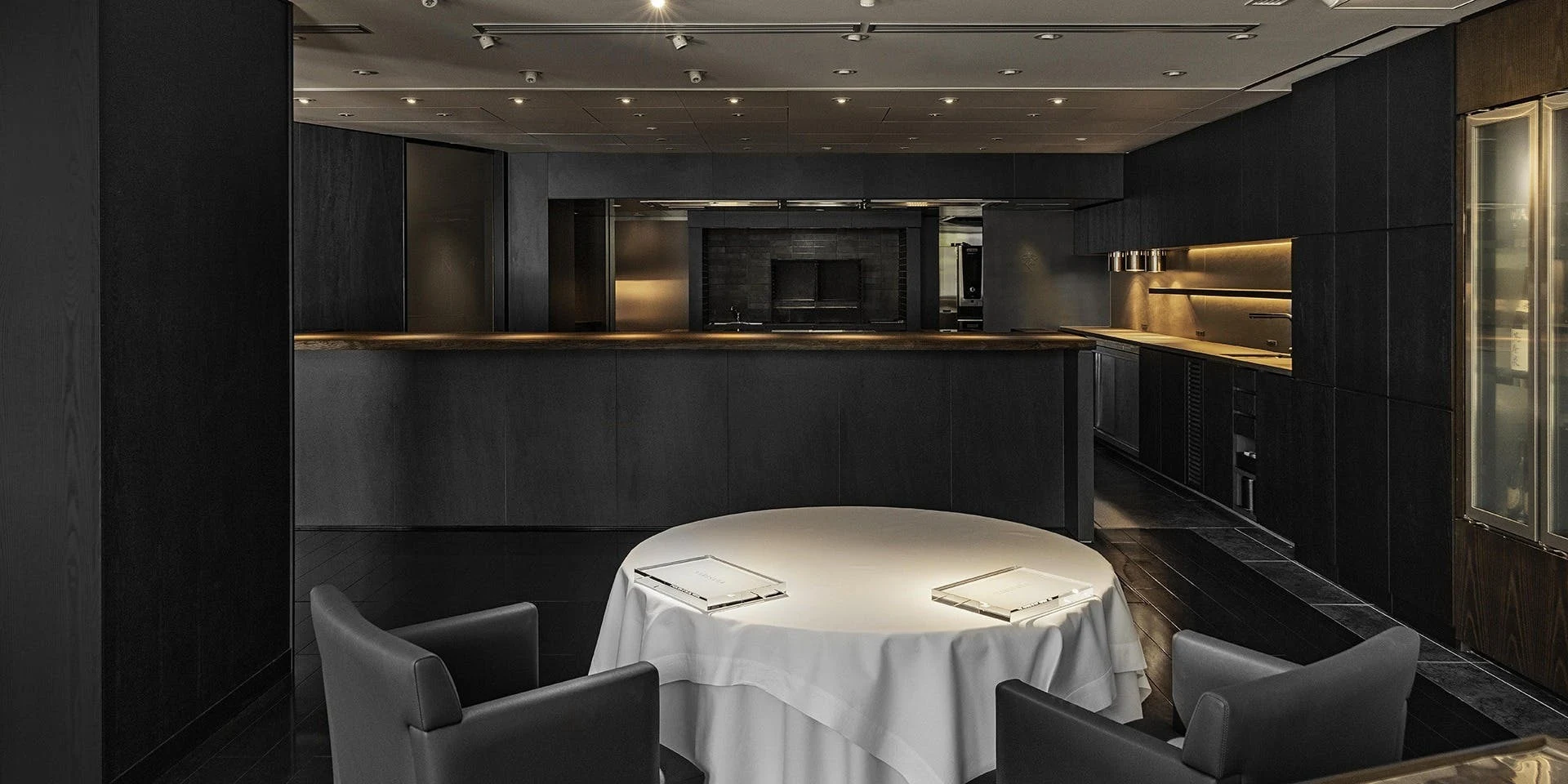
The approach to the 19th floor of The Aoyama Grand Hotel changes the usual Tokyo sushi prelude. Instead of a low street entrance, pavement-level noren, or Ginza basement corridor, the setting rises above Kita-Aoyama, a district better known for architecture, fashion houses, galleries, and polished hotel dining. That vertical arrival matters: it frames the meal within a newer Tokyo pattern, with sushi counters moving beyond inherited neighbourhood codes into hotel-led luxury spaces without abandoning counter discipline.
Aoyama SUSHI KANESAKA belongs to the Edomae conversation, not casual sushi. Opinionated About Dining placed it on its 2026 Top Restaurants in Japan Recommended list, naming Yusuke Tokudume as chef and sushi as the cuisine. In Tokyo’s crowded sushi market, where counters are hard to compare from outside, that recognition clarifies the bracket: serious, reservation-led, and aimed at diners who understand why rice temperature, cut, sequence, and pacing matter as much as seafood sourcing.
The Sunday letter
Find new places through the people who run them.
Our Sunday email brings you the chefs, winemakers and hoteliers behind our newest stories. See a sample before you subscribe.
See a sample of the Sunday emailOne email a week. Unsubscribe from any issue.
Aoyama's hotel sushi counter reflects a shift away from Ginza as the only reference point
For decades, Ginza has been the reference address for high-end sushi: compact counters, strict timing, and pricing that signals scarcity and lineage. Aoyama works differently. The neighbourhood trades on design fluency and international foot traffic rather than one dining tradition. A sushi counter here changes the meal’s social texture, making it easier to pair with a hotel stay, gallery schedule, or an evening that does not require crossing the city after dinner.
That distinction matters in 2026 because Tokyo’s premium dining is no longer concentrated in predictable pockets. Aoyama and nearby Omotesando have absorbed more serious dining rooms while keeping a different tempo from Ginza or Akasaka. The area feels curated but not sealed off, built for movement between retail, hotels, and restaurants rather than office towers emptying after work. Here, the sushi counter reads as part of an urban lifestyle shift, not a transplanted Ginza formula.
The comparison set reinforces the point. THE BELCOMO, in the same broader Aoyama orbit, shows the district’s hotel-dining fluency from a more social, all-day angle. tens. occupies another lane, with Italian cuisine and a JPY 20,000 to JPY 29,999 bracket, proving Aoyama can support polished dining beyond Japanese formality. Tonkatsu Junchan, Rossi, and SHIKAKU speak to the wider city’s range, but this sushi counter is narrower: tradition filtered through contemporary hotel infrastructure.
The reputation rests on Edomae discipline, not theatrical reinvention
Tokyo sushi does not reward novelty for its own sake. The serious end of the genre is built on repetition, calibration, and restraint: rice seasoned for the fish, fish prepared for the rice, and a sequence that works bite by bite. The Kanesaka name carries weight in that world, and the Aoyama address adapts the format for diners who want a controlled counter experience without the more austere codes of older sushi districts.
The question is not whether sushi in Tokyo is scarce; it is how to choose among counters that reveal little before arrival. External recognition from Opinionated About Dining has practical value, separating this room from hotel sushi that exists mainly as an amenity and placing it closer to the city’s serious omakase conversation. Yusuke Tokudume’s chef credit adds trust, but the format is the point: the counter, sequence, and timing carry the argument.
That makes it useful for diners who want Tokyo sushi with less friction around the evening. Aoyama can be planned alongside design shops, museum time, or a hotel itinerary, while still demanding focus once seated. Readers comparing broader Tokyo dining options can use Our full Tokyo restaurants guide for the citywide spread, then place this address within the premium sushi subset.
The wider Tokyo map matters because the city rarely rewards a single-category itinerary. Casual and specialist addresses sharpen the contrast around a sushi counter: . 鮪と炭火焼き うお炭 秋葉原店 points to tuna and charcoal cooking in Akihabara, 12/10 Shinjuku ten sits in Shinjuku’s denser dining field, 124. KAGURAZAKA (Yakitori) brings the conversation to skewers, and 3 Chome no Curry Ya San shows Tokyo’s tight specialization at another register. Even 2D Cafe helps explain the range: Tokyo can be playful at noon and exacting by dinner.
How to think about the surrounding trip
Plan this counter as the evening’s anchor, not one stop in a crowded schedule. Sushi at this level depends on cadence; arriving distracted, late, or overcommitted works against it. Aoyama makes the before-and-after easier than many sushi districts because its hotel, bar, and cultural infrastructure can support a contained night.
For a larger Tokyo itinerary, surrounding categories matter. Our full Tokyo hotels guide maps luxury lodging patterns, while Our full Tokyo bars guide is the better post-dinner companion. Longer stays can widen beyond restaurants through Our full Tokyo experiences guide, and wine-focused readers can scan Our full Tokyo wineries guide for adjacent drinking culture.
Japan’s broader dining field also frames Tokyo’s intensity. A sukiyaki address such as -Grilled beef Sukiyaki- KAMAKURA TANUKIAN 鎌倉 たぬき庵 in Kamakura, a Kyoto entry like [ki:] in Kyoto, and Sapporo’s [Curry Senmon Ten] Maruyama Kyoju. in Sapporo show how regional context changes precision. Farther afield,.cafe in Osaka,.know in Kumamoto, and (Shoku) Vietnam in Kawasaki broaden the picture beyond Tokyo formality. Across the Pacific, Jōdo Saké Bar in Los Angeles and Onigiri Time in Pasadena show how Japanese dining formats travel, simplify, and change away from Tokyo’s pressures.
The conclusion is measured: Aoyama SUSHI KANESAKA is not for diners seeking spectacle or maximal chef narrative. Its case is cleaner. In a city where serious sushi can feel opaque from outside, this counter offers a recognized Edomae format in a district that makes the logistics of a high-focus dinner less punishing. For Tokyo, that combination is its own argument.
Questions
Frequently asked
How expensive is Aoyama SUSHI KANESAKA?
Aoyama SUSHI KANESAKA is listed at a price level of $$$$.
Where is Aoyama SUSHI KANESAKA and what does it serve?
Aoyama SUSHI KANESAKA is in Minato, Tokyo, serving Edomae Sushi Omakase.
The field
How it compares
| Place | Cuisine | Notes | Awards |
|---|---|---|---|
| Aoyama SUSHI KANESAKA | Edomae Sushi Omakase | Minato, $$$$ | · |
| Den | Modern Japanese Kaiseki | Tokyo | Michelin 2 Stars, World's 50 Best |
| Florilège | Modern French-Japanese Plant-Based Fine Dining | Tokyo | Michelin 2 Stars, World's 50 Best |
| Narisawa | Modern Japanese Satoyama Fine Dining | Tokyo | Michelin 2 Stars, World's 50 Best |
| Quintessence | Modern French Fine Dining | Tokyo | Michelin 3 Stars |
| Sazenka | Modern Chinese Fine Dining | Tokyo | Michelin 3 Stars, World's 50 Best |
| Sézanne | Modern French Fine Dining | Tokyo | Michelin 3 Stars, World's 50 Best |
Similar places
Modern Japanese Kaiseki
Den
Tokyo, Japan
★★ · 50 Best
Modern French-Japanese Plant-Based Fine Dining
Florilège
Tokyo, Japan
★★ · 50 Best
Modern Japanese Satoyama Fine Dining
Narisawa
Tokyo, Japan
★★ · 50 Best
Modern French Fine Dining
Quintessence
Tokyo, Japan
★★★
Modern Chinese Fine Dining
Sazenka
Tokyo, Japan
★★★ · 50 Best
Modern French Fine Dining
Sézanne
Tokyo, Japan
★★★ · 50 Best
The Sunday letter
Get the next Made By story in your inbox.
We send one email every Sunday morning with the places and people we covered that week.
See a sample of the Sunday emailOne email a week. Unsubscribe from any issue.