Made ByHotel
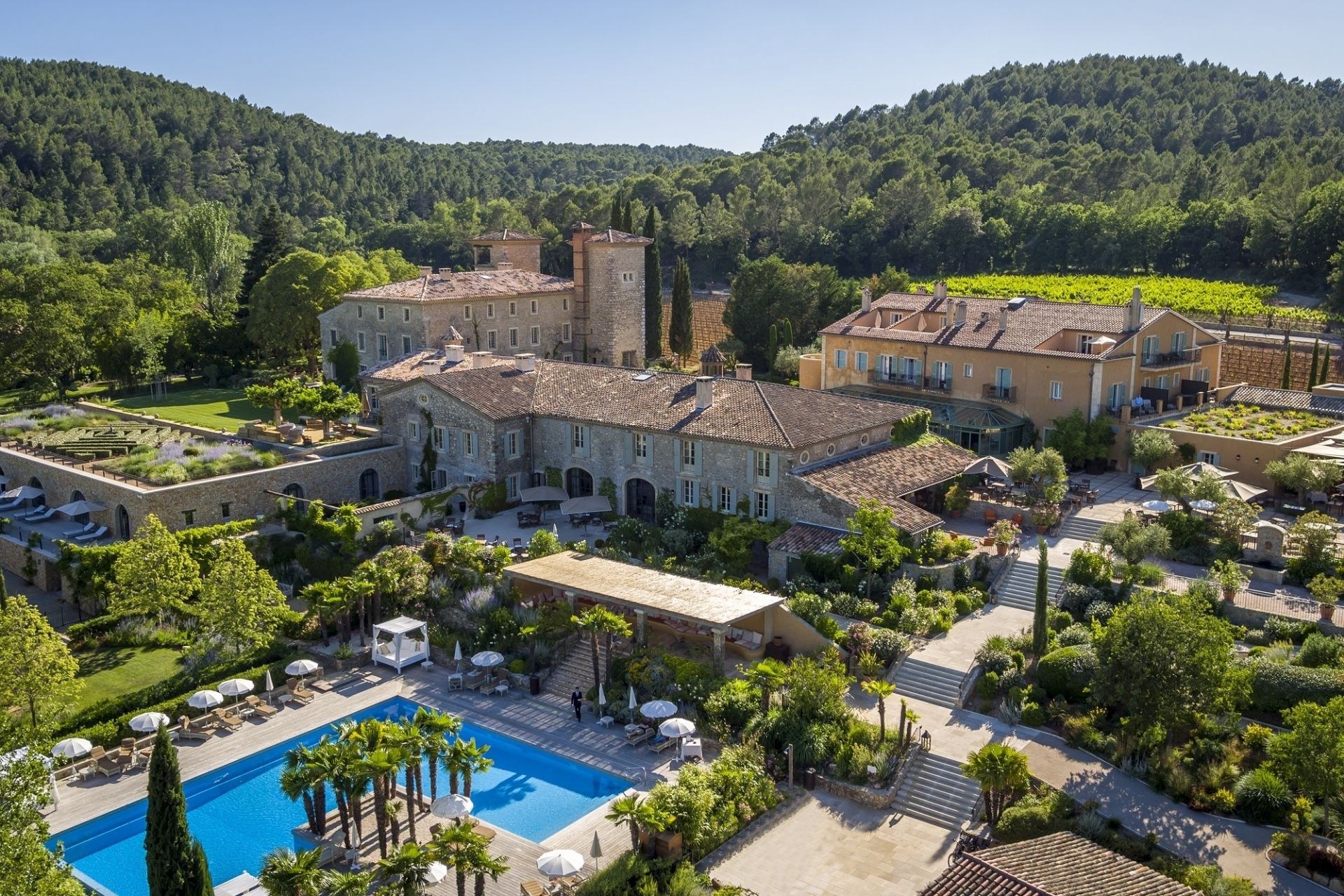
A 1,300-acre Relais & Châteaux wine estate set among Mediterranean forest, olive groves, and 150 hectares of organic vines in the Provençal hinterland, Château de Berne holds a Michelin star, a Green Star for its eco-responsible kitchen, and a Michelin Key for its 34-room hotel. Rates start from around $473 per night, placing it firmly in the upper tier of Var department luxury.
- 1 Michelin Key
At a glance
- Price
- $$$$
- Neighborhood
- Lorgues
<h2>Arriving at the Estate: What the Landscape Communicates Before You Check In</h2><p>The approach to Château de Berne is itself a form of editorial statement. A narrow road threading through Mediterranean forest gives way to olive groves, then vine rows, before the château appears at the end of a long axis, a choreographed arrival that signals the architectural and spatial logic of everything that follows. The 1,300 acres of estate (roughly 515 hectares) do not feel managed in the resort sense; they feel inhabited, with working vineyards, natural scrub, and the kind of ambient quiet that the Var's interior delivers with particular authority. This part of inland Provence, an hour from St. Tropez and well removed from the coast, draws a specific traveller: one who has already done the Riviera and is looking for something that requires less performance.</p><p>Among French wine-estate hotels, this genre has produced a distinctive typology: the working domaine that wraps luxury accommodation around a producing vineyard, integrating gastronomy and land into a coherent proposition. Properties like <a href="https://www.enprimeurclub.com/hotels/les-sources-de-caudalie-bordeaux-hotel">Les Sources de Caudalie in Bordeaux</a> and <a href="https://www.enprimeurclub.com/hotels/chateau-lafaurie-peyraguey-hotel-restaurant-lalique-lieu-dit-peyraguey-hotel">Château Lafaurie-Peyraguey in Sauternes</a> operate in the same category. Château de Berne's Provençal coordinates give it a Mediterranean terroir identity that those Bordelais counterparts cannot replicate, and its 150 hectares of organic vines, a meaningful scale for a single estate, make the wine component something more than decoration.</p><h2>The Architecture of Stay: Rooms, Villas, and the Design Register</h2><p>The 34 rooms and 7 private villas represent two distinct modes of occupation. The rooms in the château itself read as two parts traditional Provençal and one part contemporary-boutique, a calibration that avoids both the sterile anonymity of international hotel design and the fussiness of heritage-heavy restoration. Ochres, terracottas, and stone tones are the dominant palette, colours that reference the local landscape without resorting to kitsch. In a region where many properties either over-Provençalize their interiors or drift toward generic Mediterranean luxury, this calibration is worth noting.</p><p>The villa offering operates on a different scale of experience. Seven private villas set within the estate's grounds deliver the kind of spatial autonomy that neither a hotel room nor a suite can approximate. Views across the vineyard replace corridor corridors; the distance from the main château building shifts the social contract entirely. For travellers whose reference point is something like <a href="https://www.enprimeurclub.com/hotels/la-reserve-ramatuelle-hotel-spa-and-villas-ramatuelle-hotel">La Réserve Ramatuelle</a> or the villa formats at <a href="https://www.enprimeurclub.com/hotels/villa-la-coste-le-puy-sainte-reparade-hotel">Villa La Coste</a>, this is familiar territory presented through a wine-estate lens.</p><p>800 m² spa, developed in partnership with Cinq Mondes and the estate's own Vinésime programme, opens onto a terrace and Japanese garden, a juxtaposition that reads slightly unexpected against the Provençal context but works as a spatial counterpoint. The integration of wellness within a wine-producing estate is now a well-developed format across French luxury hospitality, appearing at properties from <a href="https://www.enprimeurclub.com/hotels/royal-champagne-hotel-spa-champillon-hotel">Royal Champagne in Champagne</a> to <a href="https://www.enprimeurclub.com/hotels/domaine-les-crayeres-reims-hotel">Domaine Les Crayères in Reims</a>. At Château de Berne, the vine-based treatments connect the spa to the estate's producing identity rather than treating wellness as a bolt-on amenity.</p><h2>Gastronomy as a Function of the Estate</h2><p>Michelin's assessment of Château de Berne's restaurant, Le Jardin de Berne, is doubled: one star for culinary achievement and one Green Star for ecological approach. The Green Star, introduced by Michelin in 2020 and now awarded to a relatively small number of restaurants, signals a verifiable commitment to sustainable sourcing and kitchen practice, not merely a willingness to mention local producers on a menu. Chef Louis Rameau leads the kitchen, operating within a framework that the estate's organic viticulture and garden-to-table sourcing make structurally coherent rather than aspirational.</p><p>Beyond the starred restaurant, the estate runs a bistro adjacent to the cellar and a chef's table format called La Table du Chef, which brings guests behind the scenes of the gourmet kitchen in a more informal register. This layering of dining formats, formal, casual, experiential, reflects a broader shift in how wine estates structure gastronomy. The cellar-adjacent bistro in particular positions the wine programme as context rather than afterthought. Properties with comparable multi-format dining approaches include <a href="https://www.enprimeurclub.com/hotels/baumaniere-les-baux-de-provence-les-baux-hotel">Baumanière in Les Baux-de-Provence</a>, where different dining registers serve different modes of the same stay.</p><p>The 150 hectares under organic cultivation also supply the estate's own wine range, which runs as its own track through the guest experience. Tastings, vineyard walks, and cooking classes sit alongside the restaurant as structured encounters with the estate's productive identity. This is the genre's core proposition: the property teaches as much as it feeds.</p><h2>Where Château de Berne Sits in Its Competitive Set</h2><p>The 2026 La Liste Leading Hotels assessment places Château de Berne at 92 points, alongside recognition from Gault & Millau (Exceptional Hotel, 5 points, 2025) and Condé Nast Traveller's Leading Hotels ranking at number 20 for 2025. The Michelin Key rounds out a credential profile that positions the property in the upper tier of Relais & Châteaux estates globally. Within France specifically, it earns category recognitions as a Regional Winner for Luxury Wine Estate Hotel, Global Winner for Luxury Private Villa, and Country Winner for Luxury Hotel, a spread that reflects the breadth of what the estate offers rather than a single dominant strength.</p><p>Rates from approximately US$407 per night for rooms, with higher-tier villa pricing, place Château de Berne in direct competition with properties like <a href="https://www.enprimeurclub.com/hotels/chateau-de-la-gaude-aix-en-provence-hotel">Château de la Gaude in Aix-en-Provence</a> and <a href="https://www.enprimeurclub.com/hotels/la-bastide-de-gordes-gordes-hotel">La Bastide de Gordes</a>. Against coastal Riviera options, <a href="https://www.enprimeurclub.com/hotels/hotel-du-cap-eden-roc-antibes-hotel">Hotel Du Cap-Eden-Roc</a> or <a href="https://www.enprimeurclub.com/hotels/the-maybourne-riviera-roquebrune-cap-martin-hotel">The Maybourne Riviera</a>, the value proposition shifts: the estate trades sea views and social visibility for land, scale, and the slower rhythm of a working agricultural property. That exchange suits a particular travel posture.</p><p>For those comparing within the broader Relais & Châteaux France portfolio, the Var interior has a different character than either the Luberon (where <a href="https://www.enprimeurclub.com/hotels/la-bastide-de-gordes-gordes-hotel">La Bastide de Gordes</a> operates) or the Alpilles corridor anchored by Baumanière. The microclimate is warmer and drier; the social register is less frequented by the Parisian summer circuit. This relative remove is part of the draw for guests arriving from <a href="https://www.enprimeurclub.com/hotels/cheval-blanc-paris-paris-hotel">Cheval Blanc Paris</a> or comparable urban properties looking for full decompression.</p><h2>Planning a Stay</h2><p>Château de Berne is located at Chemin des Imberts, 83780 Flayosc, in the Var department, accessible by car from the A8 autoroute with Toulon-Hyères and Nice Côte d'Azur airports both within approximately an hour's drive. The estate's phone is +33 (0)4 94 60 48 88 and reservations can be made via chateauberne.com or through berne@relaischateaux.com. The 34-room hotel operates at five-star grading within the Relais & Châteaux portfolio; villa stays should be enquired separately as availability runs independently of the main hotel. The Michelin-starred Le Jardin de Berne operates to its own seasonal calendar, and given the starred format and a relatively small property, advance booking alongside room reservations is advisable. The spa requires appointment scheduling. Cookery classes and guided vineyard experiences run on a programme basis; the estate website holds current scheduling.</p>
Know before you go
- Dress code
- smart_casual
- Reservations
- recommended
- Parking
- valet
- Payment
- credit_card
- Accessibility
- wheelchair_accessible, elevator
- Outdoor seating
- Yes
- Groups
- Welcomed
- Children
- Welcomed
Frequently asked
What kind of setting is Château de Berne?
Château de Berne occupies 1,300 acres of Mediterranean forest, organic vines, and olive groves in the Var department, near Flayosc. The estate sits roughly an hour inland from St. Tropez, reached via a narrow road that passes through forest before the property opens out. La Liste Top Hotels (2026) scored it at 92 points and awarded it Regional Winner for Luxury Wine Estate Hotel, which reflects both the scale and the coherence of the setting.
Is Château de Berne award-winning?
Château de Berne has received recognition including: An invitation to travel to the heart of a Relais et Châteaux in Provence In the hinterland of Provence, in the heart of 515 hectares of nature, a small road winding through forest and olive groves leads you to Château de Berne, a 5-star Rel….
What room category do guests prefer at Château de Berne?
The estate offers 34 rooms in the château and 7 private villas, which represent two fundamentally different modes of stay. The villas are positioned for guests who want uninterrupted vineyard views and separation from the main building, and they earned a Global Winner award for Luxury Private Villa from La Liste (2026). Rooms in the château itself are decorated in Provençal tones with a roughly two-thirds traditional, one-third contemporary register. Rates begin at $473 per night across the property.
What's the address for Château de Berne?
Château de Berne is located at Chemin des Imberts, 83780 Flayosc, Lorgues.
What makes Château de Berne worth visiting?
Le Jardin de Berne holds both a Michelin Star and a Michelin Green Star (2025), the latter recognising its eco-responsible culinary approach — a double distinction that relatively few French country-house restaurants carry simultaneously. Beyond the restaurant, the estate runs 150 hectares of certified organic vines, an 800 m² Cinq Mondes spa, and cookery classes. Condé Nast ranked it among its Best Hotels at No. 20 for 2025, and Gault & Millau designated it an Exceptional Hotel with 5 points the same year.
What's the best way to book Château de Berne?
Reservations can be made directly through the estate at or by phone at +33 (0)4 94 60 48 88, and by email at berne@relaischateaux.com. Booking direct is the standard route for Relais & Châteaux properties, which typically gives access to villa availability and restaurant coordination from a single point of contact. Published room rates start from $473 per night.
Does Château de Berne's restaurant have eco-responsible credentials alongside its Michelin Star?
Yes. Le Jardin de Berne, led by Chef Louis Rameau, holds both a Michelin Star and a Michelin Green Star as of 2025 — the Green Star specifically recognising the restaurant's eco-responsible approach, which aligns with the estate's 150 hectares of organic vines. The property's garden-to-table framework means sourcing is tied directly to the estate rather than external supply chains. This dual Michelin recognition places Le Jardin de Berne in a small category of French destination restaurants where culinary and environmental standards are assessed separately and both pass.
Address
Chemin des Imberts, 83780 Flayosc
Lorgues
How it compares
- Cuisine
- 18th-century chateau in Provençal countryside with winery
- Price
- $$$$
- Awards
- Michelin 1 Key, 5-Star
- Notes
- Lorgues
- Cuisine
- Historic Art Deco Mediterranean haven
- Price
- $$$$
- Awards
- Michelin 2 Key, 5-Star
- Notes
- Cassis
- Cuisine
- timeless luxury hotel reviving old-school glamour of Saint-Tropez
- Price
- $$$$
- Awards
- Michelin 1 Key, 5-Star
- Notes
- near Place des Lices
- Cuisine
- Belle Époque luxury beachfront hotel with modern updates
- Price
- $$$$
- Awards
- Michelin 1 Key, 5-Star
- Notes
- Saint-Jean-Cap-Ferrat
- Cuisine
- Classic Florentine Renaissance-style luxury hotel with pink and white facade dating from 1880.
- Price
- $$$$
- Awards
- Michelin 1 Key, 5-Star
- Notes
- Beaulieu-sur-Mer
- Cuisine
- Converted Provençal stone farm buildings with modern comforts
- Price
- $$$$
- Awards
- Michelin 1 Key, 5-Star
- Notes
- Joucas