Ithurria
- 01CuisineBasque French Fine Dining
- 02CityAinhoa, France
- 03RecognitionOne Michelin Star
- 1 Michelin Star · Michelin Guide
- Michelin 1 Star · 2026
- We're Smart World 1 Radish · 2025
- Michelin 1 Star · 2025
- Opinionated About Dining Classical in Europe Ranked #332 · 2025
- Gault & Millau Remarkable Restaurant: 15.5pts · 2025
- Michelin 1 Star · 2024
- Opinionated About Dining Classical in Europe Ranked #273 · 2024
- Opinionated About Dining Classical in Europe Recommended · 2023
Where the Basque Auberge Tradition Holds Its Ground
The French auberge sits at the intersection of two ideas that modern dining often pulls apart: serious cooking and genuine hospitality. In the Pays Basque, that intersection has a specific geography. The pelota wall, the pilgrimage road, the village square, the family kitchen that has fed the same community across generations, these are not decorative details but structural ones. They explain why a certain kind of Basque-French restaurant feels different from its equivalents elsewhere in France. The auberge here is not a concept; it is a building type with an embedded social function.
Ithurria sits at 218 Qur Karrika in Ainhoa, France, and holds one Michelin star. The village sits on the historical road to Santiago de Compostela, a designation that shaped its architecture and its hospitality trade across centuries. This context matters because it frames what kind of restaurant Ithurria is: not a destination built around a chef's individual ambition, but a place where the building, the village, and the table have accrued meaning together over a long period. For more on eating and drinking in the area, see our full Ainhoa restaurants guide.
The Bistro Tradition in the Basque Register
France's tradition of family-run, regionally rooted dining rooms occupies a different register from the metropolitan bistro. Where the Parisian bistro developed as an urban form, wine, simple plates, speed, democratic pricing, the rural auberge grew around slower rhythms: pilgrims, seasonal workers, market days, and the accommodation trade. The Basque version adds a further layer of specificity: a cuisine shaped by the Atlantic coast to the west, the Pyrenean foothills to the south, and a cultural identity distinct enough to maintain its own language and its own sporting culture.
What survives at the better examples of this tradition is not nostalgia but continuity of method. The kitchen garden, the relationship with local fishermen, the terracotta floor that was there before anyone currently working in the kitchen was born, these are functional inheritances rather than decorative ones. Restaurants like Les Pyrénées in Saint-Jean-Pied-de-Port occupy the same tradition, where generational handover and regional rootedness are the organizing principles of the kitchen's identity. At the more architecturally ambitious end of French regional dining, multi-generational houses like Auberge de l'Ill in Illhaeusern and Bras in Laguiole demonstrate how deep the family-inn model runs through serious French cooking outside the capital.
The Kitchen: Inheritance and Succession
The generational handover is one of the structural stories of French regional dining. When it works, it represents genuine continuity of knowledge, sourcing relationships, garden management, local supplier networks, rather than just a change of personnel. At Ithurria, the transition from Xavier Isabal to the next generation has produced a kitchen led by Martin Isabal, who trained in starred establishments before returning, with his pastry-chef brother Louis alongside him. The configuration reflects a pattern common to serious French family restaurants: the returning generation brings technical credentials from outside before applying them to inherited infrastructure.
The Michelin assessment, which awarded a star in 2024 and maintained recognition in 2025 alongside a Plate designation, reflects that this transition has held quality. OAD's methodology, which weights experienced critic responses, tends to reward exactly the kind of deeply regional, terroir-focused cooking that Ithurria represents.
What the Menu Signals About the Region
Sourcing profile documented in Ithurria's Michelin citation is specific: produce from their own kitchen garden, fish from Saint-Jean-de-Luz, a commitment to local producers exclusively. Saint-Jean-de-Luz is one of the Basque Coast's primary fishing ports, known particularly for anchovies and tuna. The appearance of ikejime-treated line-caught red tuna from that port on the menu is a marker of technique applied to a locally specific ingredient, ikejime being a Japanese method of fish dispatch that has become standard in European fine dining kitchens focused on texture and quality at the cellular level.
Garden tomato jelly with smoked anchovies reads as a Basque pantry inventory in refined form: the anchovy, cured and smoked, is among the most historically significant Basque ingredients, with the Pays Basque and the Cantabrian coast producing some of the most regarded anchovy in Europe. The courgette flower from the kitchen garden and the raspberry and hazelnut dessert complete a menu architecture built entirely around what grows and is caught within a short radius. This is not a marketing position; it is the natural expression of a kitchen that has been sourcing from the same landscape across generations.
Broader context for this approach in French fine dining sits at some distance from the urban creative end represented by restaurants like AM par Alexandre Mazzia in Marseille or the technical scale of Mirazur in Menton. Ithurria's frame of reference is tighter, more local, and more explicitly rooted in a tradition than in an individual creative project. The same orientation toward heritage and terroir connects it to places like Paul Bocuse's Auberge du Pont de Collonges and Troisgros in Ouches at the level of principle, even if the price point and scale differ considerably.
The Room: What Traditional Means Here
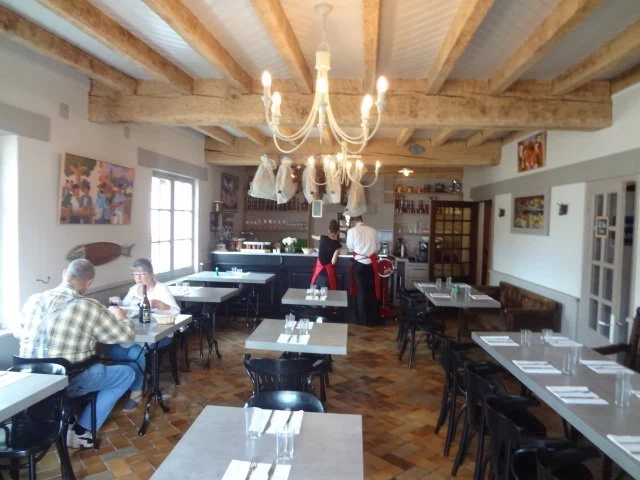
Physical room at Ithurria is described in consistent terms across multiple assessments: terracotta tiled floors, wooden rafters, gleaming copper pots, vintage tableware. These are not preservation choices made for atmosphere; they are the original fabric of a working inn that was built before any of its current critical recognition existed. The front of house is managed by Thomas Rouch, identified as a long-standing member of the team serving as both maître d' and sommelier, a combined role that in provincial French dining often reflects the economics of a serious but not oversized operation. His long tenure matters because the depth of a sommelier's knowledge of local Basque and regional French wine takes years to accumulate.
Basque Country spans both France and Spain, and its wine culture has expanded significantly in the past two decades. Irouléguy, the appellation directly south of Ainhoa in the foothills of the Pyrenees, produces structured reds and whites from Tannat, Cabernet Franc, Gros Manseng, and Petit Manseng, varieties with direct relevance to a menu built around Basque terroir. A local sommelier with Rouch's experience at a Michelin-starred table will have shaped a list with this geography in mind. Nearby Argi Eder in Ainhoa represents the other significant dining address in the same village, offering a point of comparison for anyone spending time in the area.
Planning a Visit
Ithurria operates on a schedule that reflects its dual function as a village restaurant and a destination dining room. Lunch service runs on Monday, Friday, Saturday, and Sunday from noon to 1:30 PM; dinner service runs Tuesday, Thursday, Friday, Saturday, and Sunday from 7:30 PM to 9 PM. Wednesday is closed. The smart-casual dress code and recommended reservations make this a deliberate dining occasion rather than a casual drop-in. Ainhoa itself is a small village in the French Basque Country, approximately 25 kilometres from Biarritz, which has the nearest commercial airport with regular connections. The village is most easily reached by car; the drive from Biarritz takes under 40 minutes and passes through the distinctive Basque range of rolling green hills and red-and-white farmhouses.
What People Recommend at Ithurria
Among the dishes highlighted in critical assessments, the wafer-thin jelly of pressed garden tomatoes with smoked anchovies appears most consistently as an example of the kitchen's approach: a Basque pantry ingredient (the anchovy) treated with precision, paired with produce from the kitchen garden, and rendered in a format that requires significant technical control. The ikejime preparation of line-caught red tuna from Saint-Jean-de-Luz draws attention to sourcing and technique simultaneously. On the dessert side, the raspberry soufflé with crunchy hazelnuts reflects Louis Isabal's pastry background. The broader recommendation, combined with the Michelin star, suggests a kitchen that rewards visitors specifically interested in classical Basque-French cooking executed with contemporary rigour and genuine local roots.
Questions
Frequently asked
What recognition does Ithurria hold?
Ithurria holds 1 Michelin star.
How expensive is Ithurria?
Ithurria is listed at a price level of $$$$.
Where is Ithurria and what does it serve?
Ithurria is in Ainhoa, Ainhoa, serving Basque French Fine Dining.
The field
How it compares
| Place | Awards | Cuisine | Notes |
|---|---|---|---|
| Ithurria | Michelin 1 Star | Basque French Fine Dining | Ainhoa, $$$$ |
| Alkimia | Michelin 1 Star | Modern Catalan Fine Dining | Barcelona |
| Cocina Hermanos Torres | Michelin 3 Stars, World's 50 Best | Modern Spanish Fine Dining | Barcelona |
| focus ATELIER | Michelin 2 Stars | Modern French Fine Dining | Vitznau |
| Ikoyi | Michelin 2 Stars, World's 50 Best | Modern West African Fine Dining | London |
| Sorn | Michelin 3 Stars, World's 50 Best | Fine Southern Thai | Bangkok |
| Woven by Adam Smith | Michelin 1 Star | Modern British Fine Dining | Ascot |
Similar places
Modern Catalan Fine Dining
Alkimia
Barcelona, Spain
★
Modern Spanish Fine Dining
Cocina Hermanos Torres
Barcelona, Spain
★★★ · 50 Best
Modern French Fine Dining
focus ATELIER
Vitznau, Switzerland
★★
Modern West African Fine Dining
Ikoyi
London, United Kingdom
★★ · 50 Best
Fine Southern Thai
Sorn
Bangkok, Thailand
★★★ · 50 Best
Modern British Fine Dining
Woven by Adam Smith
Ascot, United Kingdom
★