Made ByRestaurant
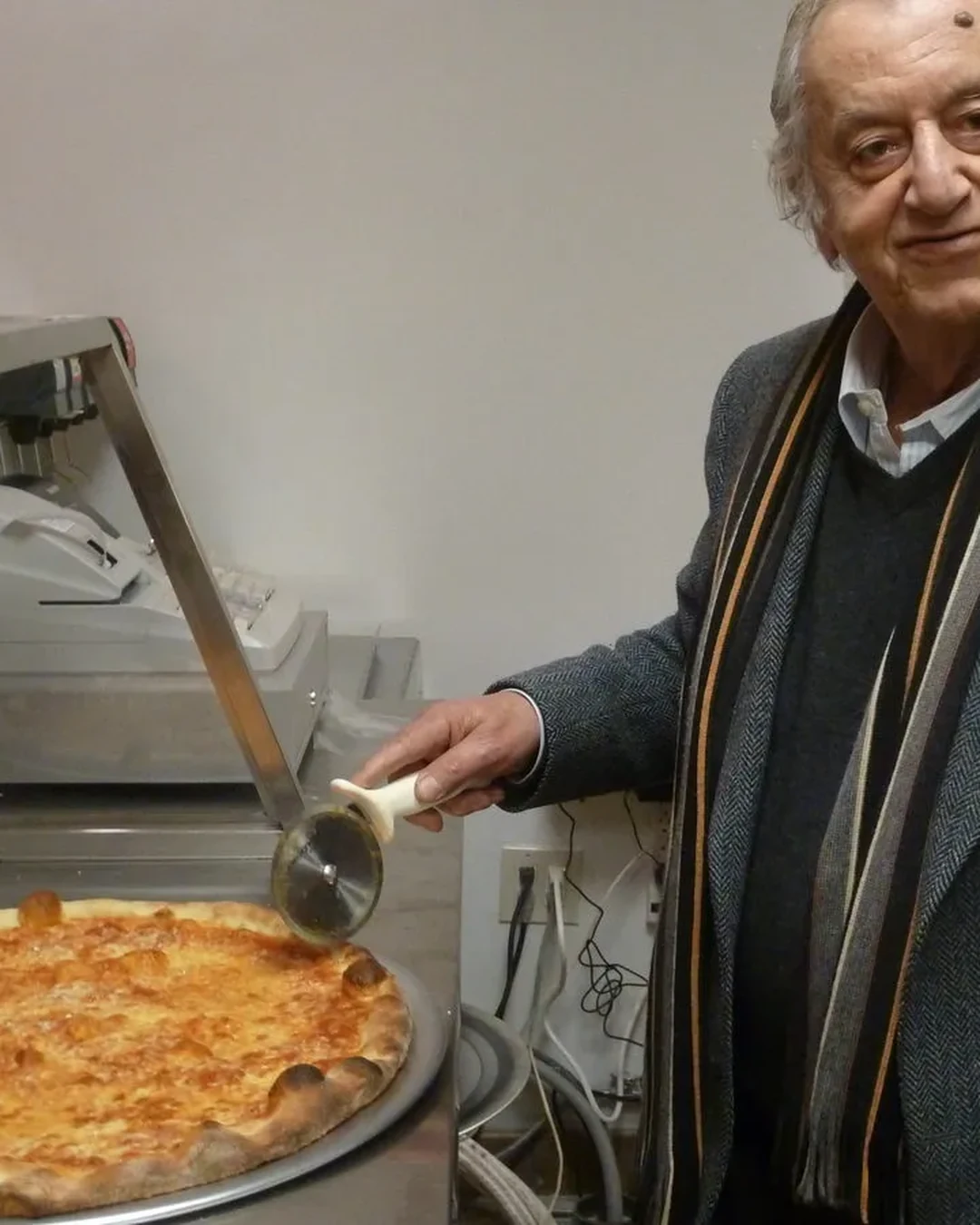
Pino Pozzuoli, Chef at Joe’s Pizza in Manhattan, keeps the Classic New York slice thin, crisp and built for the fold.
At a glance
- Cuisine
- Pizzeria
The fold decides the slice
The slice has to bend without giving way. Pino Pozzuoli, Chef at Joe’s Pizza in Manhattan, keeps that test at the counter, where the crust, sauce and mozzarella meet in a form New York reads quickly. He founded Joe’s Pizza in 1975 after coming from Naples, and his public work has stayed close to one station: the slice joint, not the restaurant group, not the tasting room, not the decorated pie. The title attached to him is owner, but the discipline is bench-side. Hand-stretched pies go into the oven with a thin structure and come out browned enough to carry bright tomato sauce and a clean layer of melted mozzarella. The finished slice is built for the hand, then for the fold. That is the measure here. Pozzuoli’s lineage is stated plainly by the house: Naples as birthplace, New York as working stage, Joe’s Pizza as the place that fixed his name to a particular kind of street-style pizza. The shop does not turn that into ceremony. It repeats the same grammar of crust, sauce and cheese until the plain slice can stand without ornament.
A program built around restraint
The work at Joe’s Pizza is not a long menu pretending to be a thesis. The signature is Classic New York street-style pizza served by the slice, with plain cheese and pepperoni doing much of the speaking. The crust is thin and crisp, stretched by hand and browned so it has enough tension to fold. The tomato sauce stays bright rather than heavy. The mozzarella melts into an even layer, clean enough that the slice does not need a cover of extra toppings to feel complete. Other pies move through the counter, including fresh mozzarella, Sicilian square cheese, white cheese, marinara, veggie and meat-topped versions, but the house’s identity returns to the same foundation. The Sicilian slice is noted for a light, airy, crunchy crust, a different construction from the street slice but still judged by texture before anything else. Joe’s Pizza has also carried outside recognition, including a New York Magazine best pizza notice in 1996 and a place in GQ Magazine’s Top 25 Pizzas in the World. Those names matter less here than the repeatable cut: a triangle lifted from the deck, held by the rim, eaten before the cheese has settled too far.
The counter keeps the pace
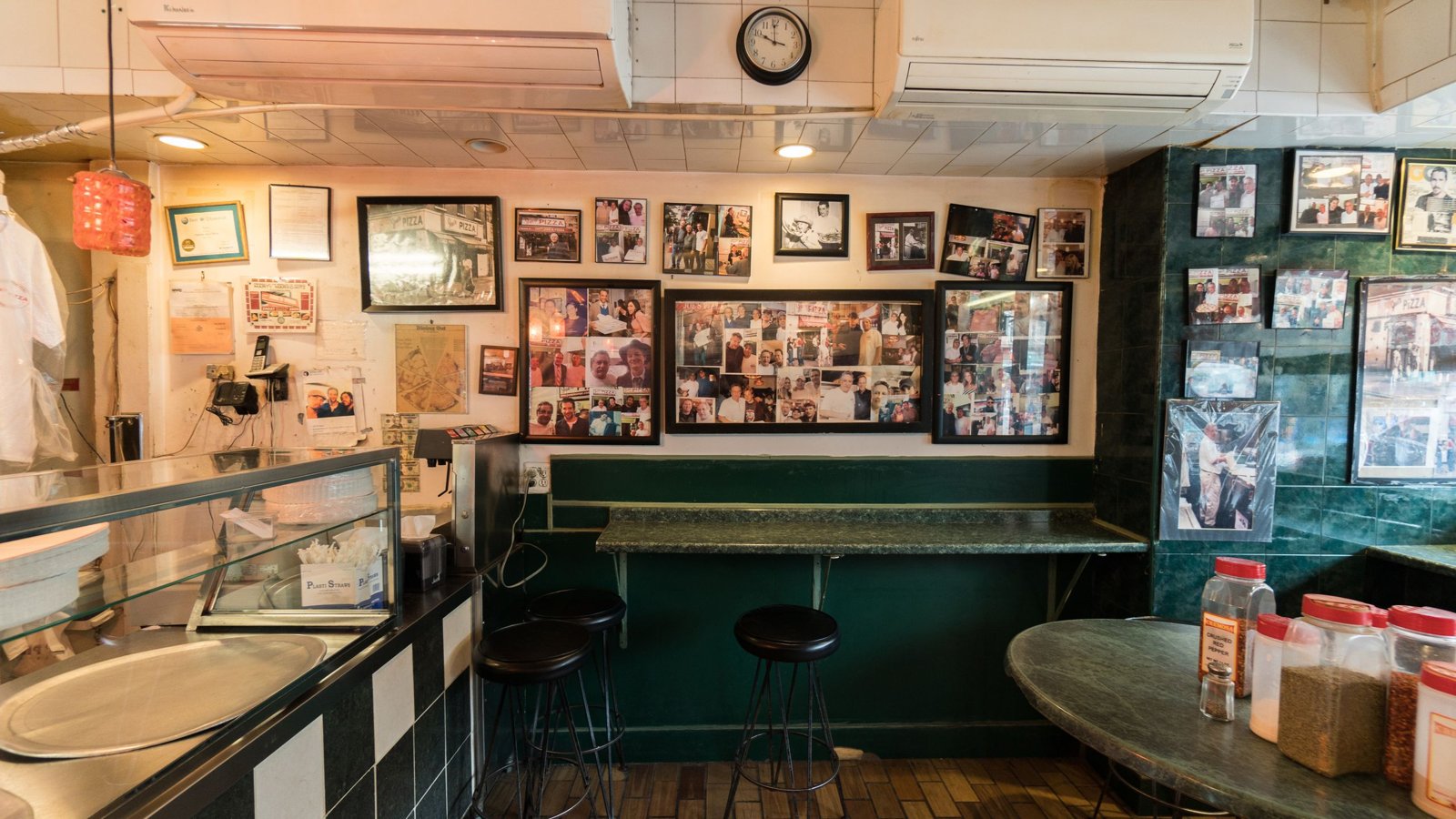
At the Broadway address, the room works like a counter-serve shop that knows its own tempo. Framed photographs, press clippings and pieces of shop history crowd the walls while the line moves toward the glass case. Some people eat standing at chest-high counters; some take the slice back to the street. The pass is fast because the object is direct. A slice lands on a paper plate, the hand finds the crust edge, and the fold happens almost before anyone names it. That pace can feel blunt, but it suits the food. Joe’s Pizza is not built around lingering. It is built around a hot slice that can be understood in motion, with enough crispness at the base to keep the tomato and mozzarella in place.
What remains on the counter
The place has stretched beyond the original Carmine Street shop into several Manhattan counters, including 1435 Broadway, yet Pozzuoli’s clearest work still sits in the same narrow discipline. Growth has not changed the central test. The slice has to be thin, crisp, bright with tomato and clean with mozzarella; it has to fold and still hold. End there, and the house’s argument is specific enough: Pino Pozzuoli, Joe’s Pizza, 1975, the Classic New York slice.
Address
Manhattan, New York, United States
In residence
Similar places

Japanese-influenced Californian Kaiseki
Single Thread Farm
Healdsburg, United States
★★★ · 50 Best
French Seafood Fine Dining
Le Bernardin
New York City, United States
★★★ · 50 Best

Modern Korean Tasting Menu
Atomix
New York City, United States
★★ · 50 Best

French
Sézanne
Tokyo, Japan
★★★ · 50 Best

Modern Seafood Fine Dining
Providence
Los Angeles, United States
★★★ · 50 Best

Contemporary Plant-Based Fine Dining
Eleven Madison Park
New York City, United States
★★★ · 50 Best