Hugh Mangum, chef at Mighty quinn in Manhattan, keeps brisket, wood smoke and counter service tied to a working barbecue method.
- Opinionated About Dining Cheap Eats in North America Highly Recommended · 2026
Smoke kept under watch
The brisket meets the knife at the counter, hand-sliced after a long hold in smoke. Hugh Mangum, chef at Mighty quinn in Manhattan, oversees the food with the discipline of a maker who built the operation from its first full-service restaurant in the East Village in 2012. His formal entry was culinary school; before the kitchen, he worked the road as a touring musician in a rock band, where timing, repetition, and output were not abstractions. At Mighty Quinn's Barbeque, that second career became a system: Texas and Carolina habits folded into a New York counter-service room, spice blends set against wood smoke, and meat managed through the hours when most restaurants are dark. Mangum co-founded the business and still holds the food side, a role that asks for more than a signature plate. It asks for control over a process that can travel from one smoker to another without losing its center. His own shorthand names brisket as a signature, and here the cut does most of the talking: sliced to order, served with enough restraint that the smoke, fat, and bark stay legible.
Wood smoke as the program
The method at Mighty Quinn's begins with all-natural meats and poultry, seasoned with house spice blends and smoked with wood for many hours. That phrase sounds simple until the station is considered. Barbecue is not a fire-and-forget craft; someone has to tend the smoker 24/7, watching heat, fuel, airflow, and time as closely as a baker watches proof. The menu keeps the grammar direct: hand-sliced brisket, pulled pork, St. Louis cut spare ribs, burnt ends, chicken, sandwiches, bowls, mac and cheese, cornbread, beans worked with bacon and brisket pieces. The Brontosaurus Rib gives the room its most visible gesture, but the quieter test is consistency across the board, especially with brisket and burnt ends, where moisture and bark can turn in opposite directions if the cook loses attention. Mangum's work here sits in the scaling of craft, not in theatrical reinvention. The long way has to survive a counter line, a tray, and the next order.
The counter and the cut
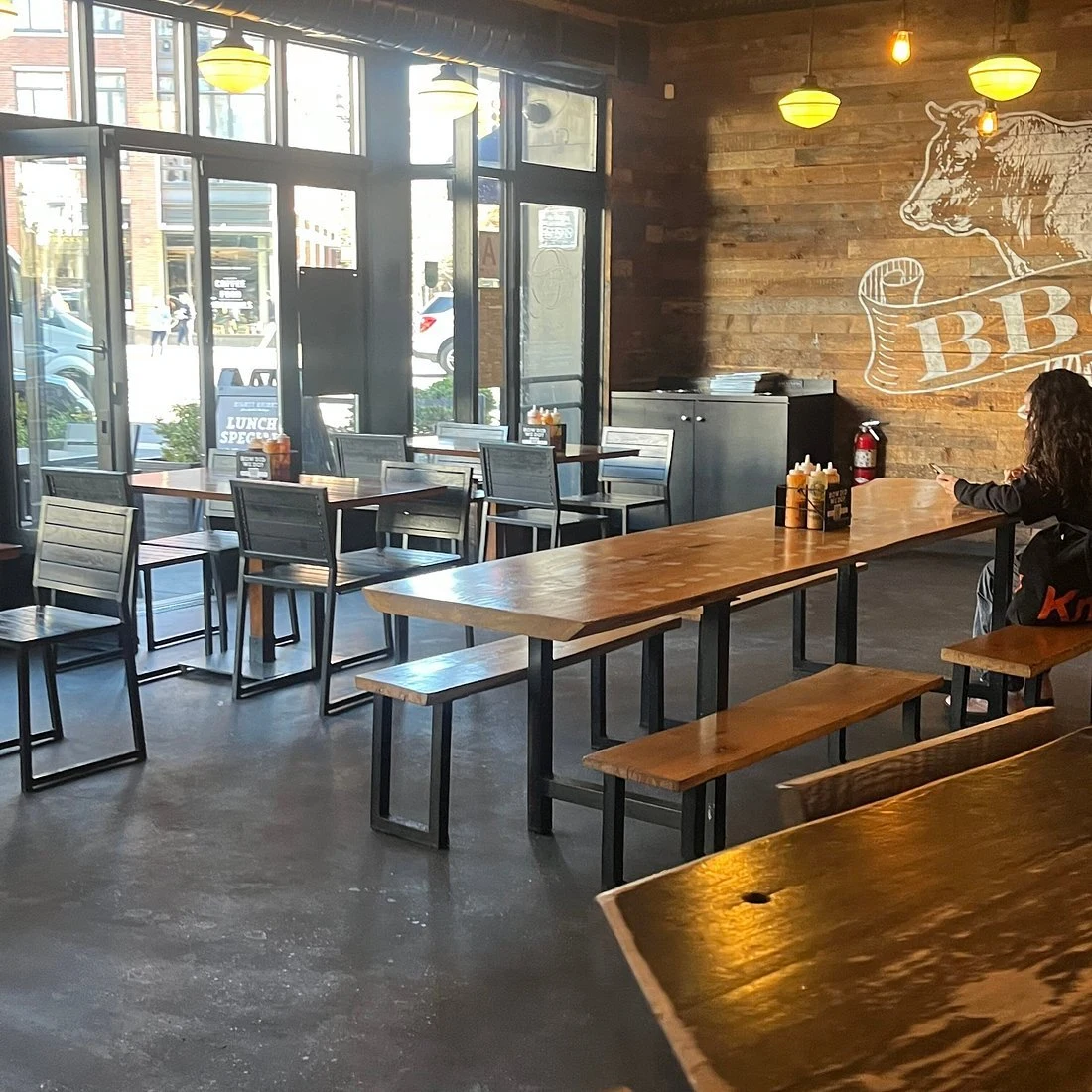
The Manhattan room works in the register of modern counter service: white tile, heavy wood tables, beer, trays moving past the pass, and meat cut where the guest can read the grain. It is clean without pretending barbecue is tidy. Smoke marks the food before the sauce does. The counter brings the work forward, closer to a cafeteria line than a hushed dining room, which suits the craft; this is food built in advance by heat and patience, then finished in the open with a knife, a scoop, a ladle, and a steady hand. The fine-dining note here is not ceremony. It is the decision to make the cut visible, to let the brisket show whether the smoker was watched.
Built to keep moving
Mangum's present work is maintenance as much as creation: keeping an idea useful after the first version has already met the public. That is the harder part of a barbecue house that has grown beyond its opening address. The craft remains tied to the same concrete nouns, the smoker, the spice blend, the counter, and Hugh Mangum's brisket.
Questions
Frequently asked
Who is behind Mighty quinn?
Hugh Mangum is the chef at Mighty quinn in Manhattan and co-founded the business. He oversees the food side and still holds that role.
What is Mighty quinn known for?
Mighty quinn is known for barbecue built around brisket, wood smoke, and a working method that keeps the meat under watch for many hours. Mangum names brisket as a signature.
How is the food served?
The Manhattan room uses counter service. Brisket is hand-sliced to order at the counter, and the menu also includes pulled pork, St. Louis cut spare ribs, burnt ends, chicken, sandwiches, bowls, mac and cheese, cornbread, and beans worked with bacon and brisket pieces.
What is the cooking method at Mighty quinn?
The kitchen starts with all-natural meats and poultry, seasons them with house spice blends, and smokes them with wood for many hours. Someone tends the smoker around the clock, watching heat, fuel, airflow, and time.
When did Mighty quinn begin?
Mangum built the operation from its first full-service restaurant in the East Village in 2012.
The field
How it compares
| Place | Cuisine | Awards | Notes |
|---|---|---|---|
| Mighty quinn | Barbecue | · | · |
| 8 1/2 Otto e Mezzo Bombana (Hong Kong) | 3 Michelin-Star Italian Fine Dining | Michelin 3 Stars, World's 50 Best | Hong Kong |
| Blue Hill at Stone Barns | Farm-to-Table Fine Dining | Michelin 2 Stars, World's 50 Best | Tarrytown |
| Jordnær | Modern Nordic Seafood Fine Dining | Michelin 3 Stars, World's 50 Best | Gentofte |
| Les Amis | Classic French Haute Cuisine | Michelin 3 Stars, World's 50 Best | Singapore |
| Potong | Progressive Thai-Chinese Fine Dining | Michelin 1 Star, World's 50 Best | Bangkok |
| Zén | Neo-Nordic with Japanese Influences | Michelin 3 Stars, World's 50 Best | Singapore |
In residence
Similar places
3 Michelin-Star Italian Fine Dining
8 1/2 Otto e Mezzo Bombana (Hong Kong)
Hong Kong, Hong Kong
★★★ · 50 Best
Farm-to-Table Fine Dining
Blue Hill at Stone Barns
Tarrytown, United States
★★ · 50 Best
Modern Nordic Seafood Fine Dining
Jordnær
Gentofte, Denmark
★★★ · 50 Best
Classic French Haute Cuisine
Les Amis
Singapore, Singapore
★★★ · 50 Best
Progressive Thai-Chinese Fine Dining
Potong
Bangkok, Thailand
★ · 50 Best
Neo-Nordic with Japanese Influences
Zén
Singapore, Singapore
★★★ · 50 Best