
- Pearl 3 Star Prestige · 2025
Where the Land Dictates the Barrel
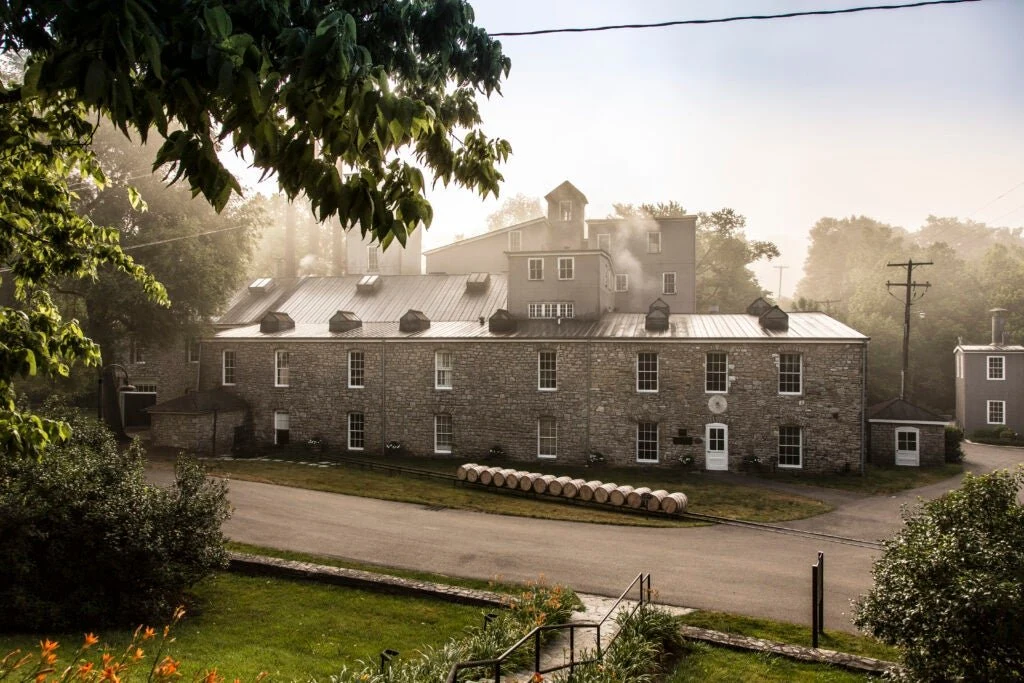
Approach Woodford Reserve along McCracken Pike outside Versailles, Kentucky, and the Bluegrass terrain makes an argument before you reach the gate. The gently rolling limestone country of Woodford County sits at the geographic core of American whiskey production, and that is not coincidence. The same karst geology that filters local spring water to an unusually low iron content and high mineral concentration is the same geology that, a few miles north and east, defines the horse farms and tobacco fields that have made this county agriculturally distinct for two centuries. Terroir, a word more naturally at home in Burgundy or the Douro, earns its application here.
That kind of recognition carries more weight in the context of American whiskey's recent premiumisation wave, where hundreds of labels compete for credibility and few can point to a documented, site-specific production tradition that predates the modern boom.
The Sunday letter
Find new places through the people who run them.
Our Sunday email brings you the chefs, winemakers and hoteliers behind our newest stories. See a sample before you subscribe.
See a sample of the Sunday emailOne email a week. Unsubscribe from any issue.
Limestone Country and What It Produces
The argument for Woodford County as a distinct whiskey-producing terroir rests on three converging factors: water chemistry, temperature range, and grain provenance. The limestone shelf underlying this part of central Kentucky filters groundwater to a composition that is low in iron, which would otherwise oxidise new make spirit, and high in calcium, which supports active yeast fermentation. The region's temperature swings between winter lows and summer peaks are pronounced enough to drive active barrel interaction, pushing spirit in and out of the wood with each cycle and accelerating the extraction of colour, vanillin, and tannin that defines aged bourbon character.
This is the same logic that governs how producers in other terroir-defined categories think about geography. The way Château Bélair-Monange in Saint-Emilion works within the specific clay-limestone soils of the appellation's plateau, or how Albert Boxler in Niedermorschwihr draws on Alsace's geological patchwork to differentiate single-vineyard expressions, reflects the same underlying principle: place constrains and shapes the product in ways that technique alone cannot replicate. In Kentucky, the barrel warehouse and the distillery building are the vineyard equivalent, and the county's climate is the growing season.
The Versailles Address in Context
Versailles, Kentucky, is the seat of Woodford County and sits roughly equidistant between Lexington and Frankfort, two cities with their own claims on Kentucky's cultural and agricultural history. The town's character is shaped by the horse industry and by a landscape that has remained largely agricultural even as bourbon tourism has expanded. The McCracken Pike address places Woodford Reserve outside the town centre, on a rural corridor where the physical experience of arrival is consistent with what a serious spirits producer should communicate: that the product comes from somewhere specific, and that the somewhere matters.
For visitors planning the trip, Versailles is accessible from Lexington's Blue Grass Airport, approximately 20 miles to the east, making it a logical base for a broader Bluegrass itinerary. The bourbon trail concentration in this part of Kentucky means Woodford County sits within a day's reach of several other significant producers, and the rural infrastructure around Versailles, including accommodation options in both Lexington and Frankfort, makes multi-stop planning direct.
In the context of American whiskey, where marketing spend and brand heritage often substitute for genuine production distinction, a structured external rating carries indexing value that matters to a serious buyer or visitor.
For comparison, other producers carrying significant external recognition in their respective categories, including Château Batailley in Pauillac, Château Boyd-Cantenac in Cantenac, and Château Branaire Ducru in St-Julien, earn their standing through documented classification and consistent critical performance over time. The logic is similar: a rating is evidence of where a producer sits in the competitive set, not a substitute for the product itself.
Bourbon in the Broader Spirits Landscape
American whiskey's relationship with terroir has historically been underarticulated compared to wine or single malt Scotch. Producers like Aberlour in Aberlour operate within a Scotch whisky tradition where regionality, the Speyside character in Aberlour's case, is built into how consumers understand the product. Bourbon has been slower to claim geography as a differentiator, partly because the category's legal requirements set a floor but not a ceiling for terroir claims, and partly because the industry expanded so rapidly in the 2010s that production volume often outpaced provenance storytelling.
The producers who have held a credible terroir position through that expansion are those with a documented site history and a production footprint that is genuinely tied to a specific county or watershed. Woodford County's place in that conversation is established by geology and climate record, not by marketing. The same argument that makes Château Cantemerle in Haut-Médoc legible as a Médoc expression, or Château Clinet in Pomerol as a Pomerol one, applies here: the appellation is doing real work, not decorative work.
Producers in other categories have also demonstrated that terroir communication can extend across spirit and wine formats. Chartreuse in Voiron draws on the alpine herb geography of the Chartreuse massif as a core part of its identity. Château d'Esclans in Courthézon made a credible case for Provence rosé as a serious, site-specific category. The pattern across these examples is consistent: the producers with particularly durable reputations are those who can articulate the connection between geography and product with specificity.
Planning a Visit
Woodford Reserve's physical address at 7785 McCracken Pike, Versailles, KY 40383, is the starting point for any visit. As with most serious whiskey producers in the region, the experience is oriented around the production site itself, and the rural setting means arriving by car is the practical default from either Lexington or Frankfort.
The connective tissue across all of these is the same: a producer with a specific address, a documented relationship with its land, and recognition that reflects both.
Questions
Frequently asked
Who works at Woodford Reserve?
Made By profiles Elizabeth McCall (Master Distiller, Woodford Reserve) at Woodford Reserve.
How expensive is Woodford Reserve?
Woodford Reserve is listed at a price level of $$$.
The field
How it compares
| Place | Notes | Awards |
|---|---|---|
| Woodford Reserve | Versailles, $$$ | · |
| Château Pichon Longueville Baron | Pauillac | World's 50 Best |
| Château Suduiraut | Preignac | · |
| Domaine Dujac | Morey-Saint-Denis | · |
| Domaine Roulot | Meursault | · |
| Screaming Eagle | Napa | · |
| Valdicava | Montalcino | · |
In residence
Similar places

The Sunday letter
Get the next Made By story in your inbox.
We send one email every Sunday morning with the places and people we covered that week.
See a sample of the Sunday emailOne email a week. Unsubscribe from any issue.