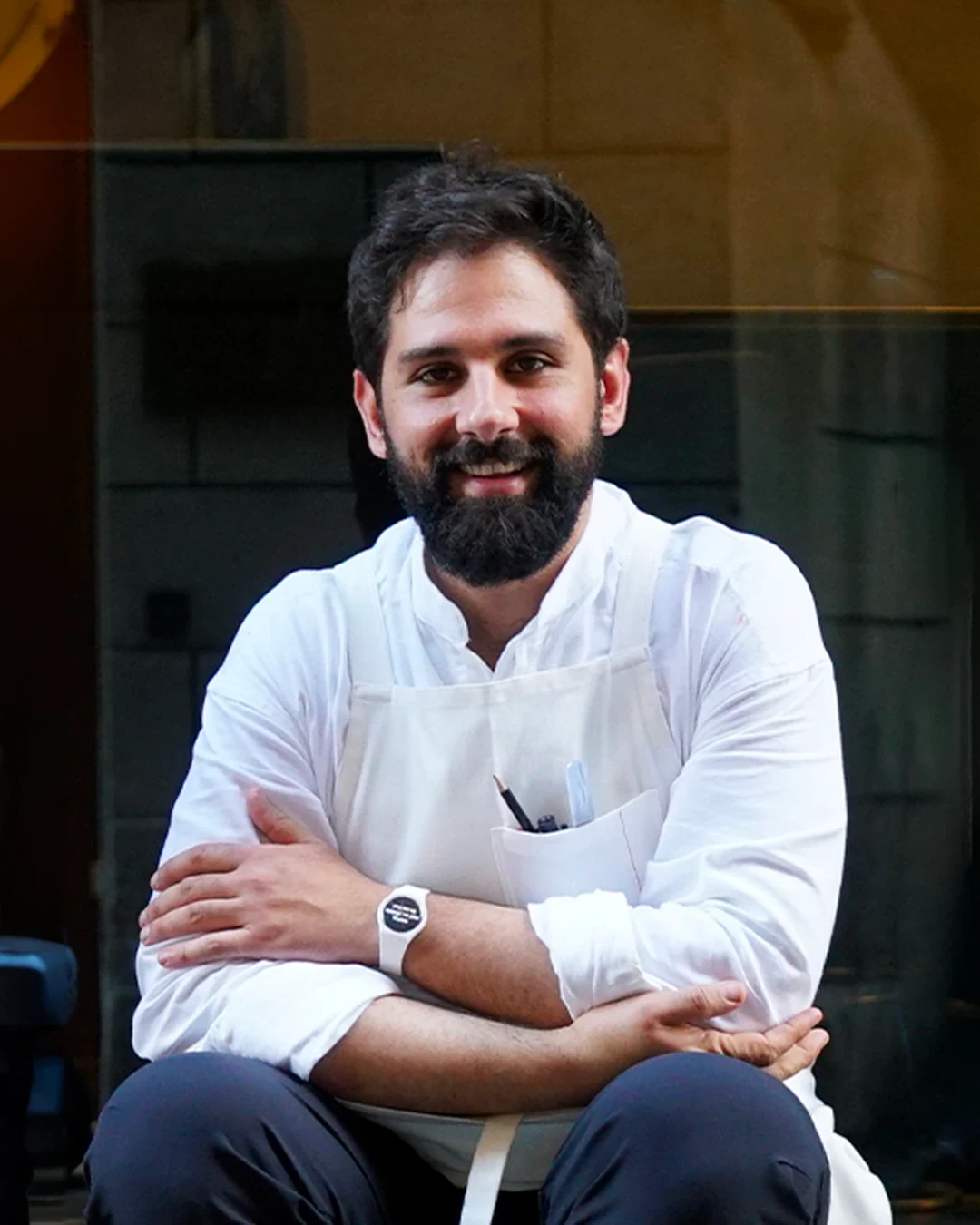
Portrait of Alessandro Miocchi
i. Biography
Rome gives Alessandro Miocchi a hard urban field to cook in: old stone, market produce, offal memory, sea air pushing inland, and a dining culture that keeps an eye on restraint as well as risk. At Retrobottega, where he has been chef since 2016, that pressure shows up as Modern Italian cooking shaped by foraging, tension, and pairings that land on the plate with a deliberate edge.
The Sunday letter
Read Made By's new profiles every Sunday.
Meet the chefs, winemakers and sommeliers behind the places we cover. See a sample below before you subscribe.
See a sample of the Sunday emailOne email a week. Unsubscribe from any issue.
The Climb
Working with Enrico Crippa, then with Antonio Guida, and later in the kitchens at Il Pagliaccio gave Alessandro Miocchi a line of training marked by precision and discipline. Those rooms demanded close attention, and that discipline is still visible in the work now associated with his name: controlled, alert, and careful not to let intensity tip into excess. Since 2016, the kitchen at Retrobottega has been the place where that foundation turns into daily practice.
Today
Since 2016, Miocchi has led Retrobottega as chef, and the restaurant’s identity sits firmly inside Modern Italian cuisine without reading as decoration. The cooking is built from gathered ingredients, game, seafood, sourness, and roots, with each element set against another so texture and contrast do the work. The result is a menu that seems to prefer friction to polish, letting one component sharpen the next rather than smoothing everything into a single surface. Wild boar tartare with grilled calamari is a clear example of that approach. It places land and sea in the same frame without trying to erase the difference, so rawness and char, depth and brine, stay present together. Pigeon with tamarind and Jerusalem artichoke uses the same logic. Game, acidity, and a tuber sit side by side, and the value is in the tightness of the composition: dark richness, bright pull, grounded sweetness, all held within a Modern Italian register that favors clarity over ornament. For Alessandro Miocchi, this is not decoration but part of the craft language attached to his name. At Retrobottega, the menu reads less like a list of luxury markers than a working conversation between what is gathered, what is butchered, what is grilled, and what is sharpened by contrast.
Career - chef — Retrobottega, Rome (2016–present) - worked with — Enrico Crippa - worked with — Antonio Guida - worked in the kitchens — Il Pagliaccio
Recognition
Wild boar tartare with grilled calamari is unusual by design, putting raw game and charred cephalopod in the same thought. Pigeon with tamarind and Jerusalem artichoke offers another marker of the same language. The dish does not rely on a familiar Italian pairing to explain itself; it places bird, sour fruit, and root together, then asks the kitchen to make the relationship legible. Taken together, those dishes make Alessandro Miocchi’s authorship concrete. He is legible through the food served in Rome, the Modern Italian frame he works within, and the foraging practice that keeps the cooking close to material.
FAQ Where did Alessandro Miocchi work before? Alessandro Miocchi's earlier career included Enrico Crippa, Antonio Guida, and Il Pagliaccio. What is Alessandro Miocchi known for? Modern Italian cuisine.
Explore
In the same rooms
The Sunday letter
Get the next Made By profile in your inbox.
We send one email every Sunday morning with the people we profiled that week.
See a sample of the Sunday emailOne email a week. Unsubscribe from any issue.