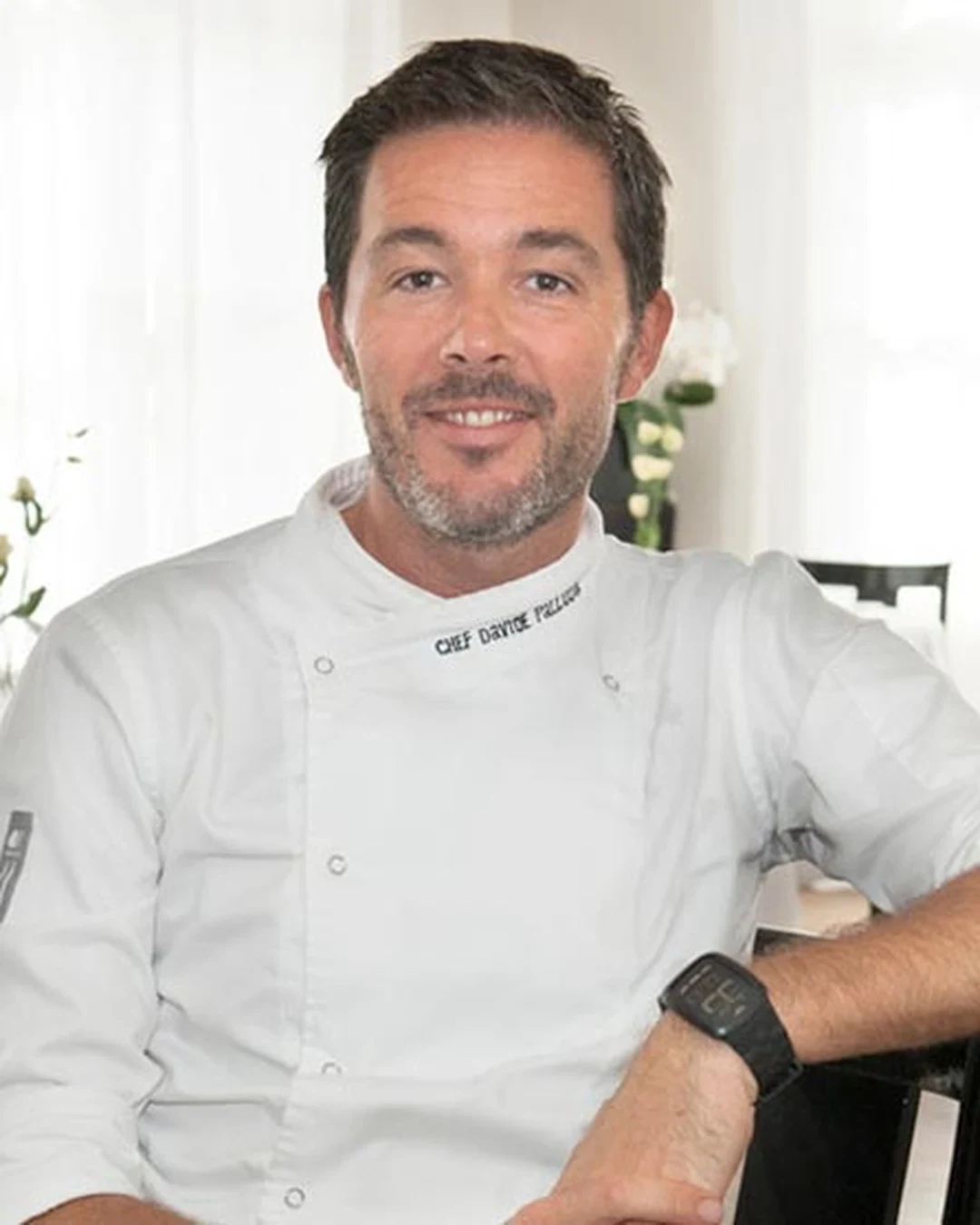
Portrait of Davide Palluda
i. Biography
Roero food-and-wine culture gives All’Enoteca its working brief: cook from Canale with enough discipline to keep place legible without turning it into period costume. Davide Palluda opened the restaurant in 1995 at age 24, building it as a project for that culture as much as a dining room. The work is measured in restraint, ingredient authority, and the long correction of a cuisine that must stay contemporary without losing its local grammar.
The Sunday letter
Read Made By's new profiles every Sunday.
Meet the chefs, winemakers and sommeliers behind the places we cover. See a sample below before you subscribe.
See a sample of the Sunday emailOne email a week. Unsubscribe from any issue.
The Path
Hotel-school training set the early frame: technique, order, and the habits required before a cook can make useful choices. Davide Palluda trained at Barolo Hotel School, then used that structure to shape a personal language in contemporary Italian gastronomy. The line that followed has been marked by precision, restraint, and a deepening sense of place. A restaurant identity is built by repetition, not declaration. In 1995, Palluda became co-founder and chef of All’Enoteca, where the work in Canale centered on Roero food-and-wine culture without treating it as nostalgia. The cooking has been described through balance: the tone of a dish, the rhythm of a meal, and the ability to bring memory forward without overexplaining it. Research gives a kitchen another tempo. In 2006, Palluda co-founded DP Laboratory alongside his continuing work at All’Enoteca. Where the restaurant tests ideas in service, the laboratory extends the practice into inquiry, focus, and refinement. The two roles mark a career of sustained attention rather than abrupt reinvention.
The Work Today
The benchmark is deliberately plain: “With an aim that will require a lifelong commitment: that of getting as close as possible to the flavour of the vegetable soup made by Sister Angela, who used to cook here when the restaurant was a kindergarten.” In Palluda’s account, the target is not novelty but proximity — to a remembered flavour, a bowl of vegetable soup, and a dish made before the restaurant took its present form. Simplicity is a severe test when it is treated as a standard rather than a style. The vegetable soup made by Sister Angela functions as a measure for All’Enoteca’s craft: restraint, modesty, and accuracy. The point is not to surpass the past, but to approach it closely enough to understand what made it durable. Service supplies the second measure: “An inner joy released by the happiness that a dish can inspire. The subtle pleasure that derives from that sense of constant pressure: with every client and every mouthful.” The statement places the work where cooks recognize it — in pressure, plate by plate, and in the guest’s response. Excellence, in this register, is not an abstract claim. At All’Enoteca, as Palluda describes it, it is tested repeatedly and at close range: remembered flavour, present appetite, the pressure of service, and the responsibility of making pleasure precise.
In Their Words “With an aim that will require a lifelong commitment: that of getting as close as possible to the flavour of the vegetable soup made by Sister Angela, who used to cook here when the restaurant was a kindergarten.” “An inner joy released by the happiness that a dish can inspire. The subtle pleasure that derives from that sense of constant pressure: with every client and every mouthful. These are my days at the “Enoteca”.”
Career - Co-founder and chef — All’Enoteca, Canale, Piedmont, Italy (1995–present) - Co-founder — DP Laboratory (2006–present) Education: Barolo Hotel School
Acclaim
Davide Palluda has received Espresso Guide — Best Young Chef of the Year (2000). Recognition has tracked both the restaurant’s early authority and its continued range: Davide Palluda’s honors include Michelin Star (2000), Passion Dessert award for All’Enoteca (2025), and Best Young Chef of the Year (2000).
FAQ What is Davide Palluda's current role? Davide Palluda is Chef and Owner. Where did Davide Palluda train or study? Davide Palluda trained at Barolo Hotel School. What recognition has Davide Palluda received?

The Sunday letter
Get the next Made By profile in your inbox.
We send one email every Sunday morning with the people we profiled that week.
See a sample of the Sunday emailOne email a week. Unsubscribe from any issue.