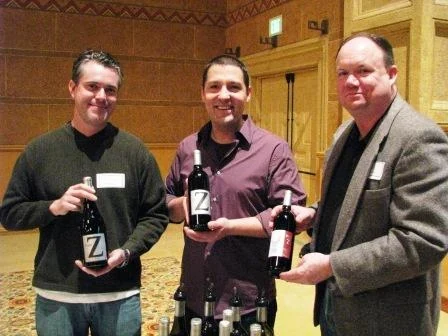
Portrait of Doug Nierman
i. Biography
In Milton-Freewater, Oregon, the cellar work at Zerba Cellars is built on separation: varieties held apart, textures kept intact, intervention kept low. Doug Nierman came up in the upper Wenatchee Valley on a pear orchard, and that farm discipline still shows in the way he talks about wine—plain, practical, and attentive to fruit, place, and the value of not forcing a blend before its parts are ready.
The Sunday email
Read about winemakers like Doug Nierman in the Sunday email.
Every Sunday we send a lead story and up to four more about the chefs, winemakers, sommeliers and hoteliers behind the restaurants, bars, wineries and hotels we cover.
Recent stories
Free. One email a week, and you can unsubscribe from any issue.
The Climb
Formal study at Pacific Lutheran University, Walla Walla Community College, and University of California, Davis gave Doug Nierman the baseline many winemakers need; the deeper education came later, in repeated harvests and cellar seasons in Washington and California. That progression reads as incremental rather than dramatic: one cellar informing the next, one season sharpening the next decision. Today, Doug is winemaker of Zerba Cellars.
Today
Nierman works as winemaker at Zerba Cellars in Milton-Freewater, Oregon. At Zerba Cellars, the work spans enough material to require range, but not so much that identity gets blurred. Doug Nierman’s approach keeps lots distinct and wines organized by their own character, with separation treated as a working principle rather than a limitation. That restraint is the point. Each lot is given room to stay itself before anything larger is assembled, and that method suits a background shaped by orchard work: fruit first, translation second, and no need to make more of the wine than the wine already offers.
Signature
Doug's signature wines include Wild Z Red Wine, 2014 Cabernet Franc, 2013 Cockburn Vineyard Riesling Ice Wine, 2013 Winesap Vineyard Estate Red Wine, and 2013 Zinfandel. Those bottlings show a winemaker working across formats without losing the thread. Wild Z Red Wine points to blending; 2014 Cabernet Franc to structure; 2013 Cockburn Vineyard Riesling Ice Wine to concentration; 2013 Winesap Vineyard Estate Red Wine to site; and 2013 Zinfandel to familiarity handled with care. The common line through them is clarity: wines kept readable, specific, and tied to their source.
In Their Words “We do produce a lot of different wines, probably upwards to 20 different varietals.” “I view winemaking as an art that should be subtly guided and helped by science.” The first line sets the scale of the cellar without turning it into a claim of grandeur. The second defines the method: art, but not in isolation; science, but not as a substitute for judgment. For a working winemaker, that balance is the job.
Recognition
Several named wines mark the range of Nierman’s work. What is notable in that range is not novelty for its own sake, but consistency across different wine types. The named bottles point to a career built on patience, restraint, and attention to what each variety can do when it is handled without excess.
FAQ
Asked of Doug
What is Doug Nierman's current role?
As of 2026, Doug Nierman is Winemaker.
Where did Doug Nierman train or study?
Doug Nierman trained at Pacific Lutheran University and Walla Walla Community College.
What is Doug Nierman known for?
Cabernet Franc.
Explore
Similar Winemakers

The Sunday email
Read about winemakers like Doug Nierman in the Sunday email.
Every Sunday we send a lead story and up to four more about the chefs, winemakers, sommeliers and hoteliers behind the restaurants, bars, wineries and hotels we cover.
Recent stories
Free. One email a week, and you can unsubscribe from any issue.