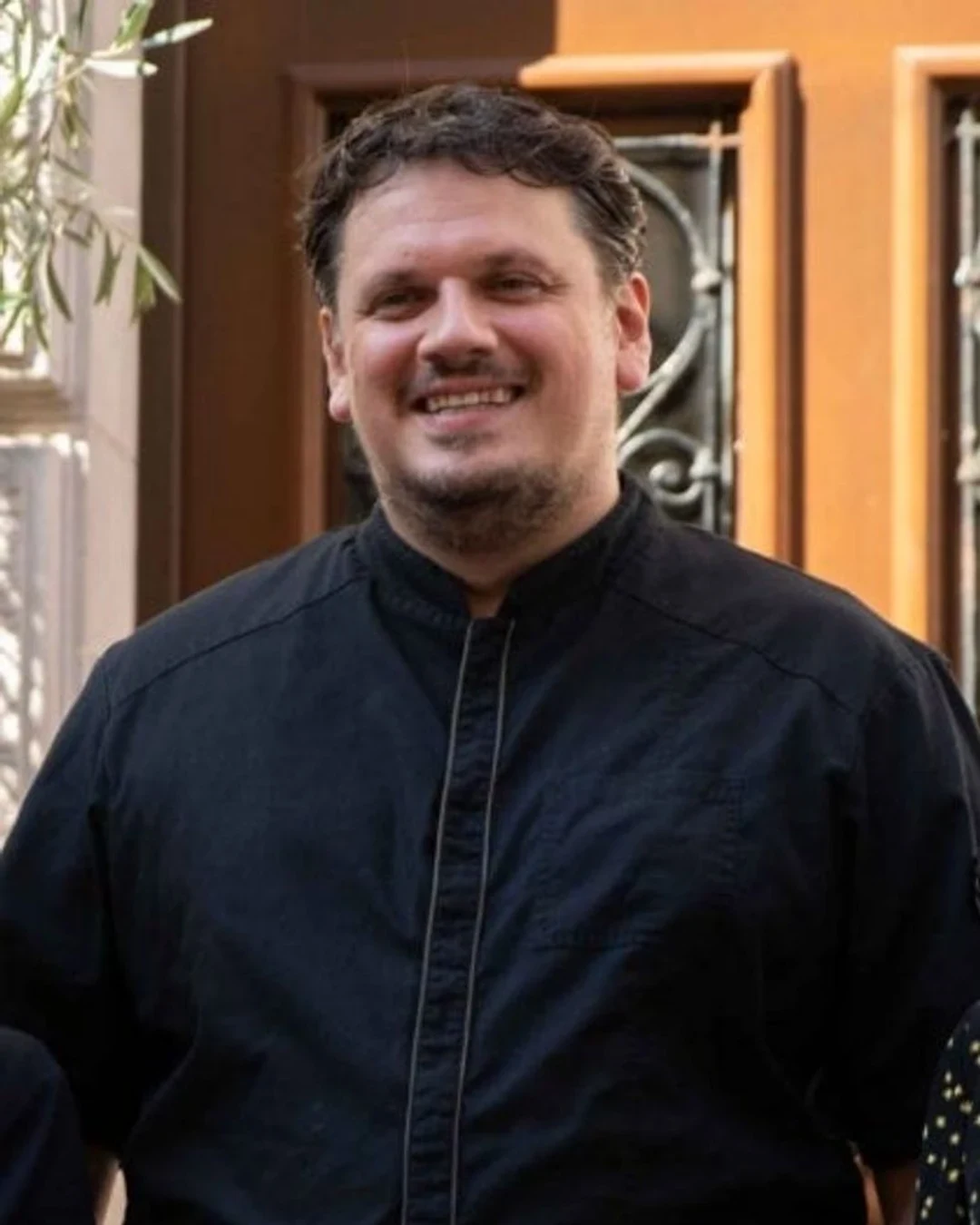
Portrait of Guillaume Besson
i. Biography
Coming Up
Technique and discipline were built early at Lycée Hôtelier d'Illkirch, before service set the tempo. From there, Guillaume Besson moved into the kitchen at Richard Coutanceau in La Rochelle, a step that brought schoolhouse basics into a professional line of fire. He later became Head Chef at restaurant on Île d'Oléron in Île d'Oléron, then worked as cook at Au Crocodile in Strasbourg (from 2009). Read in sequence, those posts show range acquired by repetition: training, pressure, responsibility, then a broader working vocabulary across coast and inland.
Since 2016, Les Funambules has been the place where those hours and shifts settle into a more personal register. Guillaume Besson’s cooking there is shaped by movement between kitchens, but it is not scattered; it is methodical, responsive, and built from experience that has been carried forward rather than left behind. The progression is incremental, each stage tightening the line between instinct and execution.
The Sunday email
Read about chefs like Guillaume Besson in the Sunday email.
Every Sunday we send a lead story and up to four more about the chefs, winemakers, sommeliers and hoteliers behind the restaurants, bars, wineries and hotels we cover.
Recent stories
Free. One email a week, and you can unsubscribe from any issue.
Where They Are Now
“\"There, I was able to test things quite freely.\"” That line points to a kitchen where technique could be exercised without being flattened by routine. Freedom in this context is not the absence of structure; it is the working space that structure makes possible. For Guillaume Besson, that kind of room to test and adjust seems to have been part of how the craft kept moving forward.
Signature
The signatures sit on a clear axis of contrast: sweetness against savor, richness against cut, marine against earthy. Veal with green asparagus, mimolett and wild garlic potato works in that register, pairing veal with spring vegetables and the layered savor of mimolett. Dashi, octopus, cockles, potatoes and lemon moves to a more coastal language, with mineral and bright notes in play. Veal carpaccio, foie gras, fried bread, sesame leans into texture as much as flavor, using tenderness, crunch, and richness in the same frame.
Across those dishes, Guillaume Besson uses familiar products without overloading them. The point is not complication for its own sake, but control: each element has a function, and the plate stays legible. That gives the cooking its shape, with balance built through placement and proportion rather than volume.
In Their Words “I have my mental catalogue of basic recipes, and I adapt them; for mashed potatoes, I might vary it with cream, coffee, Parmesan, lovage, smoked butter, hazelnut oil, lemon zest, etc.” The method here is built on recall, then adjustment. Cream, coffee, Parmesan, lovage, smoked butter, hazelnut oil, lemon zest: each addition shifts the register in a different direction, from depth to lift, from fat to herb, from aroma to acidity.
It is a practical way of thinking about flavor, and one that depends on knowing exactly what each move does. “I have always been gourmand, gourmet, epicurean, and intensely curious.” That self-description is less about personality than about method. Appetite, discernment, and curiosity all feed the same working habit: to keep testing, tasting, and comparing. In Guillaume Besson’s case, curiosity is what links the training ground to the pass, and the pass to the plate.
FAQ
Asked of Guillaume
Where did Guillaume Besson train or study?
Guillaume Besson trained at Lycée Hôtelier d'Illkirch.
What recognition has Guillaume Besson received?
Guide Michelin, one star (2019).
The Sunday email
Read about chefs like Guillaume Besson in the Sunday email.
Every Sunday we send a lead story and up to four more about the chefs, winemakers, sommeliers and hoteliers behind the restaurants, bars, wineries and hotels we cover.
Recent stories
Free. One email a week, and you can unsubscribe from any issue.