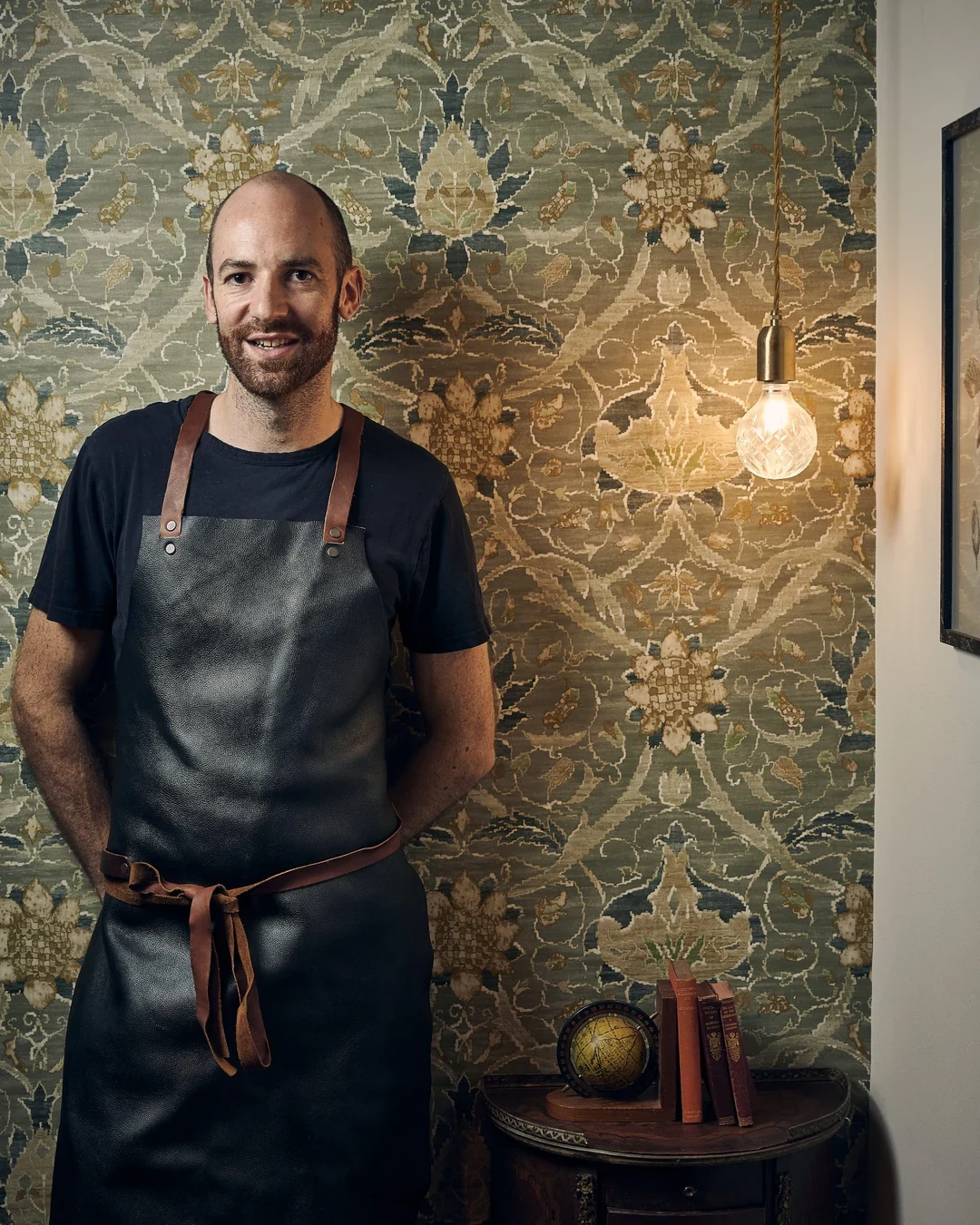
Portrait of Pip Pratt
i. Biography
Riverine Premium beef sets the working brief for Pip Pratt’s cooking: cut selection, venue fit, ageing, fire, fat, and restraint. The program treats beef as a set of distinct materials rather than a single category. T-bones, rib-eye, sirloin, rib chops, and burger mince are each assigned to a Liquid & Larder venue for a defined purpose, giving the group a beef program built on allocation as much as execution. “For the first few years, I was just making stuff with my hands, having fun (trying not to get yelled at) and I got paid.” Pip has said.
The Sunday letter
Read Made By's new profiles every Sunday.
Meet the chefs, winemakers and sommeliers behind the places we cover. See a sample below before you subscribe.
See a sample of the Sunday emailOne email a week. Unsubscribe from any issue.
The Route
Restaurant precision was part of the early formation of Pip Pratt’s craft through work as a team member at Bentley Restaurant and Bar in Australia. That setting sits in the background of the later cooking: focused, controlled, and structured around clear decisions rather than excess. Beef, heat, and simplicity became the central working language when Pratt became Head Chef at Bistecca in Sydney, Australia. The role narrowed the frame in a useful way: fewer distractions, more attention on cut, cookery, seasoning, and the point at which restraint becomes flavour. Today, the Executive Chef roles at Liquid and Larder and Bistecca place Pip Pratt inside a group where each venue carries its own format, but the cooking is tied by one operating principle: understand the ingredient, understand the cut, and avoid covering the strongest flavour with unnecessary additions.
The Practice Today
The dish architecture across the group works under a disciplined ceiling: three main flavours per dish, allowing one primary flavour to read clearly. In practice, that rule prevents crowding. The plate has enough structure to be complete, but not so much that the central ingredient has to compete for attention. The Riverine Premium beef program is cut and distributed by venue with specific intent. T-bones go to Bistecca, where the cut’s scale suits the restaurant’s focus. Rib-eye is directed to The Gidley, sirloin to Alfie’s, rib chops to Lottie, and burger mince to The Gidley and The Rover. The same core material is handled through different expressions: larger-format presence, leaner directness, and mince built for burger service. Ageing is part of the preparation, not an afterthought. For the beef program, Pratt uses 4 to 6 weeks of wet-ageing followed by a week of dry-aging, developing a richer, deeper, meatier flavour before the meat reaches the grill. By the time the beef meets the fire, a large part of the work has already happened in measured time.
Career - Executive Chef — Liquid and Larder, Sydney, Australia - Executive Chef — Bistecca, Sydney, Australia - Team member — Bentley Restaurant and Bar, Australia - Head Chef — Bistecca, Sydney, Australia
Signature
Signature dishes include Beef fat candle at Bistecca and Bistecca alla Fiorentina at Bistecca.
Honors
In 2026, Worldbeststeaks named Pratt a Meat Master for his work at Bistecca in Sydney, Australia. The recognition is tied to a beef practice defined by named breed and region, cut-by-venue allocation, ageing measured in weeks, and fire used as a primary tool. The work is not built on excess; it is built on specificity, discipline, and the satisfaction of letting a carefully chosen piece of beef do its job.
FAQ What does Pip Pratt currently do? Pip Pratt is chef at Bistecca. Where did Pip Pratt work before? Earlier in their career, Pip Pratt worked at Bentley Restaurant and Bar and Bistecca. What is Pip Pratt known for? At Bistecca, the kitchen is built around bistecca alla Fiorentina, a single-cut T-bone steak cooked over an open hearth.



The Sunday letter
Get the next Made By profile in your inbox.
We send one email every Sunday morning with the people we profiled that week.
See a sample of the Sunday emailOne email a week. Unsubscribe from any issue.