- Star Wine List · 2026
- World's Best Steaks 101 Best Steak Restaurants #11 · 2026
- World's Best Steaks 101 Best Steak Restaurants #16 · 2025
- The Best Chef One Knife · 2025
- Chef's Table Featured on Chef's Table · 2025
- World's Best Wine Lists Awards WBWL Category Winner · 2024
- World's Best Wine Lists Awards WBWL 3-Star · 2024
- World's Best Wine Lists Awards WBWL Category Winner · 2023
- World's Best Wine Lists Awards WBWL 3-Star · 2023
- World's Best Wine Lists Awards WBWL 3-Star · 2022
Fire as the Kitchen's Only Tool
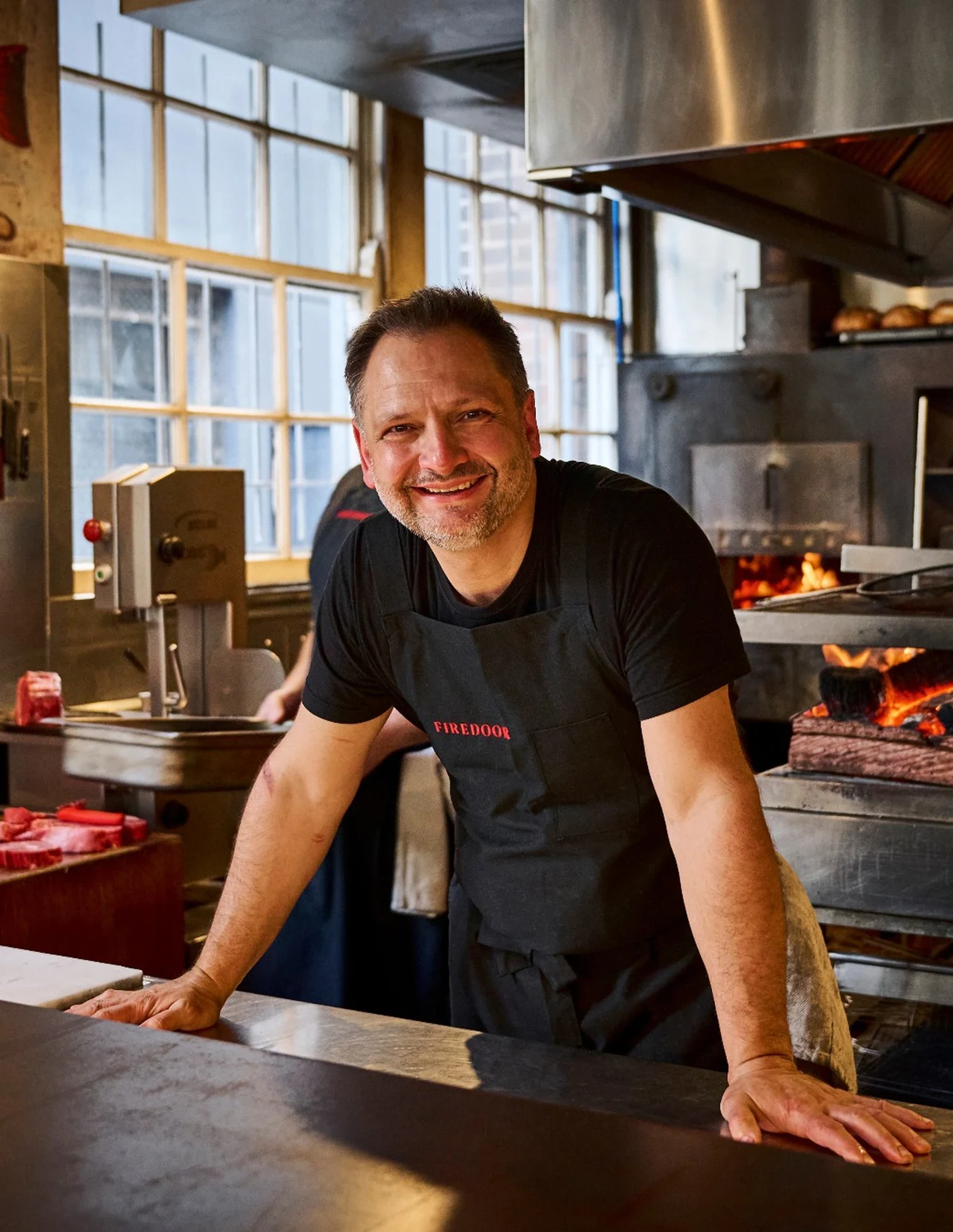
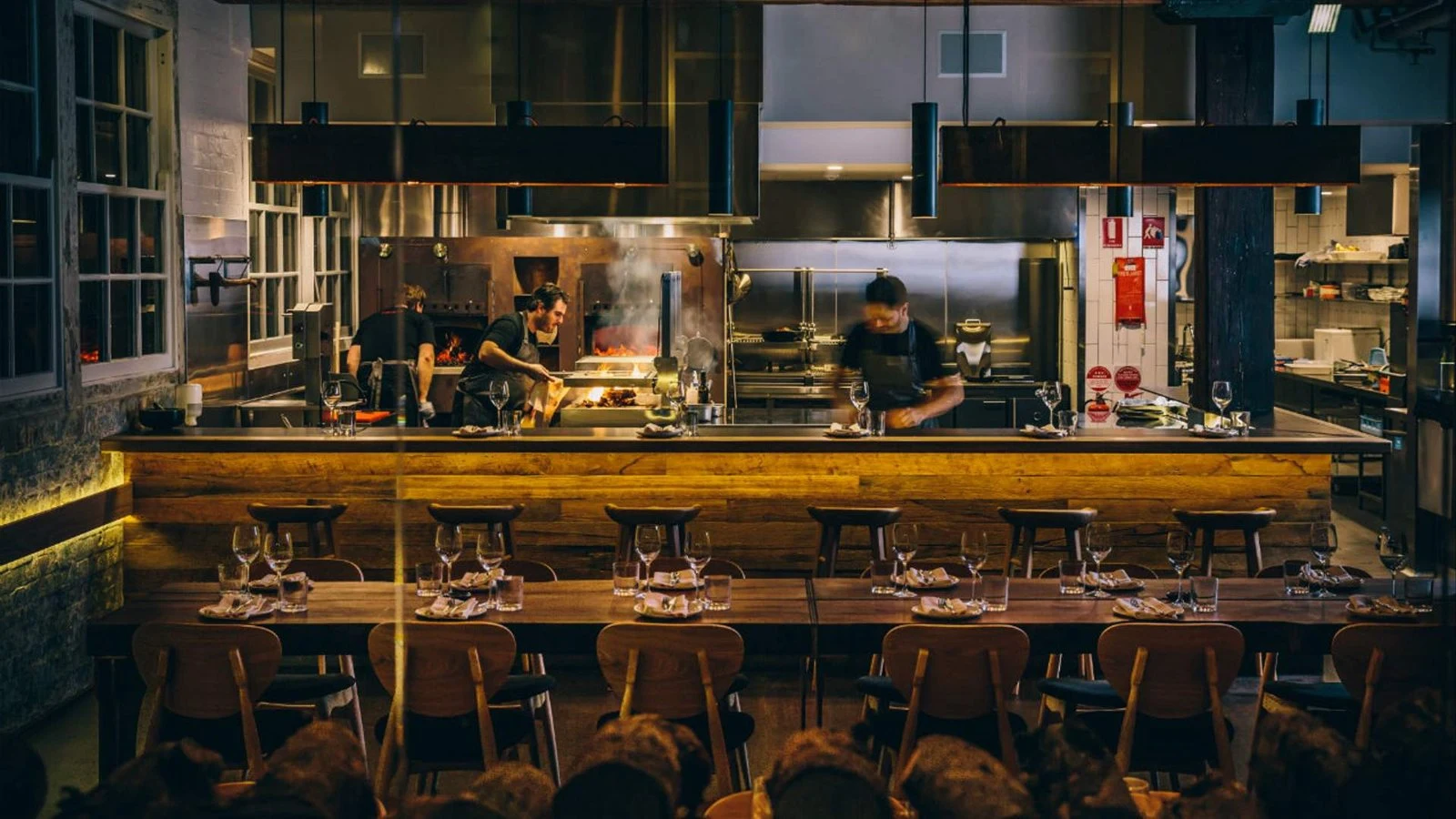
Firedoor is a Sydney restaurant in Surry Hills, with a price point of about US$250 per person, and the first thing that registers is not the room's decor or the welcome at the door, it is the smell. Wood smoke, controlled and purposeful, sits in the air from the moment you step inside. The open kitchen design places the hearth at the visual and functional centre of the space, and guests seated anywhere in the dining room have a clear line of sight to the flames. This is not ambient theatre. The fire is the entire cooking apparatus: no gas burners, no electric ovens, no induction hobs. Every element of every dish passes through wood heat.
Among Sydney restaurants that have staked an identity on a single cooking discipline, Firedoor occupies a particular position. Where Rockpool in Sydney built its reputation across classic technique and premium Australian produce, and Saint Peter made a focused argument for Australian seafood, Firedoor's constraint is method rather than ingredient category. The wood fire is the editorial position of the kitchen, and everything else, protein choice, vegetable selection, daily menu structure, is subordinate to what that method can do on a given day.
The Sunday letter
Find new places through the people who run them.
Our Sunday email brings you the chefs, winemakers and hoteliers behind our newest stories. See a sample before you subscribe.
See a sample of the Sunday emailOne email a week. Unsubscribe from any issue.
Where Lennox Hastie Fits in the Australian Fire-Cooking Conversation
Fire cooking as a serious culinary discipline has a longer European lineage than its recent Australian popularity might suggest. Lennox Hastie's training at Etxebarri in the Basque Country, one of the most technically demanding wood-fire operations in the world, places him inside a specific international tradition of live-fire precision, one that treats wood species, combustion temperature, and ember management as primary culinary variables rather than decorative flourishes. That training background matters when placing Firedoor in its comparable set: it is not a steakhouse with a wood grill, and it does not sit in the same bracket as casual charcoal-BBQ venues that have proliferated across Australian cities in the past decade.
The broader Australian fine-dining scene has developed several distinct axes over the past fifteen years. Venues like Attica in Melbourne and Brae in Birregurra have pursued a deep-roots Australian identity through native ingredients and provenance-driven sourcing. Botanic in Adelaide has pushed toward highly refined tasting-menu formalism. Firedoor sits in a different position: the discipline is elemental rather than encyclopaedic, and the menu's daily variation is a direct consequence of working with a method that does not allow for standardisation. What the fire does well on a Tuesday in June is not necessarily what it does well on a Friday in November.
The Wood, the Meat, and the Method
The restaurant's sourcing of wood species is treated with the same seriousness applied to ingredient sourcing. Mallee root and ironbark are among the varieties used, chosen for the specific heat profiles and aromatic qualities they impart. This is a meaningful distinction: different hardwoods combust at different temperatures, produce different ember beds, and leave different compounds on the surface of proteins and vegetables. A kitchen working at this level of fire specificity is operating with a degree of technical complexity that is easy to underestimate from the outside, given that the aesthetic presentation is one of deliberate simplicity.
Dry-aged rib-eye that the kitchen has become associated with, aged beyond 200 days, represents the longer end of the Australian dry-aging spectrum and requires a vendor relationship and cold-storage capacity that most restaurants do not maintain. At that age, moisture loss has concentrated flavour and altered the protein structure fundamentally, and the fire application requires a different read than a standard 30-day cut. It is the kind of dish that takes years of accumulated knowledge to execute consistently, and it has become a reference point within Sydney's meat-focused dining conversation alongside what Rockpool in Sydney has done with premium beef in a more classically European frame.
Daily-changing menu structure is a practical consequence of the cooking method rather than a marketing positioning. Fire cooking does not easily accommodate a static printed menu: ingredient quality, the availability of specific cuts, and seasonal produce all interact with what the grill can achieve that day. Diners booking Firedoor are committing to a meal whose specific contents will not be known until service begins, which puts it in alignment with omakase-style formats in the Japanese tradition, even though the culinary vocabulary is entirely different. Compare this to the more structured tasting formats at Amaru in Armadale or Cutler and Co. in Fitzroy, where the menu's architecture is fixed well in advance.
Surry Hills as Context
Surry Hills, the inner-city suburb that runs south from Central Station toward Redfern, has been Sydney's most consistent address for independent restaurant ambition over the past two decades. The neighbourhood's mix of converted terrace houses, former industrial spaces, and a resident population with above-average food literacy has made it fertile ground for operators who want to do something specific rather than something broad. Firedoor's location on Mary Street is consistent with this pattern: the street address does not carry the prestige signal of a harbourfront or CBD location, but it sits inside a precinct where the audience is self-selecting and the competition is dense enough to keep standards high.
Internationally, Firedoor's comparable set extends well beyond Australia. The discipline of serious live-fire cooking at fine-dining price points runs through a handful of restaurants globally, and diners who have eaten at Le Bernardin in New York City or Atomix in New York City, where the governing constraint is technique applied to a narrow ingredient category, will recognise the same logic at work in a very different culinary register. The constraint is the point. Removing it would make Firedoor a different restaurant entirely.
Recognition and Peer Positioning
Firedoor has received multiple awards, including a White Star from Star Wine List in October 2021. For a kitchen defined by its cooking method rather than a classical French or European structure, maintaining a wine list that earns independent critical recognition signals that the program is not an afterthought. In comparison, venues like Carlton Wine Rooms in Carlton make wine the primary editorial argument; at Firedoor, the wine recognition sits alongside rather than above the food identity.
For context across Australia's fine-dining geography, other restaurants in the premium bracket, Dan Arnold in Fortitude Valley, Bacchus in Brisbane, Agrarian Kitchen in Hobart, and 400 Gradi in Brunswick East, each occupy different disciplinary niches. Firedoor's niche is the most methodologically specific of the group, which limits its addressable audience to diners who are prepared to commit to the format's constraints and pay accordingly.
Planning Your Visit
Firedoor operates at a price point of about US$250 per person, and booking well in advance is standard practice. The daily-changing menu means there is no advantage in researching dishes in advance; the useful preparation is knowing that the meal will be structured around whatever the kitchen decides that day. Diners with specific dietary requirements should contact the restaurant at the time of booking rather than on arrival, since the fire-only method does not accommodate last-minute substitutions as readily as a multi-station kitchen. The open kitchen and ambient wood smoke make the room a more sensory environment than a standard dining room, which is worth factoring in for guests who find strong aromas intrusive rather than enveloping.
Questions
Frequently asked
Who works at Firedoor?
Made By profiles Lennox Hastie (Chef) at Firedoor.
How expensive is Firedoor?
Firedoor is listed at a price level of $$$$.
Where is Firedoor and what does it serve?
Firedoor is in Surry Hills, Sydney, serving Wood-Fired Grill.
The field
How it compares
| Place | Cuisine | Notes | Awards |
|---|---|---|---|
| Firedoor | Wood-Fired Grill | Surry Hills, $$$$ | · |
| Bennelong | Modern Australian Fine Dining | Sydney | · |
| BENTLEY Restaurant & Bar | Modern Australian Fine Dining | Sydney | · |
| Bistecca | Florentine Steakhouse | Sydney | · |
| Margaret | Modern Mediterranean Grill with Asian Influences | Sydney | · |
| Saint Peter | Modern Australian Seafood | Sydney | World's 50 Best |
| The Grill at The International | Mediterranean Grill with Steak and Seafood | Sydney | · |
In residence
Similar places
Modern Australian Fine Dining
Bennelong
Sydney, Australia
Modern Australian Fine Dining
BENTLEY Restaurant & Bar
Sydney, Australia
Florentine Steakhouse
Bistecca
Sydney, Australia
Modern Mediterranean Grill with Asian Influences
Margaret
Sydney, Australia
Modern Australian Seafood
Saint Peter
Sydney, Australia
50 Best
Mediterranean Grill with Steak and Seafood
The Grill at The International
Sydney, Australia
The Sunday letter
Get the next Made By story in your inbox.
We send one email every Sunday morning with the places and people we covered that week.
See a sample of the Sunday emailOne email a week. Unsubscribe from any issue.