Coscolo
- 01CuisineTraditional Cocido Maragato
- 02CityCastrillo de los Polvazares, Spain
- Michelin Bib Gourmand · Michelin Guide
- Michelin Bib Gourmand · 2026
- Macarfi 7.4 Food Rating · 2026
- Michelin Bib Gourmand · 2025
- Michelin Bib Gourmand · 2024
Arriving on Foot in Castrillo de los Polvazares
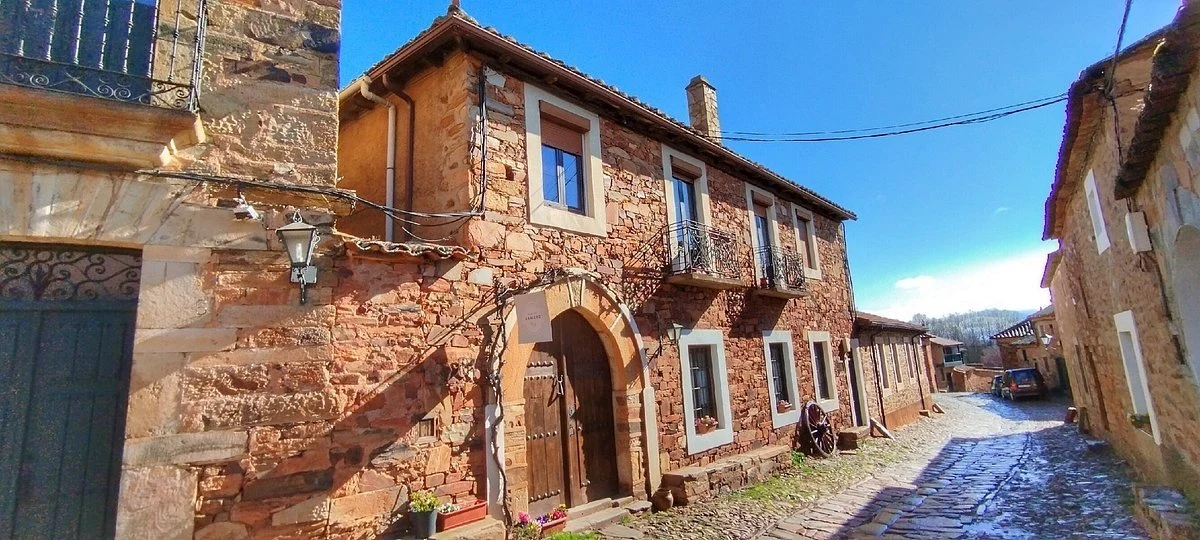
The approach to Coscolo is itself an exercise in displacement. Castrillo de los Polvazares sits on the Camino de Leonés, a lesser-walked branch of the Camino de Santiago through the Maragatería region of León, and the village has preserved its stone architecture and cobbled lanes with an unusual degree of integrity. Private vehicles are prohibited inside; visitors leave their cars at the entrance car park and continue on foot, which means the final stretch to the restaurant unfolds at a pace that matches the kitchen's own unhurried logic. The golden sandstone facades, the narrow lanes, and the absence of traffic make it feel less like a detour and more like a deliberate recalibration before the meal.
That context matters because Coscolo is not trying to be a destination restaurant in the way that DiverXO in Madrid or El Celler de Can Roca in Girona are. Its Michelin Bib Gourmand recognition places it in a category defined by quality cooking at accessible prices, not by spectacle or innovation for its own sake. The village and the restaurant belong to the same register.
The Dish That Defines the Region
Spain's relationship with the cocido, the hearty chickpea-and-meat stew, spans centuries and dozens of regional variations. The Cocido Maragato, specific to the Maragatería area around Castrillo de los Polvazares, carries one distinction that has made it a subject of culinary curiosity: it is served in reverse order. The meal begins with the meats, proceeds to the chickpeas and vegetables, and closes with the broth as a final soup. The inversion is not a modern chef's affectation; it predates the current generation of cooks by several centuries, rooted in the practical and social habits of a community historically engaged in long-distance trade. That the custom persists is testament to how deeply the dish is woven into local identity rather than merely local nostalgia.
Understanding that context positions Coscolo accurately within Spain's broader dining scene. While restaurants like Arzak in San Sebastián or Azurmendi in Larrabetzu operate at the frontier of creative reinterpretation, a different and equally legitimate tradition runs through restaurants that treat a single regional dish as the primary commitment, refining execution rather than expanding the menu's vocabulary. Coscolo belongs to that second tradition. For comparable expressions of this approach in other Spanish regions, see also Auga in Gijón.
What Casanova Brings From Navarra
Paolo Casanova comes from Navarra, a region whose culinary identity is distinct from León's: vegetable-forward, river-fed, more closely associated with the Basque culinary corridor than with the arid Castilian plateau. Paolo Casanova comes from Navarra, a region whose culinary identity is distinct from León's: vegetable-forward, river-fed, more closely associated with the Basque culinary corridor than with the arid Castilian plateau. That an outsider chose to commit to the Cocido Maragato rather than introduce a Navarran counterprogram is itself a meaningful decision, and the result is a version of the dish that carries a local foundation while admitting a trained cook's sensibility.
Casanova's contribution is not reinvention. The reverse-order service remains intact. What changes is the sourcing and preparation infrastructure: the meats and cured products used in the stew are smoked, cured, and processed on the property, using ingredients drawn from the local area. That degree of vertical integration in a €-price-range restaurant is uncommon and accounts for much of the Bib Gourmand recognition. The dish is listed on the menu as "Cocido Coscolo" rather than "Cocido Maragato", which signals authorship without disrespecting lineage. It is a careful distinction, and a chef from outside the tradition is better positioned than most to understand why it matters to make it.
For reference on how regional Spanish cooking can evolve within a tradition rather than away from it, Atrio in Cáceres and Ricard Camarena in València each demonstrate their own versions of that balance, albeit at higher price points and with wider menus.
Placing Coscolo in the Spanish Bib Gourmand Category
Spain's Michelin Bib Gourmand list has expanded in recent years across secondary cities and rural municipalities, reflecting a broader recognition that value-for-quality cooking is not confined to urban centres. Coscolo's entry in the 2025 guide places it alongside a set of restaurants that reward the trip specifically because they could not exist, at this price and with this level of ingredient commitment, anywhere else. The Cocido Coscolo depends on the village's identity, the local supply chain, and the ritual of the car-free approach. Remove any element and it becomes a different proposition.
Comparison restaurants in this category tend to share a focus on a single dish or a tightly constrained menu rather than the multi-course tasting format that dominates the higher Michelin tiers. Auberge Grand'Maison in Mûr-de-Bretagne represents a structurally similar case in France: a traditional regional format executed with precision in a village setting, recognised for quality-to-price ratio rather than innovation. The parallels are instructive.
Planning the Visit
Castrillo de los Polvazares sits within the province of León, on or near the Camino de Santiago route, and is accessible by road from the city of Astorga, which lies roughly six kilometres to the southeast. The walk from the village car park to the restaurant on Calle la Magdalena takes only a few minutes, but there is enough of the village to explore that arriving early is worthwhile. Coscolo's price point is approachable, and booking is recommended. The restaurant sits at C. la Magdalena, 1, 24718 Castrillo de los Polvazares.
Questions
Frequently asked
What recognition does Coscolo hold?
Coscolo holds a Michelin Bib Gourmand.
How expensive is Coscolo?
Coscolo is listed at a price level of $$.
Where is Coscolo and what does it serve?
Coscolo is in Castrillo de los Polvazares, Castrillo de los Polvazares, serving Traditional Cocido Maragato.
The field
How it compares
| Place | Cuisine | Notes | Awards |
|---|---|---|---|
| Coscolo | Traditional Cocido Maragato | Castrillo de los Polvazares, $$ | · |
| Belcanto | Contemporary Portuguese Fine Dining | Lisbon | Michelin 2 Stars, World's 50 Best |
| Burnt Ends | Modern Australian Barbecue | Singapore | Michelin 1 Star, World's 50 Best |
| Eleven Madison Park | Contemporary Plant-Based Fine Dining | New York City | Michelin 3 Stars, World's 50 Best |
| Geranium | Modern New Nordic Pescatarian | Copenhagen | Michelin 3 Stars, World's 50 Best |
| HAJIME | Avant-Garde Japanese Fine Dining | Osaka | Michelin 3 Stars, World's 50 Best |
| Jordnær | Modern Nordic Seafood Fine Dining | Gentofte | Michelin 3 Stars, World's 50 Best |
Similar places
Contemporary Portuguese Fine Dining
Belcanto
Lisbon, Portugal
★★ · 50 Best
Modern Australian Barbecue
Burnt Ends
Singapore, Singapore
★ · 50 Best
Contemporary Plant-Based Fine Dining
Eleven Madison Park
New York City, United States
★★★ · 50 Best
Modern New Nordic Pescatarian
Geranium
Copenhagen, Denmark
★★★ · 50 Best
Avant-Garde Japanese Fine Dining
HAJIME
Osaka, Japan
★★★ · 50 Best
Modern Nordic Seafood Fine Dining
Jordnær
Gentofte, Denmark
★★★ · 50 Best