Couvert de Vignes
In Residence
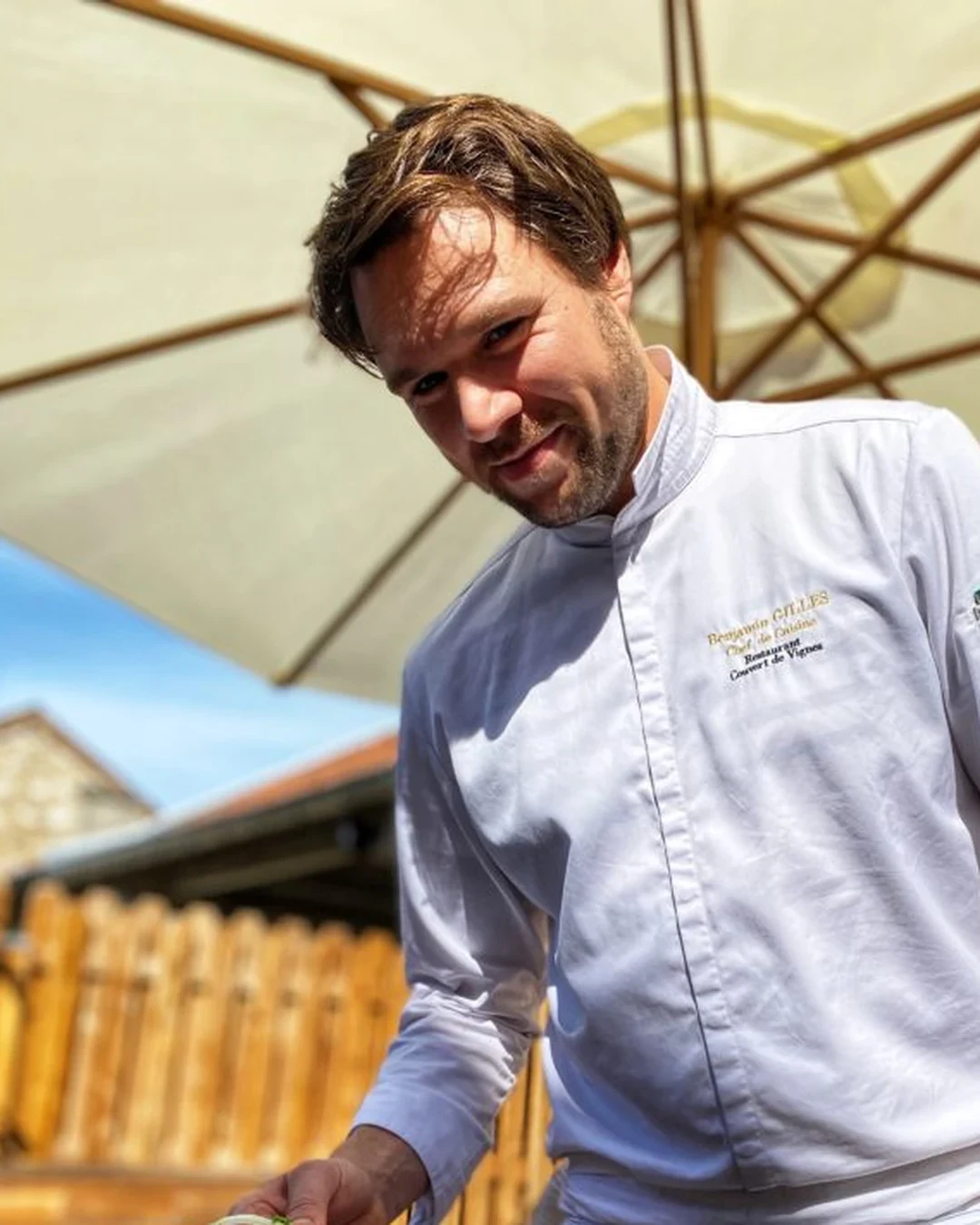
Benjamin Gilles
Chef
- 01CuisineModern French Gastronomique
- 02CityChigny-les-Roses, France
Couvert de Vignes is a restaurant in Chigny-les-Roses. Explore its food and drink, and use its official website for current menus and visitor details.
- We're Smart World 1 Radish · 2025
- Michelin Plate · 2025
- Michelin Plate · 2024
Fifteen days at a time
The menu turns every 15 days under Benjamin Gilles, Chef at Couvert de Vignes in Chigny-les-Roses. He opened the restaurant in 2019 with his wife Virginie, taking a former classroom in the village and making it the fixed address for a cooking life that had already begun under his own name in Reims. Since 2015, Gilles has also cooked through Benjamin Gilles chef à domicile, a parallel practice that keeps the line between house, client, and kitchen close to the hand.
At Couvert de Vignes, the lineage is intimate before it is institutional. Virginie stands at the origin of the house with him; the restaurant is a marital partnership, then a daily discipline shaped by a chef who chooses movement over a settled repertoire. His cooking here is modern French gastronomique, described through freshness, colour, and frank flavour rather than through a single permanent signature. The rhythm matters. A plate may have only a short life on the menu, but the method behind it returns: local sourcing, vegetable inflection, and a taste for combinations that read cleanly from the first spoonful.
The vegetable as seasoning
Gilles uses vegetables as flavour and colour enhancers, even when they are not the largest element on the plate. That distinction gives the kitchen its balance. Raw, cooked, or pickled, the produce works as register and contrast, lifting meat, fish, and sauce rather than replacing them. The signature Foie gras chaud with pot au feu and dashi bouillon shows the range of that approach, setting richness against broth and a familiar French reference against another kind of depth.
The dining format keeps the work concentrated: tasting menu and prix fixe, with a curated wine program pointed toward Champagne and regional bottles. Saint-Jacques sits among the named dishes, a course that suits the house’s preference for precision over weight. The menu change every 15 days keeps the pass alert. It also asks the kitchen to keep building, testing, and editing, rather than defending a fixed set of plates.
A classroom facing the vines
The room still carries the scale of its earlier life as a village classroom, though the surfaces have shifted: warm wood, leather accents, bright natural light, and large windows that look out toward the Montagne de Reims vineyards. The setting is not decorative background. It presses on the meal, especially when Champagne appears in the glass and the view outside explains why the wine program stays close to the region.
An open kitchen window lets diners watch Gilles at the pass. In a small restaurant, that kind of visibility changes the temperature of the room; service remains formal, but the work is not hidden. Plates move from the kitchen into an elegant, intimate room where conversation can hold its shape. The counterpoint is simple: vineyard light at the windows, the chef’s station in view, and a menu that will be gone in 15 days.
Questions
Frequently asked
What kind of restaurant is Couvert de Vignes?
Couvert de Vignes is a modern French gastronomique restaurant in Chigny-les-Roses. It runs tasting menu and prix fixe dining under chef Benjamin Gilles.
Who is behind the kitchen at Couvert de Vignes?
Benjamin Gilles leads the kitchen there, and he opened the restaurant in 2019 with his wife Virginie. Virginie stands at the origin of the house with him.
What is the menu like?
The menu changes every 15 days. The cooking is described through freshness, colour, frank flavour, local sourcing, and a strong use of vegetables as flavour and colour enhancers.
What dishes are named as signatures?
Foie gras chaud with pot au feu and dashi bouillon is named as a signature dish, and Saint-Jacques is also listed among the named dishes.
What should diners know before booking?
Reservation is essential. The dress code is smart casual, parking is on the street, and the restaurant is open for lunch on Tuesday to Saturday and for dinner on Thursday to Saturday.
The field
How it compares
| Place | Cuisine | Notes | Awards |
|---|---|---|---|
| Couvert de Vignes | Modern French Gastronomique | Chigny-les-Roses, $$$ | · |
| CIBO | Modern French Gastronomique | Dijon | Michelin 1 Star |
| Fleur de Pavé | Modern French Gastronomique | Paris | Michelin 1 Star |
| La Grand'Vigne - Les Sources de Caudalie | Modern French Gastronomique | Martillac | Michelin 2 Stars |
| Le K | Modern French Gastronomique | Montenach | Michelin 1 Star |
| Le Neuvième Art | Modern French Gastronomique | Lyon | Michelin 2 Stars |
| Le Pressoir | Modern French Gastronomique | Saint-Avé | Michelin 1 Star |
In residence
Similar places
Modern French Gastronomique
CIBO
Dijon, France
★
Modern French Gastronomique
Fleur de Pavé
Paris, France
★
Modern French Gastronomique
La Grand'Vigne - Les Sources de Caudalie
Martillac, France
★★
Modern French Gastronomique
Le K
Montenach, France
★
Modern French Gastronomique
Le Neuvième Art
Lyon, France
★★
Modern French Gastronomique
Le Pressoir
Saint-Avé, France
★