Hadongkwan
- 01CuisineTraditional Korean Gomtang
- 02CitySeoul, South Korea
From the people index
Recommended by
One trusted voice points here.
Gomtang served in brass bowls
- Opinionated About Dining Top Restaurants in Asia Recommended · 2026
- Michelin Plate · 2026
- Michelin Plate · 2025
- Michelin Plate · 2024
Brass bowls before the first spoon
Brass bowls land on the table with rice already under the broth. At Hadongkwan in Myeongdong, Seoul, gomtang sets the pace, and no chef is put forward: leadership here is collective and family-oriented, which suits a room that has never traded on authorship. What can be said is narrower and more useful: the place asks the kitchen to submit to broth, beef, rice, radish, and repetition. High-grade beef bones and radish are boiled for hours to a clean, milky broth with no additives, and the bowl arrives with generous cuts of brisket, intestine and tripe carrying the texture.
Hadongkwan was established in 1939 and has stayed close to a founding idea of purity. The menu turns on gomtang and suyuk, with kimchi and kkakdugi doing the work at the edge of the bowl. The restaurant moved from its earlier back-alley site near Cheonggye Stream to central Myeongdong after redevelopment, bringing original wooden pieces with it: signboard, doors, furniture. That kind of continuity can be sentimental in the wrong hands. Here it is practical. The bench has only a few jobs, and each one has to happen cleanly.
The Sunday letter
Find new places through the people who run them.
Our Sunday email brings you the chefs, winemakers and hoteliers behind our newest stories. See a sample before you subscribe.
See a sample of the Sunday emailOne email a week. Unsubscribe from any issue.
Gomtang held to two main forms
The method is deliberately narrow. Beef bones and radish boil for hours, giving a broth that stays light rather than heavy, with no artificial flavorings stated by the house. The regular gomtang carries rice and beef slices in the soup; the special gomtang adds tripe, bringing chew against the softer grain and meat. Suyuk keeps to boiled slices, served for sharing rather than display. Spring onions, salt, and kimchi juice let the diner finish the seasoning at the table, which means the kitchen must send out a base broth with enough clarity to take those additions without losing itself.
Hadongkwan’s discipline is also architectural. There is no tasting menu, no pastry turn, no bar program to soften the focus. The place works à la carte and returns to the same few preparations. Michelin has recognized Hadongkwan with Bib Gourmand status, including recent Seoul guides, but the award matters here only because it names consistency. The harder fact is the smaller one: a bowl built from bones, radish, rice, beef, brass, and time.
The room keeps the old furniture working
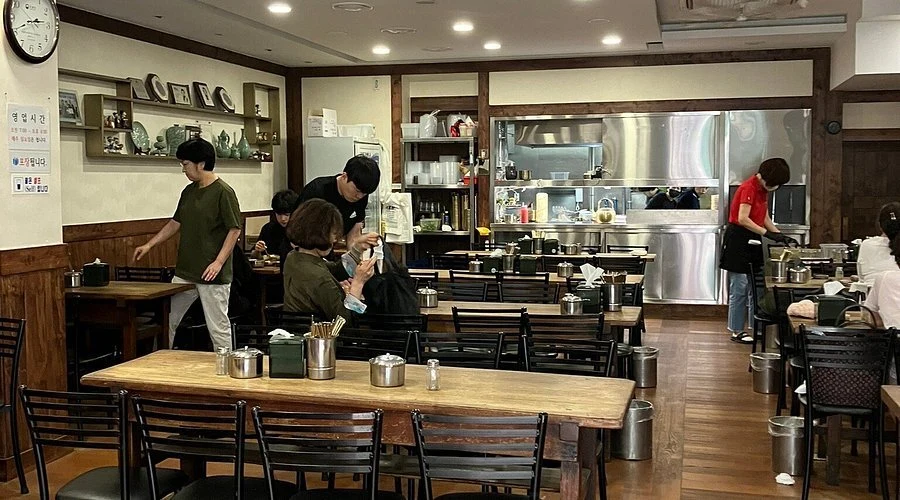
The room is rustic in the literal sense, wooden, no-frills, and built for people who have come to eat rather than settle into ceremony. Lunch can gather a line, and the service rhythm is quick enough to suggest long practice at crowd pressure. Brass pots and bowls bring a low gleam to the tables; kimchi jars and soup refills keep the meal communal without making a performance of generosity. Myeongdong moves fast outside, full of street food, retail light, and visitors. Inside, the counter and the floor keep pulling the eye back to the broth.
The atmosphere is nostalgic without being staged. Original furniture can become a prop, but Hadongkwan still asks it to carry weight: doors opening, chairs scraping, bowls passing from hand to hand. The final measure is not polish. It is the point at which a spoon cuts through clear beef broth and rice in a Hadongkwan brass bowl.
Questions
Frequently asked
What is Hadongkwan known for?
Hadongkwan is known for traditional Korean gomtang, with the menu turning on gomtang and suyuk. The broth is made by boiling high-grade beef bones and radish for hours, and the regular bowl comes with rice and beef slices, while the special gomtang adds tripe.
Who is the chef at Hadongkwan?
No individual chef is put forward there. The page describes the leadership as collective and family-oriented, which fits a room that has not traded on authorship.
What recognition does Hadongkwan hold?
Michelin has recognised Hadongkwan with Bib Gourmand status, including in recent Seoul guides.
What kind of place is Hadongkwan to visit?
It is a rustic, no-frills restaurant in Myeongdong that works à la carte and keeps to a small set of preparations. Reservations are recommended, and the dress code is casual.
The field
How it compares
| Place | Cuisine | Notes | Awards |
|---|---|---|---|
| Hadongkwan | Traditional Korean Gomtang | 소공동, $$ | · |
| alla prima | Modern Fusion Fine Dining | Seoul | Michelin 2 Stars, World's 50 Best |
| Eatanic Garden | Modern Korean Contemporary | Seoul | Michelin 1 Star, World's 50 Best |
| Evett | Modern Innovative Korean | Seoul | Michelin 2 Stars |
| Jungsik | Modern Korean Fine Dining | Seoul | Michelin 2 Stars, World's 50 Best |
| Mingles | Modern Korean Fine Dining | Seoul | Michelin 3 Stars, World's 50 Best |
| Onjium | Modern Korean Royal Court Cuisine | Seoul | Michelin 1 Star, World's 50 Best |
Similar places
Modern Fusion Fine Dining
alla prima
Seoul, South Korea
★★ · 50 Best
Modern Korean Contemporary
Eatanic Garden
Seoul, South Korea
★ · 50 Best
Modern Innovative Korean
Evett
Seoul, South Korea
★★
Modern Korean Fine Dining
Jungsik
Seoul, South Korea
★★ · 50 Best
Modern Korean Fine Dining
Mingles
Seoul, South Korea
★★★ · 50 Best
Modern Korean Royal Court Cuisine
Onjium
Seoul, South Korea
★ · 50 Best
The Sunday letter
Get the next Made By story in your inbox.
We send one email every Sunday morning with the places and people we covered that week.
See a sample of the Sunday emailOne email a week. Unsubscribe from any issue.