
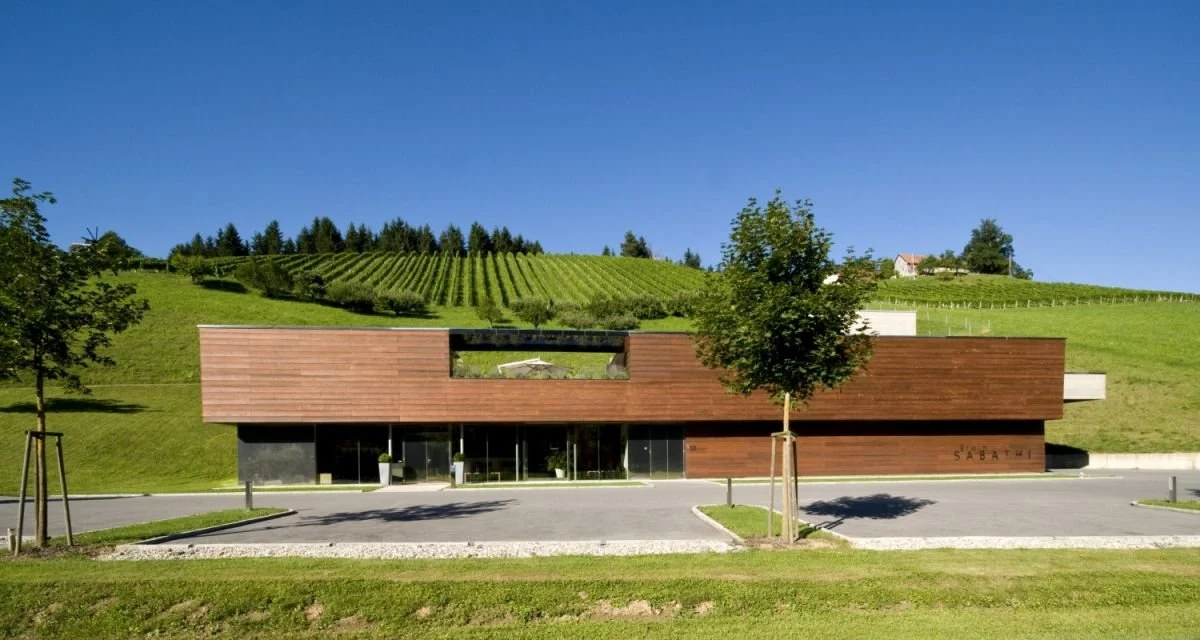
Weingut Erwin Sabathi operates from Pößnitz in Leutschach, in the Südsteiermark wine country that produces some of Austria's most precise white wines. The estate holds a Pearl 2 Star Prestige rating for 2025, placing it among a small peer group of Austrian producers recognised for consistent, terrain-specific work. The address alone, deep in the rolling vine corridors south of Graz, signals what kind of winery this is.
<h2>Where the Styrian Hills Shape the Wine</h2><p>The road into Leutschach from the north drops through a sequence of steep, vine-covered ridges that leave little ambiguity about the land's priorities. This corner of Südsteiermark, pressed against the Slovenian border, has built its reputation on a specific promise: white wines of high acidity and mineral precision, shaped by the kind of terrain that makes viticulture physically demanding but directionally clear. The soils here, a mix of opok, the region's characteristic limestone and clay marl, and weathered slate, drain quickly, stress the vines usefully, and contribute a saline, stony note that shows up reliably in the glass regardless of the vintage's warmth.</p><p>Weingut Erwin Sabathi sits within this tradition at Pößnitz 48, one of the higher addresses in the area. The estate holds a Pearl 2 Star Prestige rating for 2025, a credential that places it in the tier of Austrian producers operating with consistency and territorial focus rather than volume. Among its neighbours in the broader Styrian conversation, comparable estates like <a href="https://www.enprimeurclub.com/wineries/weingut-wohlmuth-kitzeck-winery">Weingut Wohlmuth in Kitzeck</a> share this orientation toward site-specific, restrained white wine production. Südsteiermark's prestige tier is defined by discipline and address specificity, not by scale.</p><h2>The Logic of Opok Soils</h2><p>To understand what Sabathi's wines aspire to, it helps to understand what Südsteiermark's geology asks of its producers. The opok subsoil that defines much of this appellation is a sedimentary formation laid down when the region sat beneath a shallow sea. It retains just enough moisture to sustain the vine through summer, but sheds excess water readily, preventing the kind of vegetative growth that dilutes aromatics. The result, in good vintages, is fruit with high natural acidity and a mineral backbone that carries through fermentation with relatively little intervention required.</p><p>This is a different proposition from the richer, more textural white wine traditions of Burgenland or the Wachau. While producers like <a href="https://www.enprimeurclub.com/wineries/weingut-emmerich-knoll-durnstein-winery">Weingut Emmerich Knoll in Dürnstein</a> work with the loess and primary rock slopes of the Danube corridor, and <a href="https://www.enprimeurclub.com/wineries/weingut-brundlmayer-langenlois-winery">Weingut Bründlmayer in Langenlois</a> draws on the Kamptal's gravels and gneiss, Südsteiermark's opok profile pulls in a distinct direction: lighter body, sharper edges, and a structure that rewards patience in the bottle. Sauvignon Blanc and Welschriesling are the varieties that most clearly transmit these soil characteristics, and they anchor the serious end of production across the appellation's leading estates.</p><h2>Prestige Recognition in a Competitive Field</h2><p>The Pearl 2 Star Prestige designation for 2025 is the most specific trust signal the available record offers, and it places Sabathi in a clearly defined bracket. Austrian wine recognition at this level is not awarded for approachability or commercial range. It reflects consistency in producing wines that express their origin with specificity and age in a way that sustains interest over time. For context, the prestige tier of Austrian wine is competitive because the country's leading appellations contain producers making a serious case for their terroir's distinctiveness.</p><p>Südsteiermark's argument has gained considerable traction internationally over the past two decades, with its Sauvignon Blanc in particular attracting comparison to the Styrian wines that first drew attention to this corner of central Europe in the 1980s and 90s. A 2 Star Prestige rating in this context is a signal that the estate is producing at the level where terrain, vintage, and winemaking decisions are all being managed with enough precision to generate a consistent signature. Elsewhere in the Austrian premium conversation, estates like <a href="https://www.enprimeurclub.com/wineries/weingut-kracher-illmitz-winery">Weingut Kracher in Illmitz</a> have established that Austrian wine at the prestige tier carries genuine international currency, and Sabathi occupies a parallel position within the dry white wine tradition.</p><h2>Visiting Leutschach: What to Expect From the Region</h2><p>Planning a visit to Weingut Erwin Sabathi requires engaging with the region's geography first. Leutschach sits roughly 50 kilometres south of Graz, and the drive south through the Leibnitz plain before the road climbs into the vine hills is its own kind of preparation. The area is not a wine tourism corridor in the way that, say, the Wachau's river road operates as a clearly marked route between famous cellars. Südsteiermark's leading estates are distributed across ridges and valleys, often signposted modestly, and the experience of arriving at a serious producer here tends toward the understated. You are expected to have done some homework before you arrive.</p><p>The address at Pößnitz 48 places the estate in one of the more refined positions in the commune, which is typical of the region's pattern: prestige vineyards tend to occupy the steeper, better-exposed sites on the upper slopes, where the vines receive direct morning sun and benefit from cooling evening airflow down from the higher ground to the south. Booking ahead is advisable when visiting any of the small prestige estates in this part of Styria. These are working wineries with limited visitor capacity, and arriving without prior contact is likely to result in a closed door during harvest or during the quieter winter months when staff are minimal.</p><p>For visitors building a multi-estate itinerary in the region, our full Leutschach guide maps the local wine circuit in more detail. The southern Styrian wine road connects several appellation producers within a manageable driving distance, and the proximity to the Slovenian border adds a cross-border dimension that increasingly draws wine travellers looking to compare Sauvignon Blanc styles across the two wine cultures that share this terrain.</p><h2>Sabathi in the Broader Austrian Context</h2><p>Austria's wine map is smaller than its international reputation might suggest. The country produces less wine annually than many individual French appellations, which means that estates recognised at the prestige tier are genuinely rare. The producers who earn and hold that recognition tend to share a few characteristics: single-vineyard discipline, low intervention in the cellar relative to the quality of fruit coming in, and a willingness to let difficult vintages tell the truth about what the season delivered rather than smoothing everything into a commercial house style.</p><p>Comparing the comparable set across Austrian regions is useful context for understanding where Sabathi sits. <a href="https://www.enprimeurclub.com/wineries/weingut-pittnauer-gols-winery">Weingut Pittnauer in Gols</a> operates in the Neusiedlersee's very different terroir with a similarly restrained, site-focused approach. <a href="https://www.enprimeurclub.com/wineries/weingut-heinrich-hartl-oberwaltersdorf-winery">Weingut Heinrich Hartl in Oberwaltersdorf</a> works Thermenregion soils with comparable precision. The common thread is not variety or geography but rather the commitment to letting a specific piece of ground express itself over time. Sabathi's 2025 Pearl 2 Star Prestige rating positions the estate firmly within this tradition of terroir fidelity in a part of Austria that has earned its place in the country's most serious wine conversations.</p><h3>Planning Your Visit</h3><p>Weingut Erwin Sabathi is located at Pößnitz 48, 8463 Leutschach, in the southern Styrian wine region of Austria. The estate's 2025 Pearl 2 Star Prestige designation confirms its standing in the prestige tier of Austrian wine production. Visitors travelling from Graz should allow approximately one hour for the drive south through the Leibnitz plain and into the vine hills. Contact the estate directly before visiting to confirm availability, as visits are by appointment only.</p><h3>Frequently Asked Questions</h3><h4>What kind of setting is Weingut Erwin Sabathi?</h4><p>The estate sits in Pößnitz, in the steep vine-covered hills of Leutschach in Südsteiermark, approximately 50 kilometres south of Graz. The setting is characteristic of the region's leading addresses: an refined slope position, a working winery environment, and the kind of understated arrival that signals serious production over tourism performance. The Pearl 2 Star Prestige rating for 2025 places it in a small group of recognised Austrian estates producing at a consistently high level.</p><h4>What should I taste at Weingut Erwin Sabathi?</h4><p>Südsteiermark's signature varieties are Sauvignon Blanc and Welschriesling, and these are the wines that most directly transmit the region's opok soil character: high acidity, mineral precision, and a stony note that distinguishes the appellation from Austria's other white wine regions. A prestige-rated estate in this area will typically show these varieties at their most site-specific. Austrian wine at this level rewards cellaring, and tasting a current release alongside a bottle with a few years on it reveals the structural argument the region makes for its terroir.</p><h4>What is Weingut Erwin Sabathi leading at?</h4><p>The estate's strongest claim is terroir expression in a region that has built its reputation on exactly that. The Pearl 2 Star Prestige recognition for 2025 confirms consistent performance at the level where soil, variety, and winemaking decisions are aligned toward a specific outcome rather than a broad commercial range. Within the Leutschach context, Sabathi operates in the same serious register as other Südsteiermark prestige producers, with the elevation and soil composition of the Pößnitz address providing the raw material for wines of genuine structural distinction.</p>
The estate sits at Pößnitz 48 in Leutschach, a village roughly 50 kilometres south of Graz in Austria's Südsteiermark wine zone. The terrain here is defined by steep, vine-covered ridges with opok subsoil, giving the property a working agricultural character rather than a polished resort feel. Visits require engaging with the region's geography on its own terms.
Weingut Erwin Sabathi is located at Pößnitz 48, 8463 Leutschach, Leutschach.
Weingut Erwin Sabathi has received recognition including: Pearl 2 Star Prestige (2025).
Südsteiermark's reputation rests primarily on aromatic white varieties, and the region's opok soils are regarded as a key driver of mineral tension and structure in those wines. Sabathi holds a Pearl 2 Star Prestige designation for 2025, which places the estate in a clearly defined tier of regional producers. Specific current bottlings are best confirmed directly with the estate before visiting.
The estate's Pearl 2 Star Prestige recognition for 2025 points to consistent quality within the competitive Südsteiermark producer field. Sabathi's position in Leutschach, where opok-dominated hillside sites produce wines with structural definition, is the core of its standing. That combination of geology and sustained prestige-tier recognition is what distinguishes the estate within Austria's southern Styrian corridor.
Pößnitz 48, 8463 Leutschach
Leutschach