Hand harvests under Gaisberg stone
- Falstaff Winery - 4 Stars · 2026
- Pearl 2 Star Prestige · 2025
Several passes before the cellar
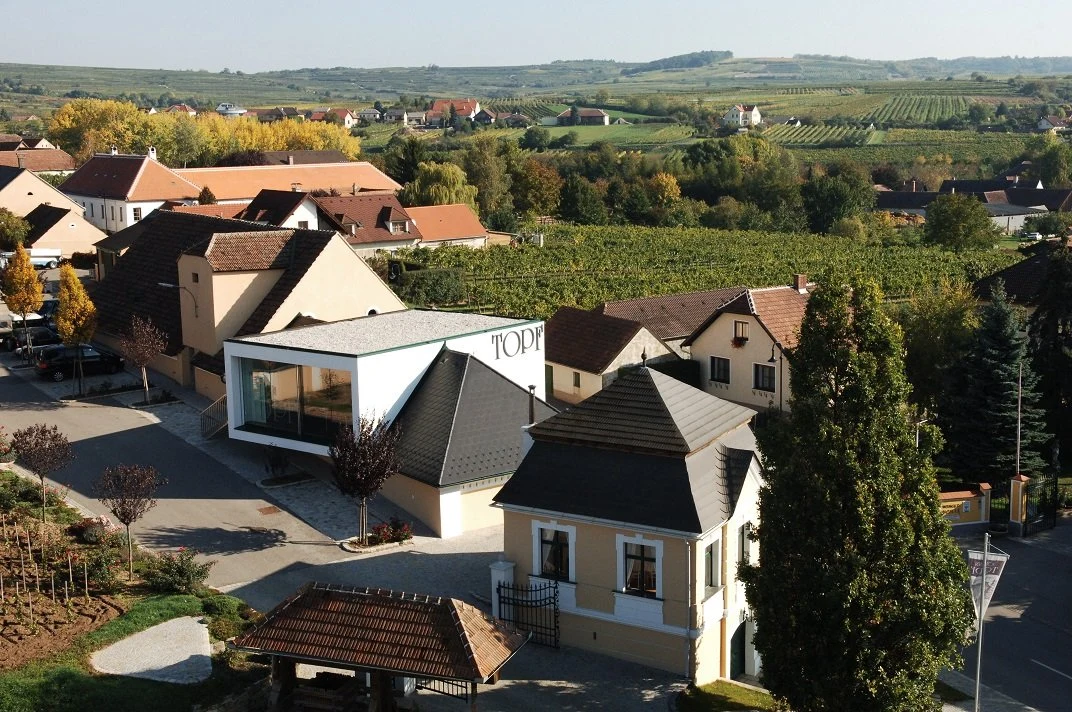
Several passes through the rows decide what comes in first. Johann Topf, winemaker at Weingut Johann Topf in Straß im Straßertale, makes that call in Kamptal before steel or wood has any part in the wine. His station is not a new one, although the house does not turn its history into ornament. The farm was first mentioned in the local parish register in 1649, and the family winery has carried its knowledge forward through many generations, with the practical memory that comes from working the same hillsides rather than merely owning them. Topf’s discipline begins with the match between grape and soil. Grüner Veltliner, Riesling, Chardonnay, Zweigelt and Pinot Noir are not treated as a list of varieties, but as material that must be set in the right place before the cellar can clarify anything. The estate works organically across 50 hectares, in a village at the foot of the Gaisberg, and that scale gives him room to separate sites without losing sight of the hand work. His role is less about imposing a signature than keeping each picking close to its origin.
Ripeness chosen by hand
Harvest here moves by physiological ripeness, not by a fixed date. Topf and the picking teams take the fruit by hand in several passes, returning to the rows when a lot has reached the condition he wants for the wine. That method asks for time in the vineyard and restraint in the cellar, because each pass carries a slightly different reading of the season. Once the grapes arrive, maturation follows the material: steel for some wines, wood for others, chosen according to grape variety, ripeness or vintage. The cellar itself adds a physical measure to the work. The wines mature in historic vaults 12 meters deep inside the Gaisberg, in stone spaces described as 500-year-old. Depth matters here. So does temperature, shadow and the absence of hurry. Premium Kamptal sites give the estate its frame, but the sequence remains plain: soil first, fruit next, vessel after that. The bottlings are built from those decisions rather than from a single house formula.
Stone under Gaisberg
The cellar changes the pace of the place. Above ground, Straß im Straßertale sits in a scenic fold of Kamptal, with vineyard lines rising toward Gaisberg and a tasting room that brings a modern edge into a baroque setting. Below, the older vaults pull attention back to the material facts of wine: barrels or tanks, damp stone, the quiet interval between harvest and release. The room does not need volume to make its point. It holds the work in a register close to the vineyard, where the question remains whether a parcel of Grüner Veltliner or Riesling has carried its soil cleanly enough to survive the long way from row to glass. In that sense, the estate’s heritage stays active. The old vaults are not backdrop; they are part of the method at Weingut Johann Topf.
Questions
Frequently asked
Who makes the wines at Weingut Johann Topf?
Johann Topf is the winemaker at Weingut Johann Topf in Straß im Straßertale.
What grapes does the estate work with?
The estate works with Grüner Veltliner, Riesling, Chardonnay, Zweigelt and Pinot Noir.
How are the grapes picked and selected?
Harvest moves by physiological ripeness rather than a fixed date, and the picking teams take the fruit by hand in several passes through the rows.
How is the winery run in the vineyard?
Weingut Johann Topf works organically across 50 hectares in Kamptal vineyard parcels.
What is the cellar like?
The wines mature in historic vaults 12 meters deep inside the Gaisberg, in stone spaces described as 500-year-old.
The field
How it compares
| Place | Notes |
|---|---|
| Weingut Johann Topf | Straß im Straßertale, $$ |
| Weingut Allram | Straß im Straßertale |
| Weingut Arndorfer | Straß im Straßertale |
| Weingut Hubert Patzl | Straß im Straßertale |
| Weingut Kamauf | Straß im Straßertale |
| Weingut Maglock-Nagel | Straß im Straßertale |
| Weingut Peter Dolle | Straß im Straßertale |