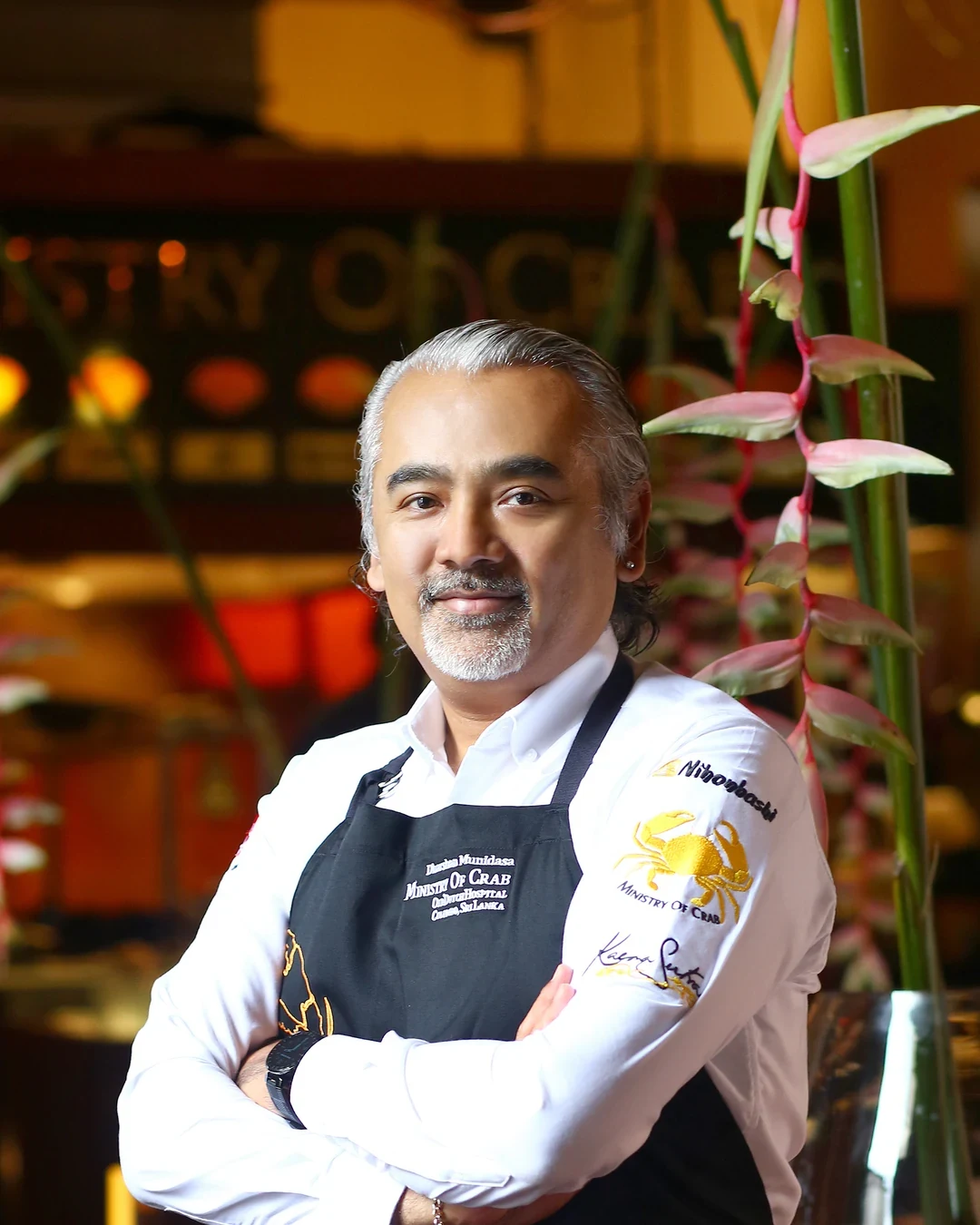
Portrait of Dharshan Munidasa
i. Biography
He has made that non-culinary education part of the record, saying: “I never attended culinary school.” The point is not biographical flourish. It explains a career built outside the standard kitchen pipeline, where discipline, observation, and self-directed study became the working tools. In Dharshan Munidasa’s case, the route into hospitality was shaped less by formal culinary training than by the repeated act of building a point of view and then putting it into service.
The Sunday letter
Read Made By's new profiles every Sunday.
Meet the chefs, winemakers and sommeliers behind the places we cover. See a sample below before you subscribe.
See a sample of the Sunday emailOne email a week. Unsubscribe from any issue.
The Path
Dharshan Munidasa trained at Wycherley International School and The Johns Hopkins University, then stepped into the public eye as co-founder / host at Culinary Journeys with Dharshan (2010–2011). That early role shows a chef-restaurateur working in public before the full expansion of his restaurant portfolio, using the format to connect food with place, memory, and interpretation. Rather than presenting a conventional culinary pedigree, he built visibility through observation and authorship. The career that followed has the feel of a long construction project: deliberate, grounded in Sri Lanka, and extended through concepts that bear his name and his approach. Today, he is founder / chef-restaurateur of Nihonbashi (since 1995), founder / chef-restaurateur of Nihonbashi (Odel branch) (since 2001), founder / chef-restaurateur of Nihonbashi (Hilton Colombo Residencies branch) (since 2002), co-founder / restaurateur of Ministry of Crab (since 2011), founder / restaurateur of Kaema Sutra (since 2014), and founder / restaurateur of The Tuna & The Crab (since 2014). Read as a timeline, those roles show continuity more than reinvention. Nihonbashi establishes the long base; Ministry of Crab, Kaema Sutra, and The Tuna & The Crab add distinct addresses and concepts without breaking the line of authorship. The pattern is one of steady expansion through ownership and repeat practice, with each project carrying the same discipline of intent.
The Work Today
In the present day, Dharshan Munidasa’s restaurant work is marked by endurance and control. The repeated founder / chef-restaurateur credit across Nihonbashi and its branches points to an approach that treats restaurant-making as a craft of structure as much as menu. The later co-founder / restaurateur role at Ministry of Crab in 2011, followed by founder / restaurateur credits at Kaema Sutra and The Tuna & The Crab in 2014, shows a portfolio built through accumulation rather than a single defining opening. The through-line is consistency: concepts introduced, held, and developed over time. His public-facing role at Culinary Journeys with Dharshan (2010–2011) sits beside the restaurant work rather than apart from it. That format required him to speak food as well as build it, translating ideas into something legible on camera. Taken together, the television work and the restaurants show a restaurateur who works in both presentation and practice. The emphasis is on clarity of concept, repetition of standards, and a point of view that can hold across different settings.
Career - Founder / chef-restaurateur — Nihonbashi, Galle Face Terrace, Colombo, Sri Lanka (1995–present) - Founder / chef-restaurateur — Nihonbashi (Odel branch), Alexandra Place, Colombo, Sri Lanka (2001–present) - Founder / chef-restaurateur — Nihonbashi (Hilton Colombo Residencies branch), Hilton Colombo Residencies, Colombo, Sri Lanka (2002–present) - Co-founder / restaurateur — Ministry of Crab, Old Dutch Hospital Shopping Precinct, Colombo, Sri Lanka (2011–present) - Founder / restaurateur — Kaema Sutra (2014–present) - Founder / restaurateur — The Tuna & The Crab, Galle Fort, Sri Lanka (2014–present) - Co-founder / host — Culinary Journeys with Dharshan (2010–2011) Education: Wycherley International School; The Johns Hopkins University
Signature
Dharshan's signature dishes include Crabzilla, Chilli Crab, Baked Crab, Small Island Iced Tea, and Iced Tea Soda. The set covers a clear range. Crabzilla and Chilli Crab put crab at the

The Sunday letter
Get the next Made By profile in your inbox.
We send one email every Sunday morning with the people we profiled that week.
See a sample of the Sunday emailOne email a week. Unsubscribe from any issue.