Historical artist and designer
Edward Hald
- Discipline
- Historical artist and designer
Portrait of Edward Hald
i. Biography
Stockholm, Sweden sets the frame for Edward Hald’s work: a Swedish painter working in glass, oriented toward color, cut, and the controlled reveal of clear material under blue. In that meeting of city and studio, the craft sits at the point where light enters matter and holds both image and depth at once.
The Sunday email
Get new Made By stories every Sunday.
Every Sunday we send a lead story and up to four more about the chefs, winemakers, sommeliers and hoteliers behind the restaurants, bars, wineries and hotels we cover.
Recent stories



Free. One email a week, and you can unsubscribe from any issue.
The Place Swedish art glass is the field that holds Edward Hald’s practice, where the object is never only a vessel. In this tradition, form is carried in the hand, pattern is carried in the material, and light does the final work of making the surface legible. Hald’s eye reads as painterly, but the result is rooted in glass: what it can carry, what it can hide, and what it can return when light shifts. Orrefors Glassworks gave Edward Hald a working position inside the furnace and the workshop, where design and making stay bound together.
At that scale, the discipline is practical: how glass takes color, how a line holds, and how transparency can be invited, resisted, or exposed. Hald’s imagination was not separate from process; it was shaped by the demands of making. Painter remains the most useful word for Edward Hald, even when the support is a vase rather than a canvas. The medium changes the terms. In glass, an idea has to answer to thickness, reflection, curvature, and the way light moves through the object. The image is not placed on top; it is held inside a translucent structure.
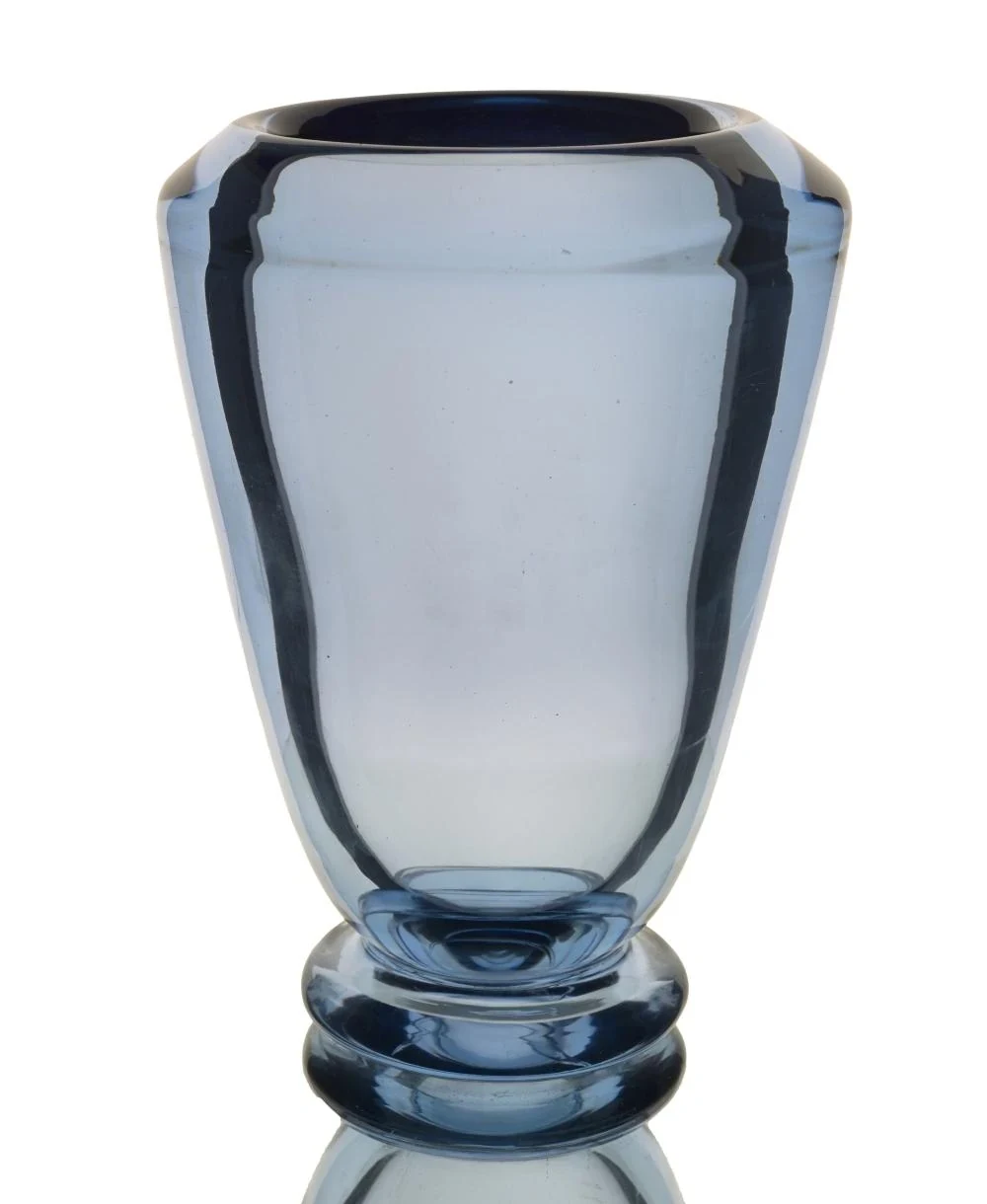
The Method The Fireworks vase, designed for Orrefors Glassworks, makes Edward Hald’s method plain. Its pattern is engraved through a layer of blue to reveal the clear glass beneath, so the design is cut out of color rather than applied to the surface. That gives the work a sharp, architectural order, while the moving light keeps it from sitting still. Subtraction does the technical work here. Blue becomes the field, clear glass becomes the spark, and the engraved line becomes a route for light.
In that exchange, Swedish art glass is defined by contrast: colored skin against luminous core, opacity against revelation, restraint against brilliance. Edward Hald’s practice as both painter and glass maker is carried by that relation between surface and depth. The eye reads the motif, but the hand and the light read the material: the coolness of the glass, the resistance of the engraved layer, and the clarity opened beneath it.
The Range Alongside the Fireworks vase, it places Edward Hald in the language of designed glass objects rather than loose studio gesture: specific works and a long association with a Swedish glass house. Across the known works, his specialty is Swedish art glass. The emphasis is narrow in the best sense: glass as a disciplined material, a vessel as a site for image, and color as something that can be entered, cut through, and made to reveal what lies below.
Signature
Edward's signature dishes include The Grail, Fireworks, Graal vase, Fiskgraal, and Apburen.
FAQ
Asked of Edward
What is Edward Hald known for?
Swedish art glass.
Explore



The Sunday email
Get new Made By stories every Sunday.
Every Sunday we send a lead story and up to four more about the chefs, winemakers, sommeliers and hoteliers behind the restaurants, bars, wineries and hotels we cover.
Recent stories
Free. One email a week, and you can unsubscribe from any issue.