Chef
Lorenzo Cogo
- Discipline
- Chef
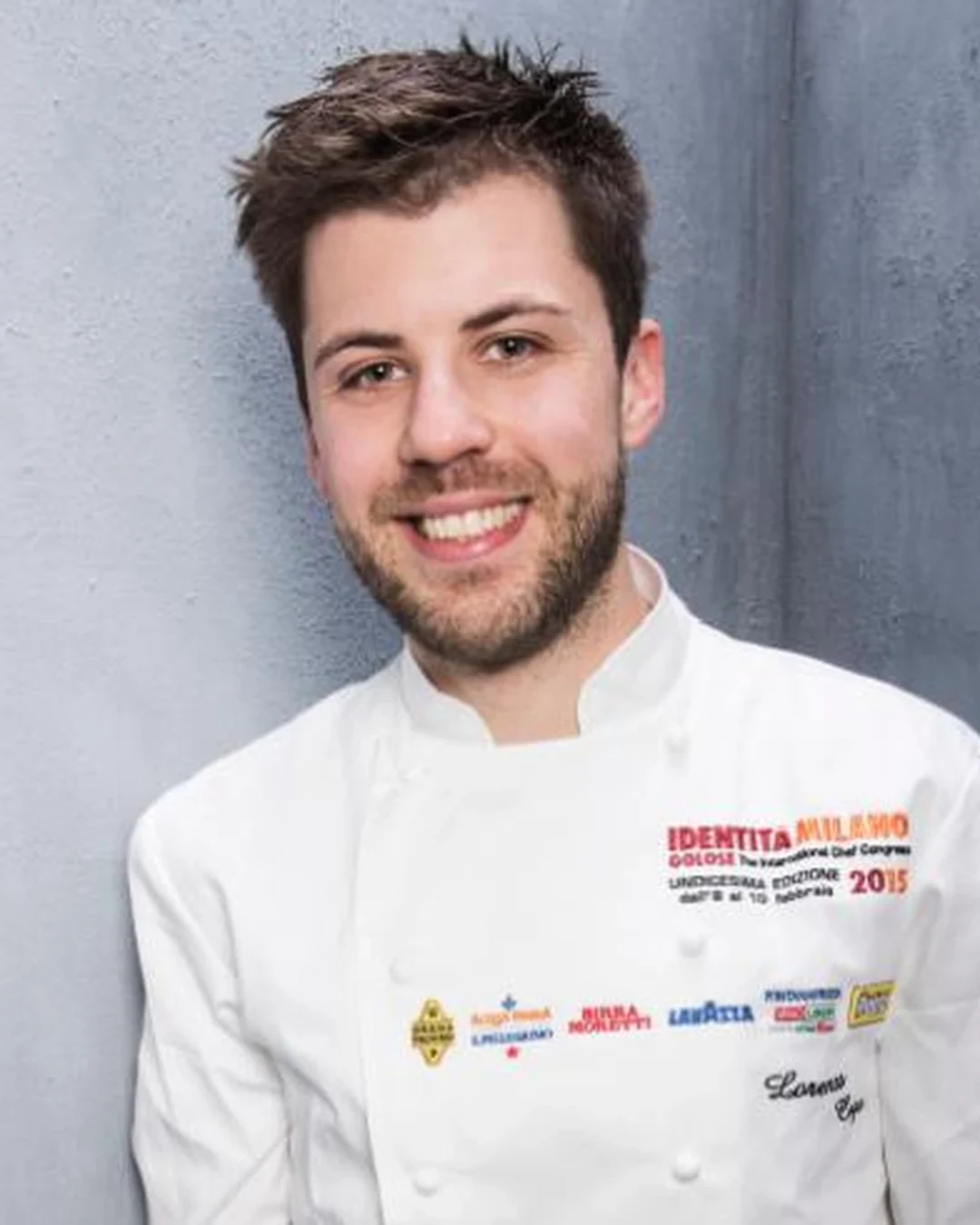
i. Biography
Training and Lineage
Veneto restaurant work gave the early grammar: service rhythm, trattoria discipline, and the daily repetition by which kitchen habits are learned before they are named. Lorenzo Cogo’s first formation came in local restaurants, including his father's trattoria, where proximity to guests and mise en place mattered as much as ambition. The craft base was regional and practical before it became international. International staging added other pressures to that base: precision, restraint, technical control, and the ability to read flavor through more than one kitchen language. Cogo’s itinerary moved through Vue de Monde in Australia and Marque Restaurant in Sydney, Australia, then The Fat Duck in London, England, Ryugin in Tokyo, Japan, and Etxebarri in Basque Country, Spain, where he served as sous-chef. Work with Ryan Clift at Tippling Club in Singapore and at Noma in Denmark extended that range without detaching it from the Veneto grounding that remained useful later. Restaurant ownership gave the accumulated training a fixed address in 2011, when Cogo became chef-owner at El Coq in Marano Vicentino, Italy (from 2011). The work then widened into civic dining through Caffè Garibaldi in Vicenza, Italy (until 2021), and into a Venice hotel-restaurant context when he served as executive chef and consultant at Dama Restaurant, Ca' Bonfadini in Venice, Italy (2022–2024). Across those roles, the through-line was not a borrowed style but the management of place, technique, and audience.
The Work Today
A Venice restaurant asks for decisions about water, trade, memory, and expectation before it asks for decoration. At Ca’ Bonfadini, Cogo has been identified as the executive chef leading a team of young talents, working in a city where the dining room is already loaded with inherited codes. His prior work across Australia, England, Japan, Spain, Singapore, and Denmark gave him a broad technical register for handling that pressure. In trade terms, that is a positioning decision as much as a product decision. The lagoon and the sea remained central, but the menu did not rely on traditional cuisine as a fixed script. The dishes kept recognizable materials in play: tagliatelle, scallops and romanesco broccoli, and dry-aged local sea bass with almond sauce and turnip greens. The craft work sat in the calibration between familiar Venetian readability and a broader contemporary handling of structure and flavor. Pasta, seafood, brassica, almond, and greens were not presented as rupture; they were arranged to move the local language forward without making it illegible. The cooking was described as fresh, innovative, and open to the world.
Career - Worked in local restaurants, including his father's trattoria — Local restaurants / father's trattoria, Veneto, Italy - Worked at Vue de Monde — Vue de Monde, Australia - Worked at Marque Restaurant — Marque Restaurant, Sydney, Australia - Worked briefly at The Fat Duck — The Fat Duck, London, England - Worked at Ryugin — Ryugin, Tokyo, Japan - Sous-chef — Etxebarri, Basque Country, Spain - Worked with Ryan Clift — Tippling Club, Singapore - Worked at Noma — Noma, Denmark
Honors
Recognition has attached both to Dama Restaurant and to Cogo’s Veneto work: Michelin Plate for Dama Restaurant (2025), Michelin Plate for Dama Restaurant (2024), Michelin star, Chosen as an example of “Outstanding Skill” for the Veneto Region in the Italian Pavilion at Expo Milano 2015 (2015), and Opinionated About Dining Top 500 European restaurants ranking for Dama Restaurant. Read together, those distinctions mark technical credibility, regional representation, and a contemporary treatment of place rather than simple career decoration.
FAQ Where did Lorenzo Cogo work before? Earlier in their career, Lorenzo Cogo worked at Local restaurants / father's trattoria, Vue de Monde, and Marque Restaurant. What recognition has Lorenzo Cogo received? Michelin Plate for Dama Restaurant (2025).


