Chef
Marcelo Tejedor
- Discipline
- Chef
- Based in
- Santiago de Compostela, Spain
i. Biography
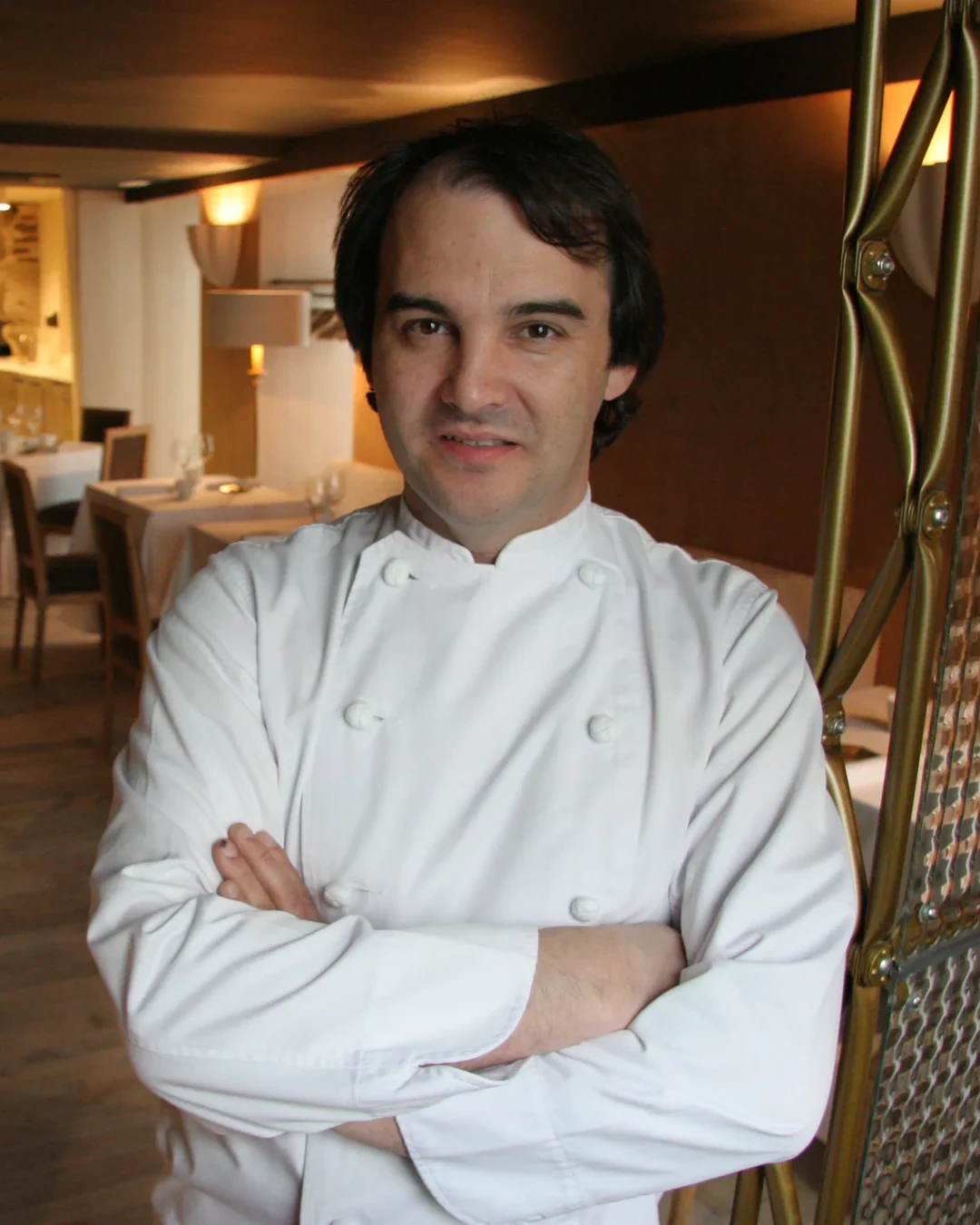
In Santiago de Compostela, Galician raw materials are the ground Marcelo Tejedor works from at Casa Marcelo, the house he founded in 1999 and leads as chef and owner. The language of the kitchen is auteur cuisine, but its grammar stays close to ingredient and touch: octopus, oil, paprika; tomato, cucumber; Galicia brought into contact with other culinary cultures.
The Estate
Casa Marcelo is the fixed point in Tejedor’s career: the Santiago de Compostela address that carries his name, his ownership, and his cooking. He founded it in 1999, and that year the house offered a single tasting menu, described at the time as disruptive. The decision sets the scale of the work. Rather than describe the kitchen through ornament, Tejedor’s own words cut back to material fact: “My philosophy is that things should taste like what they are. I like the cuisine of pulpo á feira: octopus, oil and paprika. Without manipulation.” That sentence gives a useful key to Casa Marcelo. Even where the cooking moves across borders, the raw material remains legible. The kitchen puts Galician ingredients into fusion with elements from Chinese, Peruvian, Japanese and Mexican culinary cultures, a meeting of place and outside influence rather than a masking of either.
In the Cellar
The MICHELIN Guide has awarded one star to Casa Marcelo. For Tejedor, that recognition sits beside a more specific working identity: chef and owner of the Santiago de Compostela house, where auteur cuisine is the stated specialty. The cooking is not presented as Galician cuisine sealed off from the rest of the world. It blends Galician ingredients with international influences such as Chinese, Mexican or Peruvian cuisine, and the broader craft note also names Japanese culinary culture among the elements brought into contact with Galicia. One enduring example is the cherry tomato salad with cucumber. It is described as a classic at Casa Marcelo, with several versions over the years, which suggests a dish treated less as a fixed monument than as a form returned to, adjusted, and kept alive through repetition.
The Bottlings
The 1999 single tasting menu remains one of the clearest markers of Tejedor’s work at Casa Marcelo. It gave the house a defined format from the beginning and was described as disruptive at the time. The cherry tomato salad with cucumber offers a different kind of signature: quieter, more elemental, and tied to the idea that a dish can change version while keeping its identity. In that sense, it sits close to the philosophy Tejedor states around pulpo á feira — food recognizable as itself, handled without unnecessary manipulation. Taken together, the work at Casa Marcelo reads through a small set of precise coordinates: Santiago de Compostela; Galician raw materials; auteur cuisine; a kitchen open to Chinese, Peruvian, Japanese and Mexican references; and one MICHELIN star earned for the house that Tejedor founded in 1999.
FAQ What are Marcelo Tejedor's signature releases or dishes? The cherry tomato salad with cucumber is described as a Casa Marcelo classic with several versions over the years, and the 1999 single tasting menu was described as disruptive at the time. What is Marcelo Tejedor known for making? He is known for auteur cuisine that puts Galician raw materials into fusion with elements from Chinese, Peruvian, Japanese and Mexican culinary cultures. Where does Marcelo Tejedor work? He works as chef and owner at Casa Marcelo in Santiago de Compostela, Spain.