Winemaker
Mathieu Vallée
- Discipline
- Winemaker
i. Biography
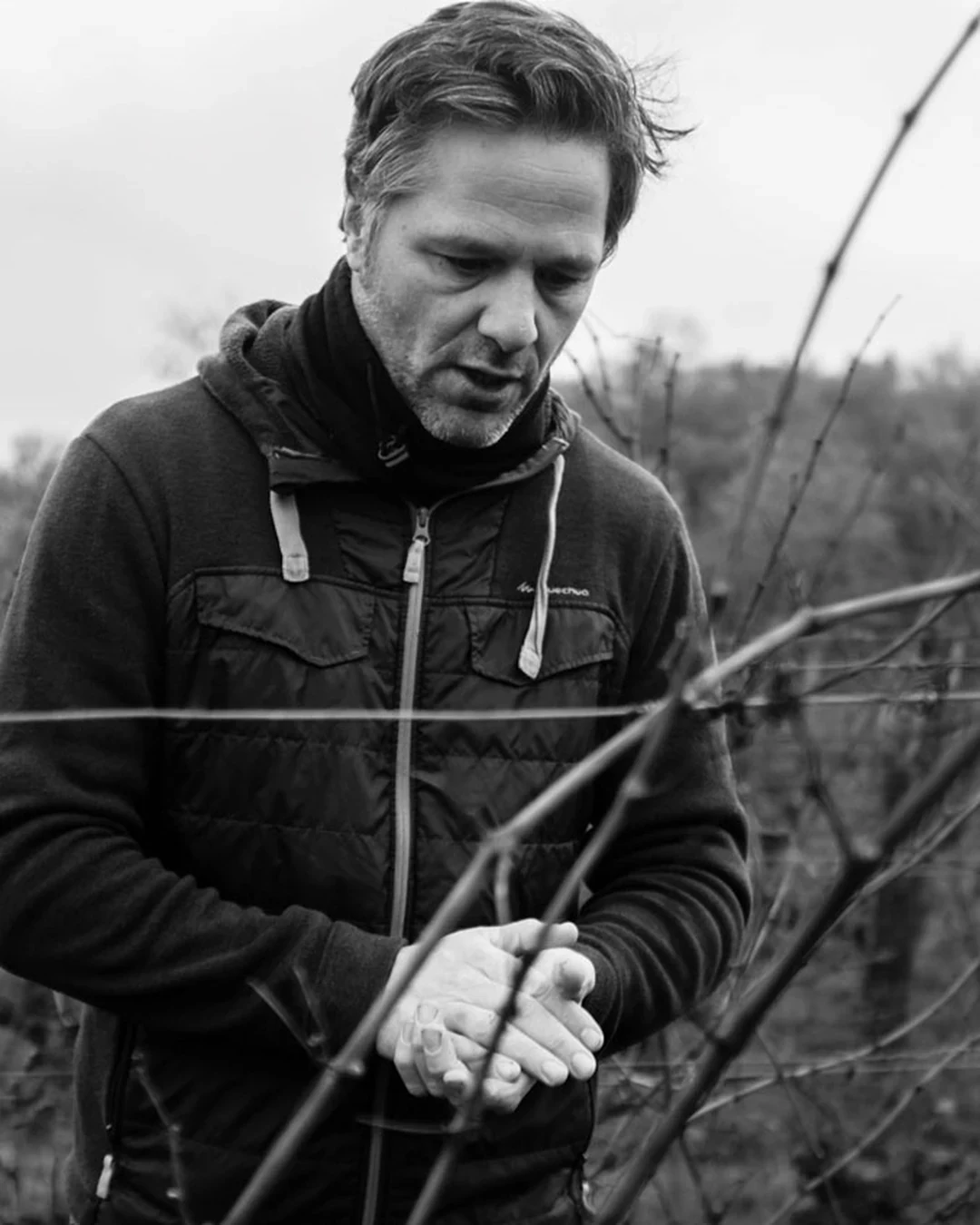
Since taking over Château Yvonne in Parnay, France, in 2007, Mathieu Vallée has worked as its winemaker and owner with a sense of formation rooted in the people who restored the ground before him. He kept the name as a tribute to Yvonne and Jean-François Lamunière, who had recreated the abandoned vineyard, so the work begins with remembrance as much as with farming.
The Training A practical education is written across the vineyard he tends: 11 hectares spread over four villages—Parnay, Turquant, Montsoreau, and Champigny—divided into 27 parcels, with vines aged 20 to 70 years. The soils are clay-limestone over tuffeau, giving the cellar a foundation that starts underground rather than in technique. At the house, farming is organic and biodynamic. Under Vallée, wine quality improved through two linked changes: reducing the use of new oak and converting the farming to biodynamics. That shift gives his tenure a clear before-and-after, not as a break from the place, but as a way of listening more closely to it.
The Lineage The most visible line of influence is the name he chose to preserve. Yvonne and Jean-François Lamunière had already done the rescuing work of bringing an abandoned vineyard back into being; Vallée’s decision to keep the château’s name makes their labor part of every vintage that follows. In the cellar, that lineage becomes restraint. Vinification uses only native yeasts, with no temperature control during fermentation and no additions other than sulfur. Every wine is bottled unfined and unfiltered, a sequence of choices that keeps intervention low from ferment to finish. His vessels are varied but carefully delimited: new and used oak barrels, foudres, Stockinger barrels, large tanks, and concrete all have a role, while he never buys second-hand or used oak. The result is not a single-container doctrine; it is a cellar shaped by selection, patience, and a refusal to cover the vineyard’s voice with unnecessary handling.
The Table La Folie is a red wine made from more than 10 parcels on the colder limestone terroir of Champigny, tying together multiple sites into one expression of cooler ground. Ile Quatre Sous is a Cabernet Franc from sandy soils, made as a soft red that is easy to drink right away. The single-vineyard Chenin Blanc cuvée Le Gory comes from a site described as poised to become a future premier cru of Saumur. Le Beaumeray gives Cabernet Franc the same kind of focused attention, drawn from a single vineyard also described as poised to become a future premier cru of Saumur. Taken together, the wines form a map of parcels, soils, and time: sandy ease, colder limestone tension, and single-vineyard concentration. They also return to the lineage at the center of Vallée’s work, where ownership is not merely possession, but care for a place already given back to life once before.
FAQ What tradition or house shaped Mathieu Vallée? The house is Château Yvonne, whose name he kept as a tribute to Yvonne and Jean-François Lamunière after they recreated the abandoned vineyard.


