Winemaker
Pierre Vincent
- Discipline
- Winemaker
- Based in
- Chassagne-Montrachet, France

i. Biography
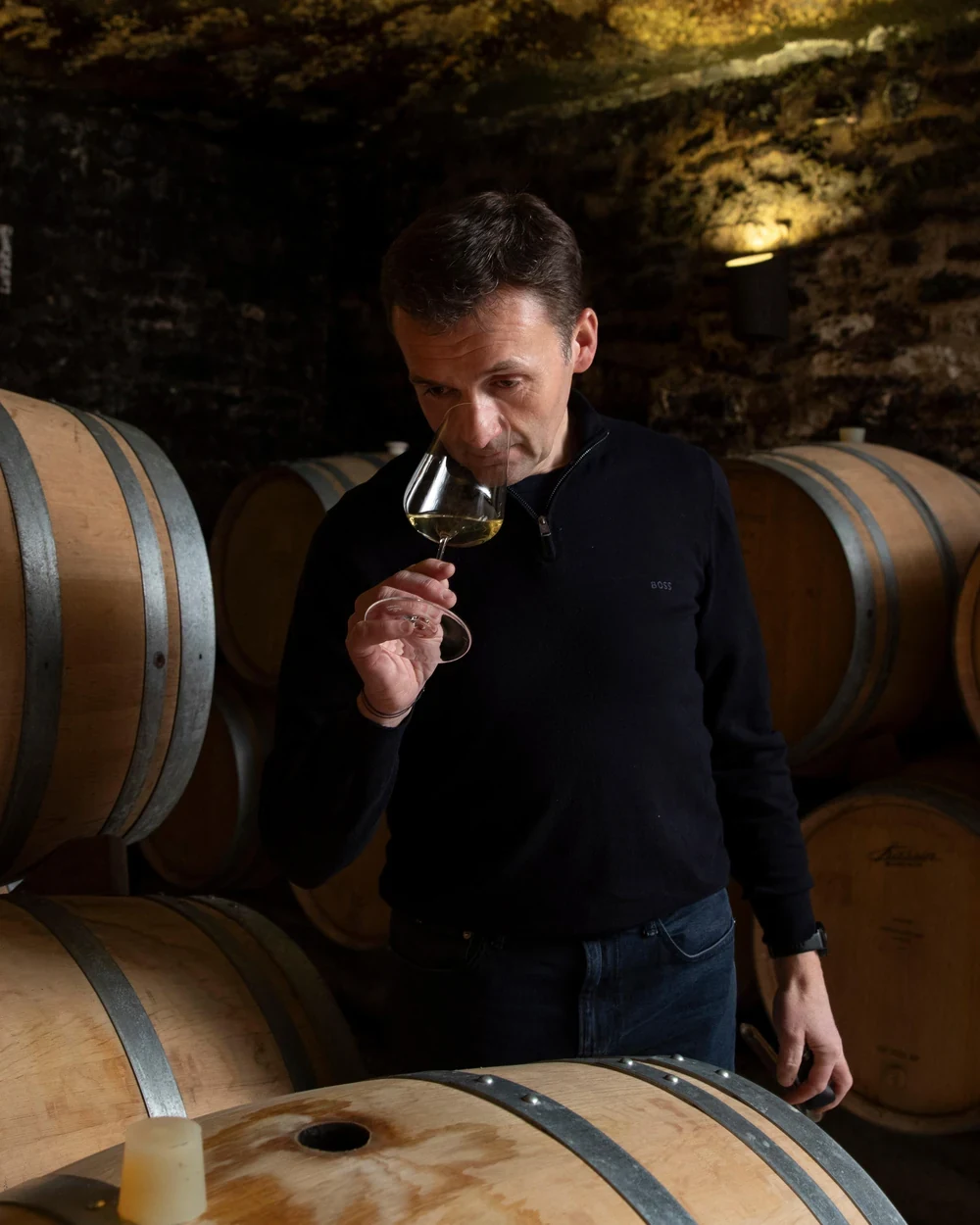
In Auxey-Duresses, Côte de Beaune fruit is being handled by reduction rather than display: fewer new barrels, no artificial additives, long ageing over two winters, and reds drawn with less extraction. In Domaine Pierre Vincent, announced after Pierre Vincent said he would leave Domaine Leflaive at the end of 2024, the working premise is that fruit, acidity, and terroir carry more of the wine when the cellar removes fewer edges. The scale reinforces the method: micro-cuvées of fewer than 900 bottles, built for close reading rather than volume.
The Path
Burgundy training is cumulative work with site, season, and cellar decision-making. Pierre Vincent’s early posts at Antonin Guyon in Savigny-lès-Beaune and Maison Jaffelin in Beaune placed him inside that practical grammar, where nuance is not a style note but the unit of measurement. Technical direction changes the craft brief from execution to architecture. At Domaine de la Vougeraie (2006–2016), Pierre Vincent held that role across the details that shape a wine’s frame; at Domaine Leflaive (2017–2024), as General Manager, the work extended into one of Burgundy’s most exacting white-wine contexts. Domaine Pierre Vincent (since 2023) narrows that experience into a personal project with Côte de Beaune material and a deliberately small cellar footprint.
The Work Today
Small-domain work often begins with sourcing and calibration rather than expansion. Domaine Pierre Vincent was established in 2023 through a partnership with Hervé Kratiroff and Eric Versini in the Côte de Beaune, Burgundy. Its inaugural 2023 vintage was crafted from the former Domaine des Terres de Velle and is presented as promising exceptional quality and collectibility—a first release framed around limited scale and close selection. The cellar position is minimally interventionist, but not passive. No artificial additives, fewer new barrels, long ageing over two winters, and a conservative use of new oak place the emphasis on fruit and terroir rather than cellar imprint. The whites are described as refined and elegant, marked by purity, acidity, and old-vine fruit; the reds are handled with light extraction and little new oak, aiming for a lighter, more elegant register rather than force. The viticultural intent is part of the same control system. The estate is dedicated to biodynamic viticulture principles, observing weather, seasons, and the lunar calendar, and aims for organic certification. Pierre Vincent also intends to convert the vineyards to biodynamic farming, continuing the philosophy he followed at both Domaine de la Vougeraie and Domaine Leflaive. Old-vine material gives the project its clearest technical anchor. Corton-Charlemagne comes from a 50/50 mix of Le Charlemagne vines planted in 1966 and En Charlemagne vines planted in 1947, and is described as fleshy, creamy, mineral, and long. Bourgogne Blanc ‘Pellans’ comes from vines planted in 1955 and is described as pure, supple, and creamy.
In Their Words “I was fascinated by nature—the technique and the analytical side of what my father did—though I did not want to join him in his profession.”
Acclaim
Trade recognition here is tied to red-wine execution rather than general reputation. In 2014, Pierre Vincent was named International Wine Challenge Red Winemaker of the Year for his work at Domaine de la Vougeraie. That sits alongside technical direction at Domaine de la Vougeraie, responsibility for making Domaine Leflaive wines in Puligny-Montrachet, and a personal project in Auxey-Duresses.
Profile updated July 2026
FAQ
Asked of Pierre
What is Pierre Vincent's current role?
Pierre Vincent is pursuing his own project, Domaine Pierre Vincent, after announcing he would leave Domaine Leflaive at the end of 2024.
Where did Pierre Vincent work before?
Earlier in their career, Pierre Vincent worked at Antonin Guyon, Maison Jaffelin, and Domaine de la Vougeraie.
What is Pierre Vincent known for?
At Domaine Pierre Vincent, his whites are described as refined and elegant, with purity, acidity and old-vine fruit; reds use light extraction and little new oak.
Explore
Featured in
In the same rooms
Similar Winemakers