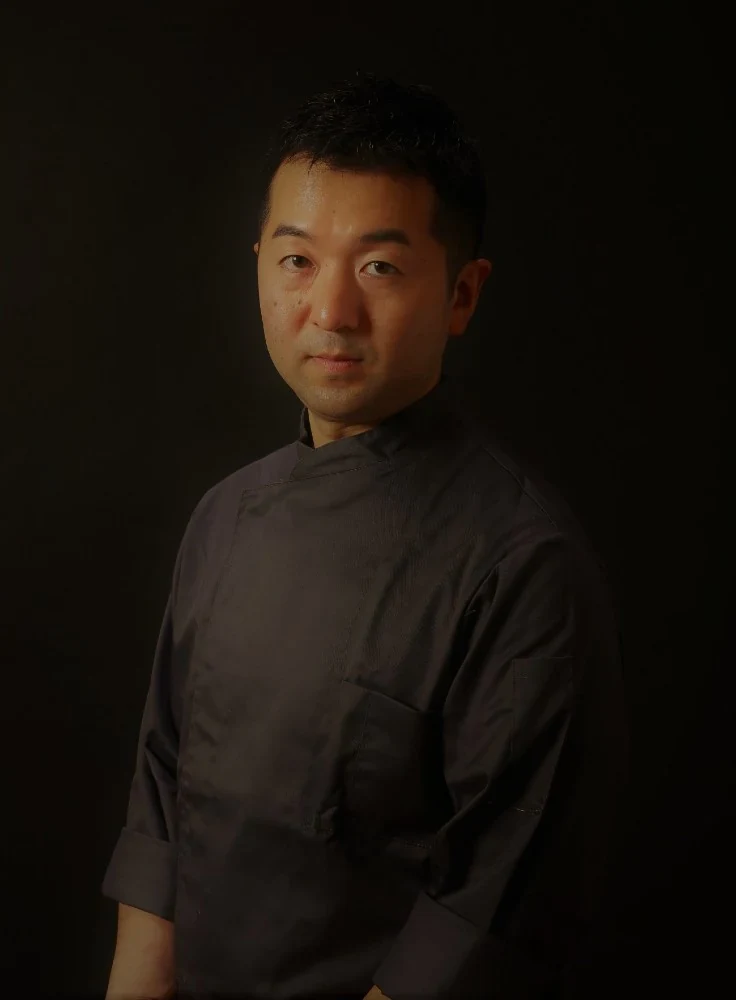
Portrait of Tomoya Kawada
i. Biography
Tomoya Kawada is Executive Chef of Sazenka, where Chinese cooking is practiced through a Japanese frame. Since 2017, he has led a service built on Sichuan cuisine, domestic ingredients, Japanese training, and tea pairings brought together in one structure. His work is defined by a deliberate tension between heat and restraint, aroma and clarity, texture and cadence, seasonality and inherited form. Rather than treating Chinese and Japanese traditions as interchangeable, he uses Japanese cuisine to shape contour, pacing, and treatment while keeping Chinese cuisine as the base. Kawada’s early professional foundation came from Chinese restaurant Abazu Choko, where he worked at the start of his career. He later moved to Japanese restaurant Nihonryori Ryugin, where he encountered a kitchen culture built on discipline, exactness, and careful treatment of domestic ingredients. That experience sharpened his Chinese work rather than replacing it. The passage from Abazu Choko to Nihonryori Ryugin brought Chinese technique and Japanese refinement into contact, and that exchange became central to his approach. Japanese attention to season and purity helped clarify China’s long culinary history, while Sichuan cuisine offered depth, heat, fragrance, and structure that could be expressed with Japanese sensibility. At Sazenka, tea pairings are not decorative additions. They function as part of the meal’s architecture, adding fragrance, temperature, bitterness, lift, and pause. The kitchen’s task is selection and calibration: what to preserve, what to clarify, and where to give each dish space. Kawada’s approach is not a departure from Chinese cuisine but a stricter way of reading it from Japan. Chinese cuisine is honored as the base, and Japanese cuisine is used to refine it. Kawada describes this approach through the idea of Wakon kansai, which means taking the knowledge and techniques of China, with its long and layered history, and refining them through the lens of Japan’s spiritual essence. In practice, the concept keeps the components distinct rather than blending them casually. Kansai refers to Chinese knowledge and technique, while Wakon names the Japanese spirit through which that knowledge is refined. The result is a cuisine that respects Chinese tradition while being shaped by Japanese discipline and clarity. The move into Japanese cuisine was also tied to his need to work with domestic ingredients. He has said that, with that challenge ahead, he realized he needed to learn more about Japanese cuisine if he was to use domestic ingredients. That insight became part of the foundation of his cooking at Sazenka, where balance matters more than compromise and where Chinese cuisine is refracted through Japanese spirit. The combination has given his work a fixed address in Tokyo and a clear identity built on careful reading, precision, and restraint.
The Sunday letter
Read Made By's new profiles every Sunday.
Meet the chefs, winemakers and sommeliers behind the places we cover. See a sample below before you subscribe.
See a sample of the Sunday emailOne email a week. Unsubscribe from any issue.

The Sunday letter
Get the next Made By profile in your inbox.
We send one email every Sunday morning with the people we profiled that week.
See a sample of the Sunday emailOne email a week. Unsubscribe from any issue.