Chef Jacob Lee relaunches Matkim, Sydney's Korean counter
Chef Jacob Lee’s eight-seat Korean counter beneath Salesforce Tower returns under his control, with no written menu for diners.
HM
Director of Editorial Standards
Hugo Marchetti
Filed October 20, 2026
8 min read
At Matkim’s black granite counter beneath Salesforce Tower, chef Jacob Lee relaunched the eight-seat Matkim Sydney restaurant in September 2024 after acquiring the business outright. Every diner sits close enough to see Lee and head chef YG Lee work from the same narrow field of motion: rice lifted from an iron pot, pork finished over binchotan in the dining room, small courses set down with the origin of the dish explained before the first bite.
The restaurant now serves a Korean omakase-style meal. Diners receive drawings of key ingredients at the seat. Matkim means to entrust, or leave it up to you. At Matkim, that trust lands in Korean dishes shaped by season, memory, substitution, and the practical limits of cooking Korean food in Australia.
The Sunday letter
Get our new stories in your inbox every Sunday.
One email with our newest profiles and guides. See a sample before you subscribe.
Eight seats make the restaurant feel like a private counter. At Matkim, eight guests sit along a black granite counter beneath Salesforce Tower, and the whole kitchen becomes visible enough that a pause, a handoff, or a plate leaving the pass reads as part of the meal. In the relaunched room, guests do not choose dishes, Lee explains each course, and the menu moves at the kitchen’s pace.
The first iteration of Matkim opened in early 2024 in collaboration with a larger company. Lee later stepped away from hospitality, then returned when Matkim’s owner offered him the chance to acquire the business outright. The September 2024 relaunch gave him control of the point of view, the menu rhythm, and the presentation of Korean cooking without familiar ordering.
Counter dining compresses the distance between decision and consequence. Lee and YG Lee work beside one another, often without speech, while Lee handles the spoken part of the service before each course. He explains where the dish comes from, why it appears in a certain form, and what part of Korean memory or technique sits behind it. At Matkim Sydney restaurant, Lee and YG Lee prepare each course before Lee explains it.
Chef Jacob Lee’s second pass at control
Jacob Lee Christian Blowes was born on 4 November 1994 and is from the Gold Coast, Queensland. Before Matkim’s counter, he began his music career as a busker in Surfers Paradise, performing on the street for more than four years. In May and June 2014, he appeared as a contestant on the third Australian series of The Voice, where will.i.am coached him.
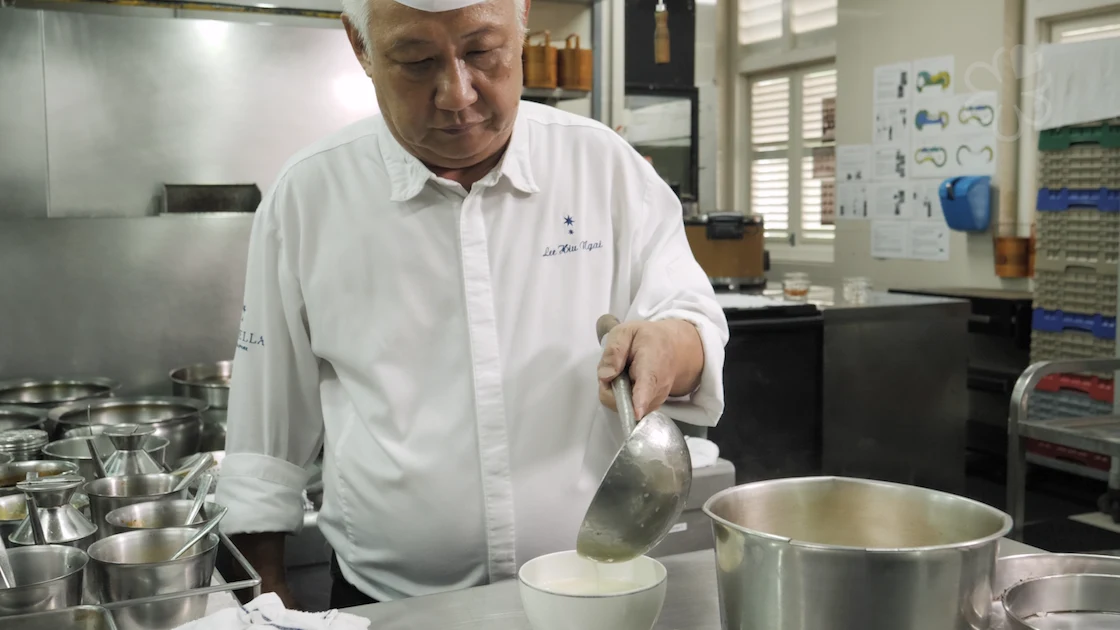
A chef in white uniform working at a counter, using a ladle to prepare a dish in a bowl.
At Matkim, the performance is stripped of amplification. Eight diners watch the hands. A course arrives, and Lee gives the origin: a childhood association, a Korean regional reference, or a practical choice forced by Australian conditions.
In the September 2024 relaunch, he returned as owner-chef after acquiring the business outright. In the early-2024 version, he opened the restaurant through collaboration with a larger company. The relaunch has one counter, one seasonal menu, and one $279 tasting menu excluding drinks.
Head chef YG Lee is central to that method. The service depends on close-range timing, with snacks arriving in succession, broth poured while noodles hold their bounce, pork cuts treated separately, and rice served as a course. In an eight-seat room, the head chef cannot disappear behind the idea of a kitchen brigade. In an eight-seat room, the hands remain in view.
Hyper-seasonal menus: what changes and how often
Matkim changes its menu each season, and the current menu carries the name muje, or untitled. Lee has said he did not want to force a fixed theme onto the food. Lee told The Sydney Morning Herald.1
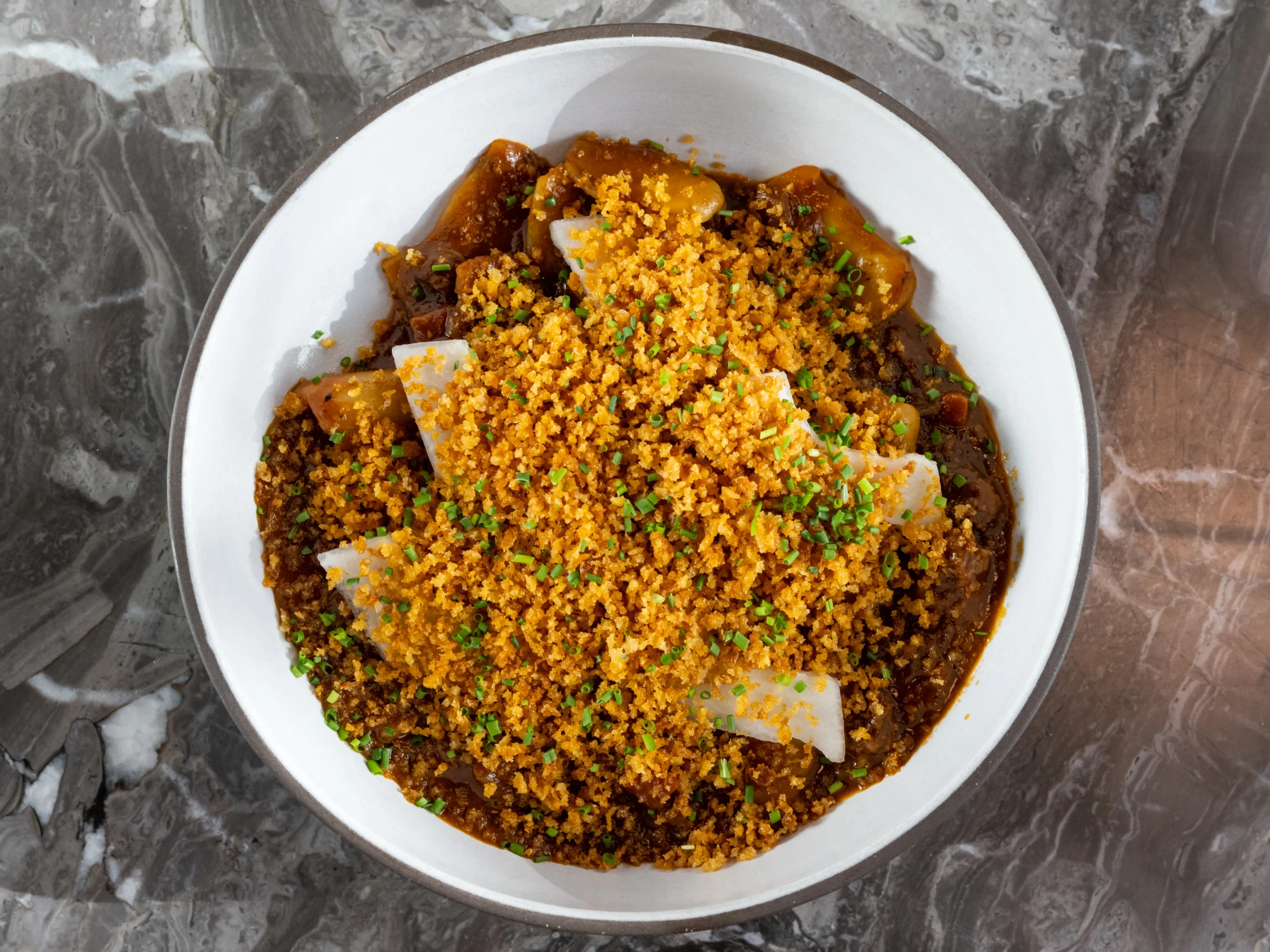
A Korean dish featuring braised meat topped with a golden breadcrumb crust, garnished with green onions and sesame seeds, served in a white bowl.
It changes the actual composition of the evening, and because there are only eight spots available each evening, every seasonal shift affects a small number of diners at close range. A mid-year menu included chestnut tarakjuk, a rice porridge with a soft grain texture, followed by raw otoro and akami tuna with jangajji vinaigrette. A small seaweed cylinder held amaebi prawn from waters around Dokdo in Korea’s far east, with the crisp sheet giving way to raw prawn sweetness.
Another course pulled sujebi into the room. The hand-torn wheat dough pieces, associated with Korean meals made to fill the stomach during periods of scarcity in the 1960s and 1970s, appeared in clam broth. Lee’s version used potato and glutinous rice flours to make the noodles softer and bouncier. The broth carried clam and anchovy depth; spoonfuls moved between prawn, whelk, noodle, and stock.
The new muje menu moves the Matkim Sydney restaurant into another set of ingredients. Marinated crab and abalone appear, with the abalone used in a classic naengchae, a cold summer salad. Lee’s snack version of bibimbap incorporates trevally, mumallaengi (dried radish), and perilla oil. Dessert moves toward mugwort and white chocolate ice-cream with roasted buckwheat cream and perilla leaf.
What relinquishing control means at the counter
Matkim’s no-choice format leaves diners without choosing the protein, steering toward a safe dish, or reading ahead for the course they expect to like most. The only map is visual. Diners receive drawings of key ingredients, and Lee explains the menu course by course.
A palate cleanser of fermented apple sorbet with Jeju green mandarin and shiso granita resets the mouth before pork. The pork course uses Bangalow pork because Australian quarantine restrictions prevent Lee from importing Jeju black pig. He buys whole rib sections, breaks them down in-house, and dry ages them for over a week to develop flavour.
The pork arrives as loin, rump, and belly, with the cuts cooked at different temperatures and finished over binchotan in the dining room. Lee serves them with myeolchi-jeot, a fermented anchovy sauce, plus onion and perilla leaf puree. Each piece asks for a different treatment before meeting the same charcoal finish, and diners see that final pass from the counter.
Matkim uses Haenaru rice from Dangjin in Chungcheongnam-do on Korea’s west coast, cooked in an iron pot. The choice of grain carries technique and origin into the middle of the menu. In a restaurant where the diner has surrendered ordering control, plain rice becomes one of the clearest signals of the kitchen’s priorities: source, vessel, heat, timing.
Korean sourcing under Australian limits
Lee’s cooking at Matkim often begins with Korean reference points, then meets Australian restriction and supply. The Bangalow pork stands in because Jeju black pig cannot be imported under Australian quarantine rules. Lee identifies Bangalow pork as the substitute. Lee builds the dish around the pork he can buy, then uses breakdown, dry ageing, different cooking temperatures, and binchotan finishing to bring the course into Matkim’s Korean frame.
The same frame appears in the seafood. Amaebi prawn from waters around Dokdo appears inside a Korean seaweed cylinder. Raw tuna arrives as otoro and akami, set against jangajji vinaigrette. Clam broth takes anchovy depth and sujebi memory into the same bowl.
Desserts give Lee room to push further without leaving the Korean pantry. Black garlic sponge cake appears with ice-cream made from jigemi, the lees left from makgeolli rice wine, and sweet potato ganache. Ssiat hotteok, the Busan street-food pancake filled with brown sugar and nuts, becomes a tarte tatin with Korean ginseng and whisky-barrel-aged maple syrup. The desserts turn Korean reference, memory, and technique into new forms.
The drinks list sits in the same orbit. Matkim offers Japanese sakes alongside Korean makgeolli, cheongju, and soju. The tasting menu costs $279 per person, excluding drinks, so the drinking decision becomes the main choice left to the guest once the food is entrusted to the kitchen.
Location, booking, and what to watch next
Matkim sits beneath Salesforce Tower in Sydney ’s CBD, a location that places an eight-seat Korean counter in the middle of a district often associated with corporate dining and fast movement between meetings. With only eight spots available each evening, the booking pressure follows from arithmetic. There are simply not many seats to sell.
The Matkim Sydney restaurant now turns on Lee’s ownership and the discipline of a room small enough for every plate to be seen leaving the pass. Muje will change with the season at the eight-seat.
The Sunday letter
Get the next Made By guide in your inbox.
We send one email every Sunday morning with the guides and profiles we published that week.