The Stefano Bemer atelier still builds shoes by hand at the bench, carrying on the house founded by the late Florentine shoemaker Stefano Bemer. At Scuola del Cuoio, apprentices in their first season work leather at long tables inside a former Franciscan dormitory, visible through glass to anyone who walks through the Santa Croce sacristy. At Liverano & Liverano on Via dei Fossi, Antonio Liverano can be found at the cutting table six days a week,1 measuring a client's shoulder drop with a cloth tape before a word is spoken about cloth. These three workshops sit within a twenty-minute walk of each other in central Florence, and the access question for each is different: one is essentially open, one requires a commission, and one sits somewhere between the two.
The short answer: Scuola del Cuoio is the most accessible, with a free-entry workshop floor and an adjacent shop open most days. Stefano Bemer requires a bespoke commission to see the bench properly, with lead times and costs that are unpublished and must be confirmed directly with the atelier. Liverano & Liverano operates by appointment for bespoke clients; the shop floor is open to browsers, but the real work happens behind a consultation.
Inside the Three Workshops: What the Rooms Are Actually Like
Scuola del Cuoio: the dormitory floor
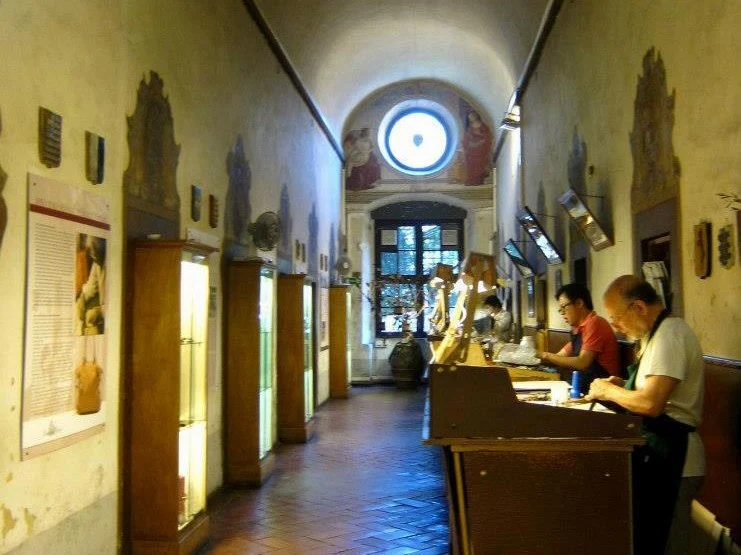
The Scuola del Cuoio occupies a wing of the Basilica di Santa Croce complex. The school was founded in 1950 by the Franciscan friars of Santa Croce together with the Gori and Casini families. Clients and visitors can watch artisans create leather goods on-site,2 at long benches under high windows, the smell of vegetable-tanned leather arriving before you reach the door. The school trains students in Florentine leather technique, and the production floor doubles as a retail space where finished bags, wallets, and belts are sold directly. The school is typically open Monday through Saturday, 10am to 5pm, closed Sundays and holidays;3 confirm current hours before planning around a specific day, as hours vary by season. Entry through the basilica's side entrance on Via San Giuseppe is free; the shop is open to walk-ins. The crowd on any given morning is a mix of tourists who have read a single guidebook entry and working craftspeople who have come specifically to watch the cutting technique. The floor is large enough that the work continues regardless of who is watching. A fully handmade bag can take up to five months to complete,4 which gives some measure of the pace at which the benches operate. Finished pieces are also sold online and at the Four Seasons Hotel in Florence,5 but the production floor is the place to see the work in progress.
Stefano Bemer: the bench by appointment
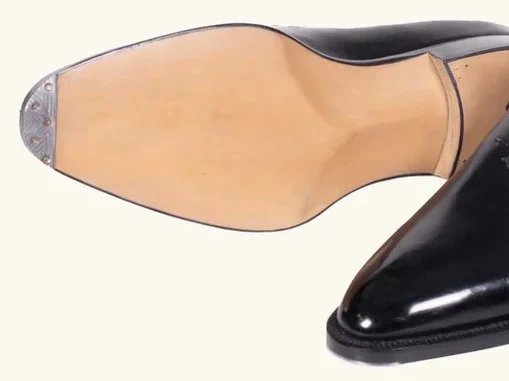
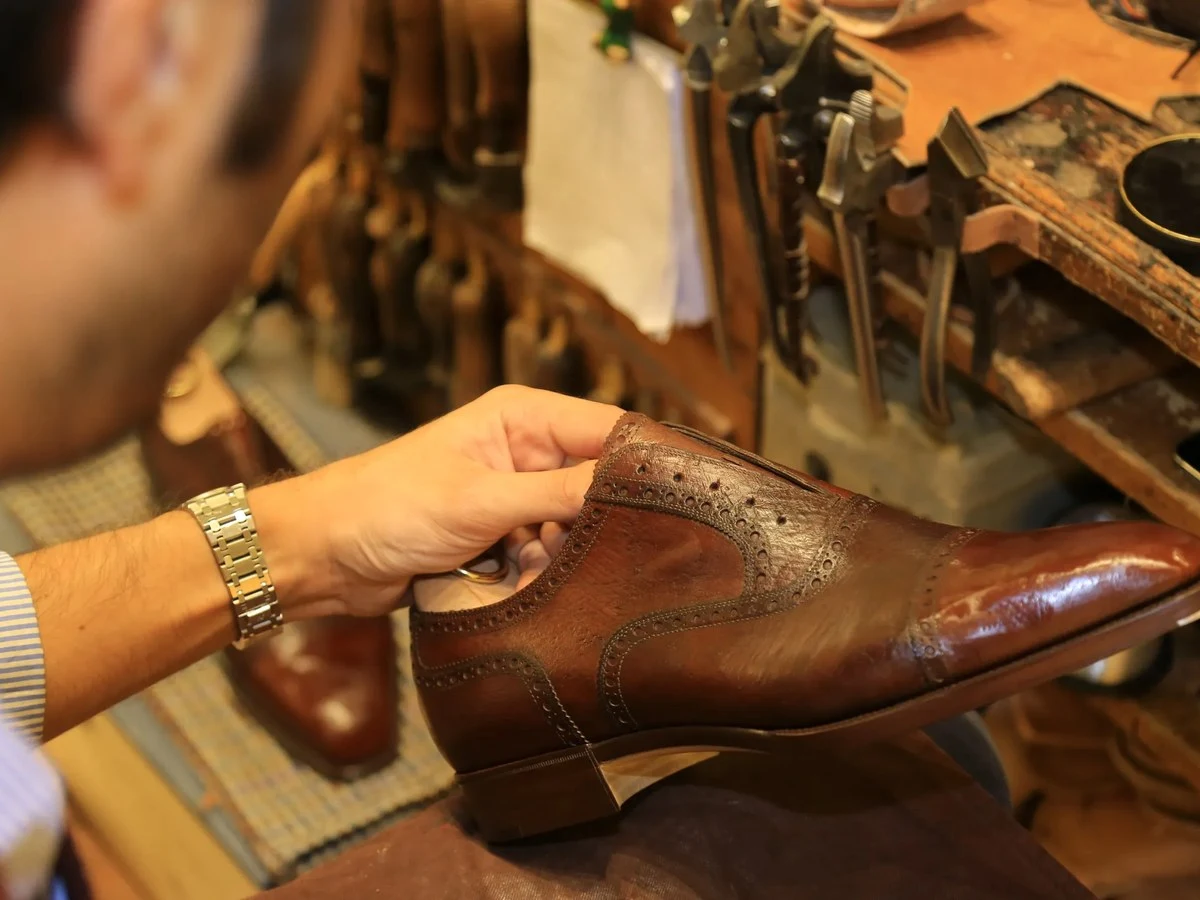
The Stefano Bemer atelier is located at Via di S. Niccolò, 2, in Florence,6 where the atelier's team builds shoes by hand using the Goodyear welt and bespoke hand-welted methods the house developed over decades. The workshop is not a public space. Clients who commission bespoke shoes are invited in for fittings and last consultations; the bench itself, where lasting and welting happen, is not a viewing gallery. What you see during a commission visit is the last room, the leather selection, and the fitting process. The atelier does not publish lead times or pricing for bespoke commissions on its website; the reliable route is to contact the atelier directly at its Florence address or through its published contact channels to open a conversation. The house also maintains a New York location at 475 Park Ave, Ground Floor,6 which is a useful point of contact for clients based in North America. The Florence atelier also hosts tailor Sartoria Vestrucci on its second floor,7 which means a single visit can cover both disciplines if the timing aligns.
Liverano & Liverano: the cutting table
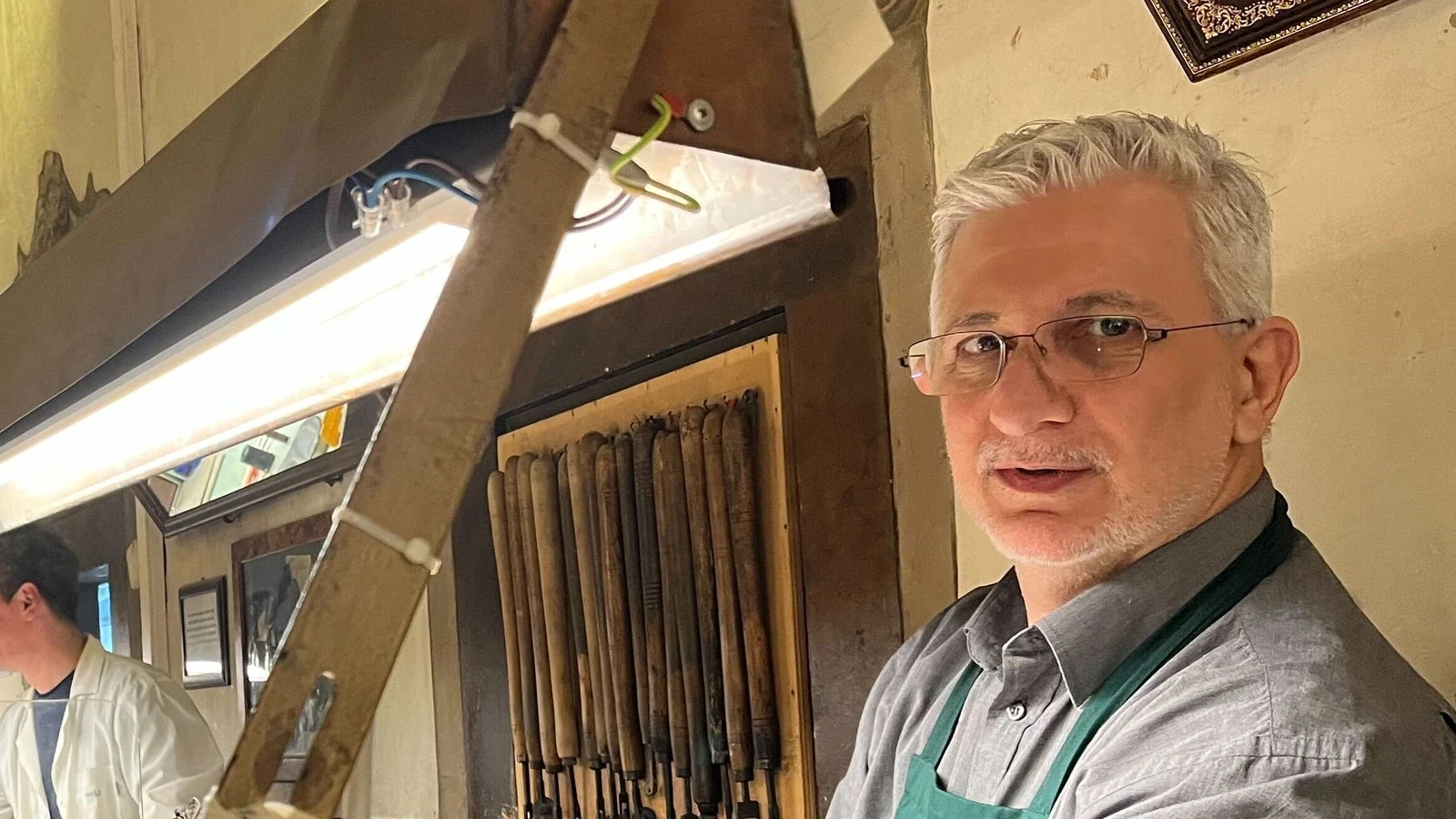
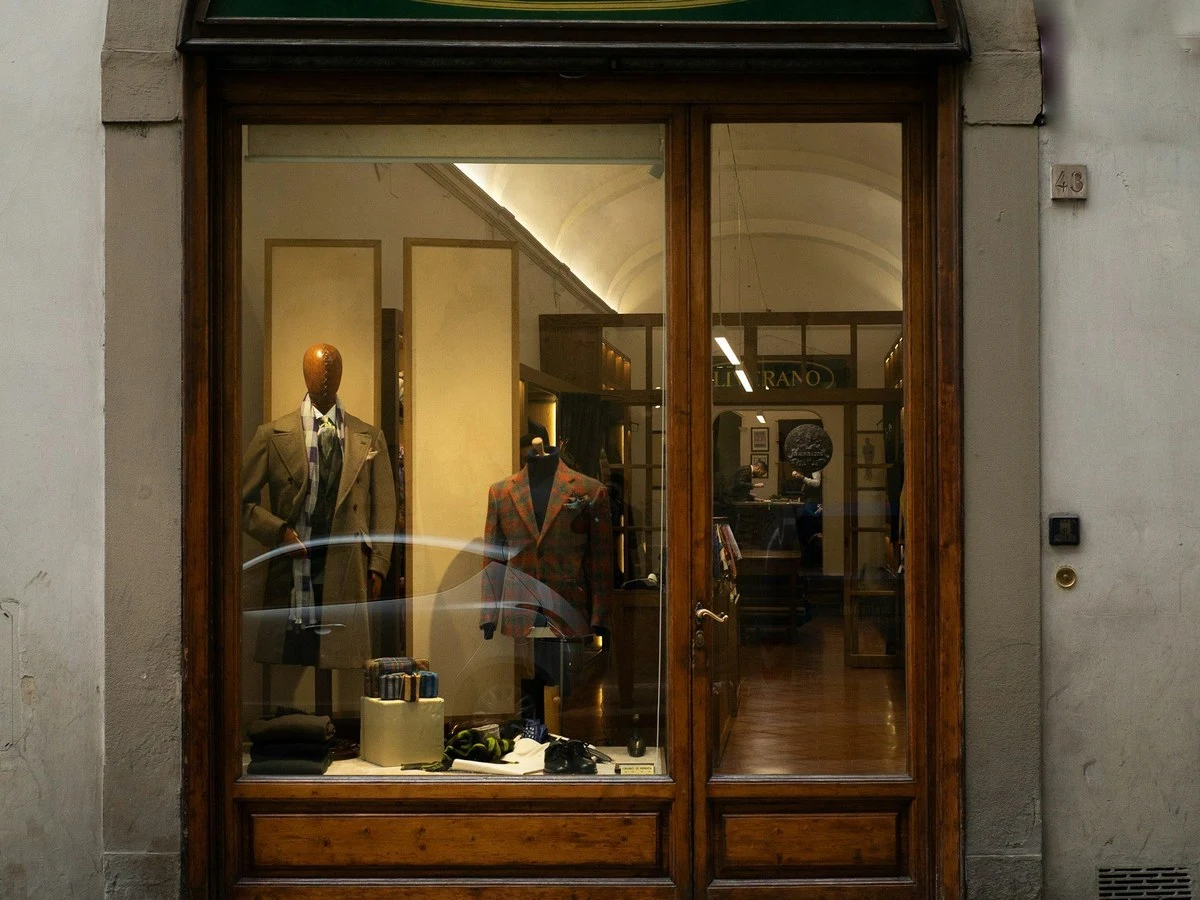
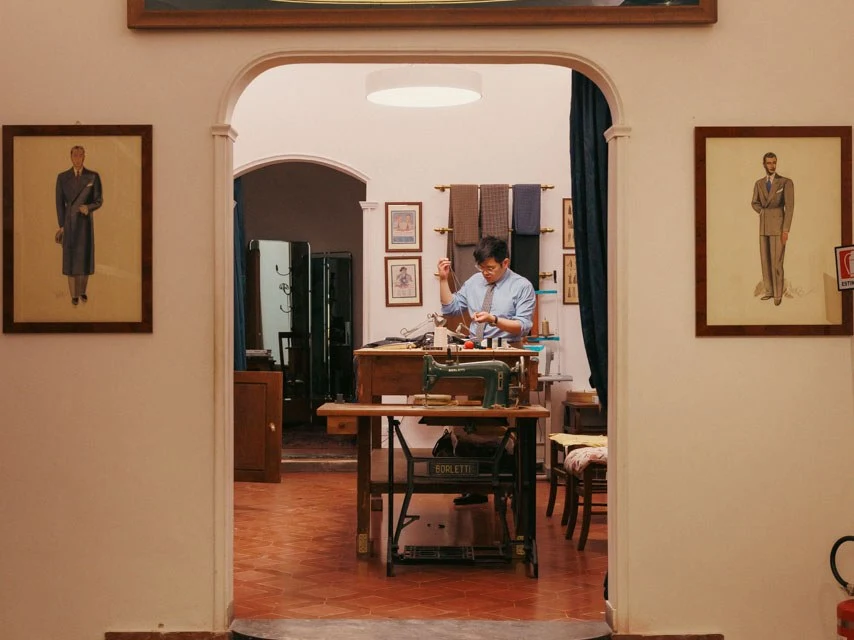
The atelier is located at Via Dei Fossi, 43/R, Florence,8 with a street-level shop where cloth bundles are stacked and a few finished garments hang; this is open to visitors without an appointment. The house is open Monday 15:00 to 19:00 and Tuesday through Saturday 10:00 to 13:00 and 14:00 to 19:00.8 The bespoke consultation, where a cutter takes measurements and discusses cloth, requires an appointment. The cutting table, where a coat front is laid out and the chalk line drawn freehand, is the heart of the house and is not a public spectacle. The house has a team member specifically appointed to deal with overseas clients,1 which makes the initial approach more direct for those travelling from outside Italy. The atelier does not publish lead times or pricing publicly; these must be confirmed directly with the house.
Why Getting to the Bench at Any of These Three Takes More Than a Walk-In
The Scuola del Cuoio is the exception: the workshop floor is genuinely open, and the access barrier is only the entry to the Santa Croce complex. The other two houses operate on the logic of the bespoke atelier, where the bench is not a destination but a consequence of a commission. Stefano Bemer and Liverano & Liverano are not workshops that sell access to their process; they sell the object the process produces. The consultation, the fitting, the selection of last or cloth, these are the moments of proximity to the work, and they are earned by commissioning.
The demand side is real. Both houses have international client lists, and both are known to practitioners in their respective disciplines well beyond Florence. A bespoke shoe commission or a coat from Liverano is not a fast transaction; the work takes time, and the makers' time is finite. Walk-in access to the bench is not the model, and it is not going to become the model.
When the Books Are Open and How to Find Out
Scuola del Cuoio does not require advance booking for a visit to the workshop floor and shop. The access question is simply whether the basilica complex is open on the day you arrive. Confirm current hours directly with the school before planning around a specific day.
For Stefano Bemer and Liverano & Liverano, neither house publishes a public booking calendar or a stated waitlist policy. The reliable route for both is direct contact: email or telephone the atelier to ask whether the books are open for new bespoke clients and what the current lead time looks like. Liverano & Liverano also conducts trunk shows in New York, with Antonio Liverano travelling with the team,9 which offers an alternative first point of contact for clients who cannot immediately travel to Florence. Neither house publishes lead-time figures; contact the ateliers directly.
The Channels That Actually Work
For Scuola del Cuoio, the school's own website is the right starting point for hours and directions. No third-party booking platform is involved.
For Stefano Bemer, the atelier's published contact page is the correct first move. The house does not use a third-party reservation system for bespoke consultations. A direct email stating your interest in a bespoke commission, your location, and your availability for a Florence visit is the standard opening.
For Liverano & Liverano, the same logic applies. The house can be reached by phone at +390552396436 or by email at info@liverano.com.8 There is no waitlist signup page, no allocation drop, no third-party channel that improves your odds.
Money versus time at each house
At Scuola del Cuoio, the cost of access is zero; the shop sells finished pieces at prices that reflect student and artisan production, generally lower than the bespoke ateliers. The tradeoff is that you are buying from a school's production floor, not from a single maker's bench.
At Stefano Bemer and Liverano & Liverano, the commission is the access. Neither house publishes pricing; both are understood within their respective disciplines to sit at the upper end of their craft's cost range. The time investment is also real: a bespoke commission at a house of this calibre typically involves multiple visits to Florence, or a combination of a Florence fitting and correspondence fittings if you are not based in Italy. The atelier will advise on the process when you make contact. There is no faster route that bypasses the fitting process; the work requires the fittings.
How to Improve Your Odds at Each House
For Scuola del Cuoio, arrive early in the morning on a weekday. The floor is active, the light is better, and the tourist volume is lower than in the afternoon. If you want to speak with an instructor or senior artisan rather than a shop assistant, a weekday morning is the window.
For Stefano Bemer and Liverano & Liverano, the strategy is the same for both: make contact well before your Florence trip, not after you arrive. Both houses work with international clients who plan visits around fittings; arriving in Florence and then calling is the approach that produces the most disappointment. If you are serious about a commission, open the conversation several months before your intended visit. Neither house has published a stated lead time, so treat any estimate as a floor, not a ceiling.
A letter of introduction that demonstrates knowledge of the house's method is not required but is noticed. These are makers who have spent careers in their discipline; a client who has done the reading is a different conversation than one who has not.
Who Should Make the Trip and When
Scuola del Cuoio is worth an hour for anyone with a working interest in leather technique, regardless of whether they intend to buy. The floor is a functioning school, and watching a student skive a gusset edge is a different education than reading about it.
Stefano Bemer is for the person who has already decided they want a hand-welted shoe built on a custom last and is prepared to invest accordingly in both money and time. Liverano & Liverano is for the person who has a specific garment in mind and is prepared to return to Florence for fittings. The shop floor is worth a visit for anyone interested in cloth selection, but the work itself is behind the consultation.
All three are best visited in spring or autumn, when Florence is cooler and the workshops are in full production. August is the wrong month; the city empties and the ateliers often close for part of the month.
If the Books Are Closed: Alternatives in the Same Tradition
Florence Craft Access: Three Houses and Their Alternatives
| House | Access difficulty | How to book | Lead time | Cost range |
|---|---|---|---|---|
| Scuola del Cuoio | Open / walk-in | No booking required | None for visit; up to five months for a handmade bag | Shop prices; entry free |
| Stefano Bemer | Commission required | Direct contact with atelier | Unpublished; contact directly | Unpublished; contact directly |
| Liverano & Liverano | Consultation by appointment | Direct contact with house | Unpublished; contact directly | Unpublished; contact directly |
| Mannina (Florence, shoes) | Shop open; bespoke by appointment | Direct contact | N/A | N/A |
| Sartoria Vanni (Florence, tailoring) | By appointment | Direct contact | N/A | N/A |
If Stefano Bemer's books are closed or the lead time does not fit your timeline, other Florentine cordwainers working in the hand-welted tradition include Mannina on Via de' Guicciardini, a house with a longer retail history and a more accessible entry point for a first commission. For tailoring in the Florentine tradition, Sartoria Vanni and several smaller houses in the Oltrarno work in a similar soft-shoulder discipline; direct contact with each is the route.
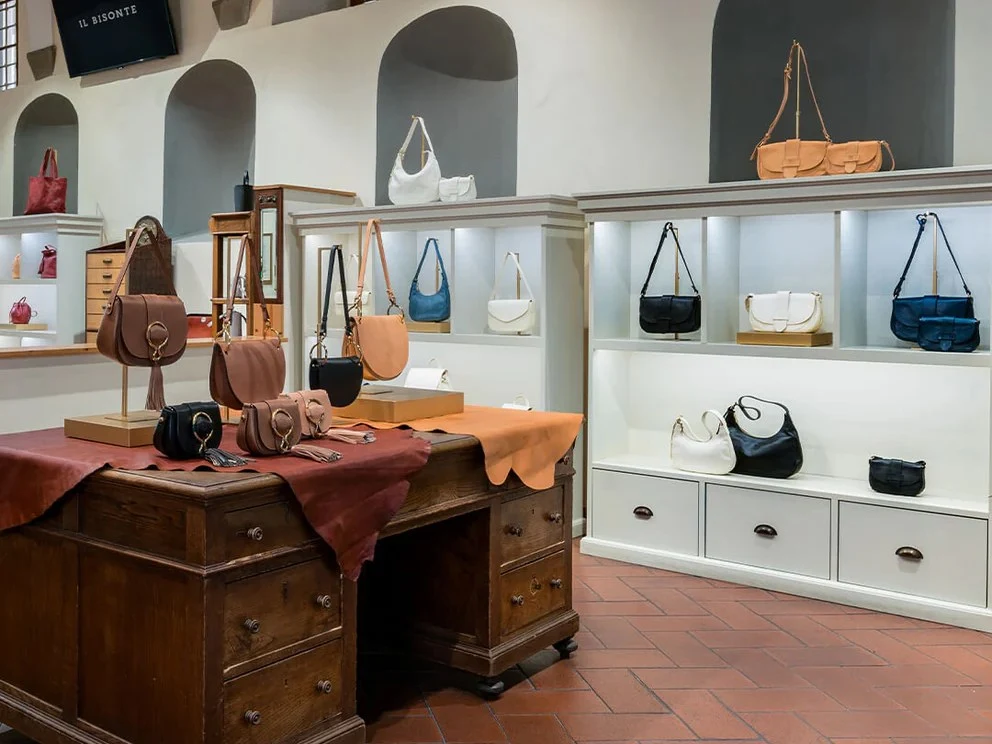
For leather goods rather than shoes, the Oltrarno neighbourhood holds a concentration of small leather workshops, several of which offer bench visits or short courses. Il Bisonte appears consistently in the same conversation as Scuola del Cuoio for accessible, production-floor leather work.
The Verdict: Three Doors, Three Different Keys
Florence's craft quarter is not a theme park, and these three houses are not interchangeable. Scuola del Cuoio is the one you walk into; the floor is open, the work is visible, and the shop sells the output of that work at prices that reflect a school's production rather than a single maker's name. Go on a weekday morning and stay long enough to watch a full cutting sequence.
Stefano Bemer and Liverano & Liverano are different propositions. The bench at each is not a viewing gallery; it is the consequence of a commission. If you are not prepared to commission, the shop floor at Liverano is worth a visit for the cloth alone, and the Bemer atelier's finished shoes can be seen in the shop. But the work, the lasting, the cutting, the fitting, happens behind a conversation that begins with a direct approach to the house, months before you arrive in Florence.
The allocation list, the waitlist, the drop time: none of these apply here. The route is a letter, a telephone call, and a willingness to return to Florence more than once. For the person who has decided the work is worth it, that is not a barrier; it is the beginning of the process. The houses worth following in Florence are at these benches, and the discipline required to reach them is, in its own way, a measure of the work itself.
Frequently Asked Questions
Can you walk into Scuola del Cuoio without a reservation and watch the leather work in progress?Yes. The Scuola del Cuoio workshop floor and shop are open to visitors without advance booking, accessible through the Santa Croce complex on Via San Giuseppe. The school is typically open Monday through Saturday, 10am to 5pm, closed Sundays and holidays; confirm current hours directly with the school before your visit, as hours vary by season.
How do you start a bespoke shoe commission at Stefano Bemer's Florence atelier?Contact the atelier directly, by email or telephone, at their Via di S. Niccolò address in Florence. The house does not use a third-party booking platform for bespoke consultations. State your interest in a commission, your location, and your availability for a Florence visit. Lead times and pricing are not published; the atelier will advise when you make contact. A New York location at 475 Park Ave is also available for clients based in North America.
Does Liverano & Liverano on Via dei Fossi accept walk-in visits, or is everything by appointment?The street-level shop on Via dei Fossi is open to visitors without an appointment, and cloth can be viewed there. A bespoke consultation, where measurements are taken and the commission process begins, requires an appointment made directly with the house by phone at +390552396436 or by email at info@liverano.com. The cutting table and fitting room are not public spaces.
What is the best time of year to visit all three Florence craft houses in one trip?Spring (April to early June) and autumn (September to October) are the most reliable windows. August is the wrong month: Florence is hot, tourist volume is at its peak, and both Stefano Bemer and Liverano & Liverano may close for part of the month. Confirm August availability directly with each house before planning around it.
Are there leather workshops in Florence where you can take a short course rather than commission a full piece from Scuola del Cuoio?Scuola del Cuoio offers courses in Florentine leather technique; check the school's website for current programme details. Several smaller Oltrarno workshops also offer half-day and full-day bench sessions. These are a different proposition from a bespoke commission at Stefano Bemer, but they are the right entry point for someone who wants time on the tools before committing to a full commission.