Angelo Gaja took the Barbaresco name to Bolgheri in 1996. Gaia Gaja now reads Ca’Marcanda through fruit, soil and heat.
HM
Director of Editorial Standards
Hugo Marchetti
Filed July 28, 2026
10 min read
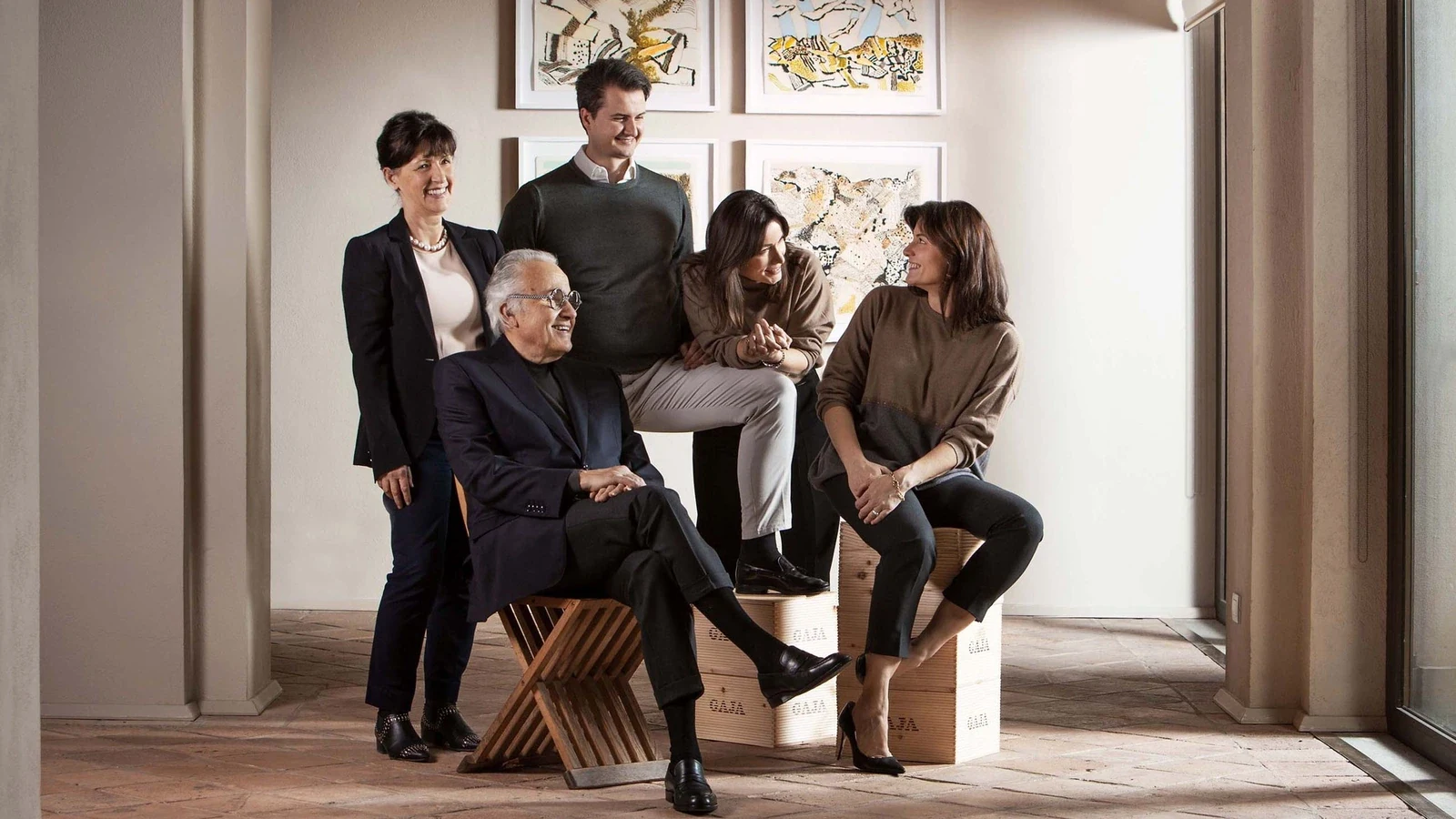
Each week at Ca’Marcanda, three fifth-generation Gaja siblings sit with the winemaker, taste the lots, and make the next set of decisions. Angelo Gaja began the Bolgheri project in 1996, and he remains involved in key viticultural decisions. The estate’s rhythm is practical: glass, vineyard, correction, return.
The names in the room matter. Angelo Gaja is tied to the family’s rise in Barbaresco. Gaia Gaja, his daughter and one of the fifth generation, has given the clearest language to the freedom the coast offered. Since 2012, the siblings have carried the weekly tasting work with the winemaker. Not legacy as a speech. Repetition at the bench.
The Sunday letter
Get our new stories in your inbox every Sunday.
One email with our newest profiles and guides. See a sample before you subscribe.
Gaia Gaja has said the family arrived “10 years later” than the key names of the historic Super Tuscan movement of the 1980s. Grattamacco, Guado al Tasso and Ornellaia had already taught drinkers to take coastal Tuscany seriously for wines outside the older Tuscan script. Ca’Marcanda was not the first proof of Bolgheri’s possibility. It had to become the Gaja family’s own test of what freedom could do under sustained discipline.
The Gaja Ca’Marcanda Story Begins in Bolgheri, presented with a vibrant red ribbon and bow.
The family’s center of gravity remains tied to Piedmont, especially Barbaresco, Barolo and Alta Langa. The map has widened. The Gaja estates now span three regions of Italy: Piedmont, Tuscany and Sicily. In Tuscany, the family works at Ca’Marcanda in Bolgheri and Pieve Santa Restituta in Montalcino. In Sicily, Idda places the family on Etna. Each property asks for a separate reading of grape, soil, exposure and local habit.
“Stylistically there were no preconceptions; it’s the new world of Italy”
Gaia Gaja
That sentence explains the attraction without turning the coast into empty ground. Bolgheri had neighbors, precedent and a growing language. It also allowed fewer preconceptions than Piedmont, where family, village and grape variety carry heavier inheritance.
Gaia Gaja and the Philosophy of Doing
Gaia Gaja’s account of Ca’Marcanda begins with doing. Not theory first, not a family name placed on the coast, not a finished estate handed down as an object. She speaks of the property as a place where she learned through experiments, where knowledge came from contact with the raw material.
Promis, a Toscana wine from Ca'Marcanda, features the producer's distinctive geometric label design in blue and white.
“Here I grew a lot thanks to the experiments at Ca’Marcanda… It is a philosophy of doing, of being hands-on”
Gaia Gaja
The sentence refuses to treat inheritance as a passive condition. Ca’Marcanda became a station for learning, with vintage variation as teacher and blending as one of the tools.
Gaia Gaja also sharpens the family’s use of Italianity. Her point is not that Italian wine must mean native grapes only. The Italian character comes through fruit, territory and the handling of the raw material. She has framed complexity as something different from complication. The distinction holds at the bench. A wine can carry many inputs and still speak clearly; it can also pile on technique until the site disappears.
A Barbaresco family farming in Bolgheri risks being read as either betrayal or imitation. The estate’s answer has stayed practical. Taste the lots. Read the heat. Change the training. Adjust the blend.
Four Labels, 120 Hectares and a Flagship
Ca’Marcanda is a 120-hectare estate focused on four labels: Promis, Magari, Camarcanda and Vistamare. Three are reds. Vistamare is the white blend. The frame gives the estate room to sort material and intention across a range rather than asking one wine to carry the whole argument.
Two bottles of Ca'Marcanda wines from 2015: Promis from Toscana and Magari from Bolgheri, both produced by Gaja.
The red program brings Cabernet Sauvignon, Cabernet Franc, Merlot, Petit Verdot and Syrah into the foreground, with Sangiovese also in the picture. The varieties tell one part of the story. The plots tell another.
Bolgheri’s landscape includes soils described from sandy to clay-driven and mineral-rich, shaped in part by the influence of the Metalliferous Hills. The area was once tied to copper, iron, marble and limestone mines. Recent zoning studies have identified around 27 different soil types in Bolgheri.
Camarcanda is the estate’s flagship wine, drawn from some of Ca’Marcanda’s best plots. Today it is Cabernet Sauvignon-driven, with Cabernet Franc alongside it. Merlot featured in the past. That shift gives collectors and cellar workers a clear way to read the estate’s evolution: through grape composition, vintage heat, fruit profile and the estate’s increasing confidence in Cabernet Franc as a partner to Cabernet Sauvignon.
Camarcanda in the Glass, 2000 to 2023
The anniversary tasting spanning 2000 to 2023 gives Ca’Marcanda a time axis. The 2000 Camarcanda still carried the warm character of that vintage 26 years on, with saline freshness and tertiary notes in the foreground. Warmth held against salt and age; coastal Tuscany can speak in that register without leaning on comparison to another place.
The 2007 Camarcanda still showed fruit with age, and the Merlot dominance in the blend came through in blueberry and toffeed mocha notes. A cellar vertical preserves choices as clearly as weather. The wine keeps the evidence.
By 2016, Camarcanda moved toward savoury freshness, a greener edge, blood orange, pomelo grapefruit, rosemary, clove and fresh red fruit. The 2020 brought sweet cherries, Mediterranean scrub, lavender, rosemary, pine and marine gorse, with chalky, moreish tannins and tertiary tones. The 2021 carried dried cherry and sous bois in a period after Merlot had been omitted from Camarcanda since the hot 2015 vintage. The 2023 showed a supple, medium-bodied frame, silky tannins, lavender, iris and crunchy red cranberry fruit.
Those six wines trace age, heat, herbal register, tannin and blend composition. For collectors, the lesson is not a single preferred vintage. It is the change in the method: Camarcanda began with Merlot in the mix and now stands as a Cabernet Sauvignon-driven wine with Cabernet Franc.
Smart Bugs, Guyot and the Farming of Heat
Climate change was already front of mind in Angelo Gaja’s choices at Ca’Marcanda. From the outset, he collaborated with university professors, entomologists, botanists and geologists. That belonged to the estate’s method: Bolgheri as a place to observe, test and alter practice under changing conditions.
The clearest example is Ca’Marcanda’s work with Professor Andrea Lucchi from the University of Pisa on insect-behaviour research. That study led to the development of smart bugs for vineyard pest control. The approach began with Ca’Marcanda and now extends to around 120 other producers.
The estate also uses mixed agriculture, composting and cover crops to encourage biodiversity and healthy soils. The mixed farming includes olives, cereals and woodland. The cover crops include mustard, vetch and clover. These are vineyard tools, part of how a team tries to keep soils alive, reduce fragility and build resilience into the farm before the fruit reaches the cellar.
Training and planting decisions have changed as well. Ca’Marcanda is shifting from cordon training to Guyot, in part to address vineyard diseases such as esca. More vigorous rootstocks are being chosen. Newer vines are planted north to south rather than east to west to help retain freshness.
What to Watch in the Next Vintage
In the cellar, broader blending possibilities help the team respond to difficult vintages. Gaia Gaja has linked adverse years to “excellence in consistency,” drawing on decades of experience and the “repetition of a craft that goes into the glass.”
The next signal at Ca’Marcanda will arrive through work rather than announcement: how the farm absorbs heat, how the cellar handles pressure, and how Camarcanda carries the estate’s identity without treating Bordeaux varieties as borrowed prestige. Cabernet Sauvignon and Cabernet Franc now have to translate Bolgheri under Italian hands, over time.
The Sunday letter
Get the next Made By guide in your inbox.
We send one email every Sunday morning with the guides and profiles we published that week.