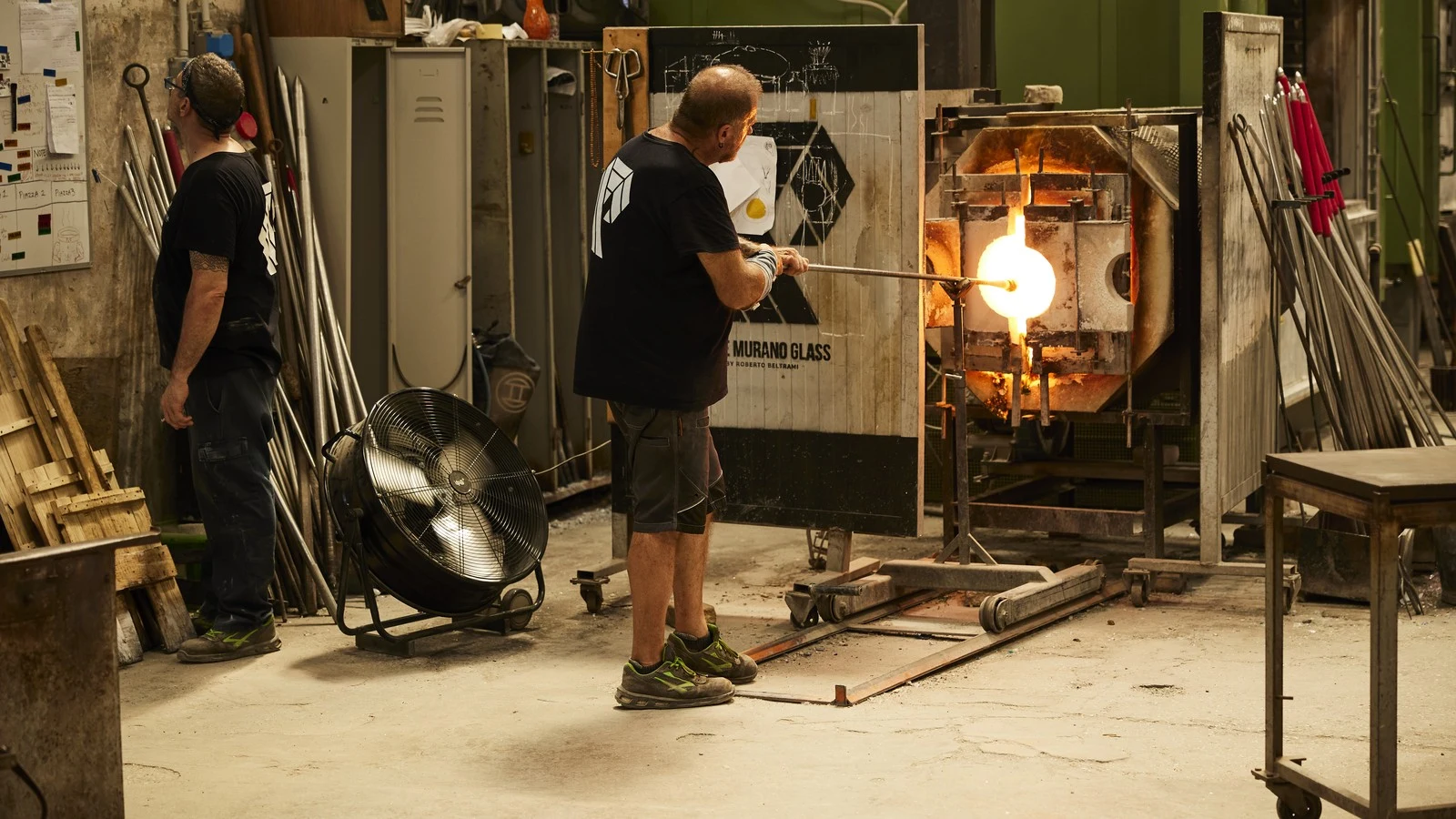
A furnace master lifts a gather of molten glass on a blowpipe, rotates it once against the lip of the bench, and hands it to the gaffer without a word. The transfer takes less than three seconds. You are standing close enough to feel the heat on your forearm.
That moment, repeated across a handful of working furnaces on the island, is what a Murano workshop visit actually delivers. Access is genuinely open at several studios: walk-in demonstrations run daily at the larger houses, and private or small-group visits to working furnaces can be arranged directly with studios whose books are open.
The caveat is that the island's visitor economy has produced a tier of performance spaces that look like workshops but function as retail floors; finding the real thing takes a little navigation.
Why Murano's Furnace Access Is Harder to Read Than It Looks
Wave Murano Glass,1 located at Fondamenta da Mula 152, sits within a broader island economy that has, over generations, layered souvenir retail over working production. The result is a spectrum: at one end, the large demonstration furnaces that run free shows for tour groups and funnel visitors toward adjacent showrooms; at the other, the smaller maestro-led studios where a single gaffer and two or three assistants produce limited runs of vessels, and where a visitor who has arranged access in advance watches the actual day's work rather than a choreographed piece.

The scarcity is not of access but of discernment. The island receives a high volume of day-trippers from Venice, and the demonstration furnaces absorb most of them efficiently. The working studios that accept visitors on a more intimate basis do not advertise heavily; they rely on word of mouth, on relationships with Venice-based guides, and on direct inquiry. The craft itself is the filter: visitors who arrive knowing what a gather is, or who can name the difference between a murrine and a filigrana cane, tend to find their way to the right rooms.
When the Furnace Doors Open
The large demonstration furnaces along the Fondamenta dei Vetrai run shows throughout the day during the main visitor season. Specific daily schedules are not published centrally and vary by studio; the most reliable approach is to contact the studio directly or check its current website before traveling, as hours shift between high season and the quieter winter months when some furnaces reduce demonstration frequency or close for maintenance.
Private and small-group visits to working studios operate on a different rhythm. These are arranged by appointment, typically by emailing or calling the studio directly. Lead times vary: some studios can accommodate a visit within a few days; others, particularly those whose maestros are mid-production on a significant commission, ask for a week or more of notice. No central booking platform aggregates these appointments. The visit calendar is unpublished and managed by the studio itself. Confirm directly before planning travel around a specific date.
The Channels That Actually Work
Three routes exist, and they yield different experiences.
Walk-in demonstration furnaces. The larger studios accept walk-in visitors for furnace demonstrations. No reservation is required for the standard show. The commercial model is the adjacent showroom. This is the lowest-friction route and the right starting point for a first visit.
Direct contact with working studios. For a visit to a studio where the day's production is the actual agenda, email or call the studio. Abate Zanetti, the Murano glass school, operates as both a teaching institution and a working studio; their site is the right first contact for anyone interested in the school's program. Studios along the smaller fondamente can be approached the same way. The conversation itself is part of the access: a studio that responds with specific questions about what you want to see is usually the one worth visiting.
Venice-based specialist guides. A small number of guides who work the Venetian craft circuit maintain relationships with maestros who do not advertise publicly. Hotel concierges and specialist guides can arrange Murano glass factory tours, including water taxi transportation.2 These guides charge for their time; the cost varies and is not published centrally. This route is worth the investment for anyone whose primary interest is the craft rather than the island as a destination.
Money vs. Time: The Two Routes Side by Side
The walk-in demonstration is free and immediate; you arrive, you watch, you leave. The tradeoff is that the show is calibrated for a general audience and the maestro is performing rather than producing.
A private visit arranged directly with a working studio costs nothing beyond the time spent making contact, but requires advance planning and some knowledge of what to ask for.
A guided visit through a specialist costs more (fees are not published centrally; contact guides directly for current rates) but compresses the research and relationship-building into a single transaction. For a practitioner-curious visitor with limited time in Venice, the guided route is the most efficient path to the real work.
Wave Murano Glass, one of the island's small-group options, limits its tour to 8 participants1 and typically books up at least one month in advance.1Tours start from €29 per person1 and run approximately 45 to 60 minutes.1Booking confirmation arrives within 48 hours, subject to availability,1 and free cancellation is available up to 24 hours before the experience starts.1 Note that participants must have fluent English; translation tools cannot be used during the experience,1 and the tour is not wheelchair accessible.1
Inside a Working Murano Furnace: What the Visit Is Actually Like
The furnace room is smaller than most visitors expect. A working studio typically runs one or two glory holes and a lehr, the annealing oven where finished pieces cool slowly over several hours to relieve internal stress. The temperature in the room sits well above comfort; in summer, it is genuinely taxing. The maestro and the assistants, the servente who handles the punty and the garzone who manages the tools and the bench, work in a rhythm established over years of shared production. There is very little conversation during a gather.
What you watch, in a working visit, is the actual sequence: the gather from the furnace, the marvering on the steel plate to shape and cool the gather slightly, the blowing or the solid-work shaping, the reheating at the glory hole, the transfer to the punty for finishing, and finally the score and break that separates the piece from the rod. A single vessel might involve four or five reheats. The gaffer's hands move with the pipe constantly; the rotation never fully stops, because gravity acts on molten glass the moment it is still.
At the demonstration furnaces, the show is compressed and narrated, often in Italian and English simultaneously. At a working studio visit, you may watch a run of identical vessels being produced for a commission, which is less theatrical but more instructive: you see the consistency the maestro is chasing, and you see the pieces that fall short of it set aside.
At Wave Murano Glass, check-in is at the front desk inside the store, not inside the factory itself,1 a small logistical detail that catches first-time visitors off guard. A maximum of one non-participating companion is allowed per booking.1 At the working studios, there is often no formal showroom; pieces are available for purchase directly, and the conversation about price is between you and the maestro or the studio's owner.
How to Get More Than the Standard Show
Arrive knowing the vocabulary. A visitor who asks about the difference between soffiato and incalmo, or who wants to understand how a murrine cane is prepared before it is incorporated into a vessel, signals to the maestro that the conversation can go somewhere. Most maestros who accept visitors are interested in the work, and a visitor who shares that interest tends to get more time and more access.
Visit in the morning. Production work at most studios begins early, and the first hours of the day are when the most demanding pieces are made. Afternoon visits at the demonstration furnaces tend to coincide with tour group peaks.
If your interest is in a specific technique, say so in your initial contact. A studio that specializes in filigrana, the cane-based lattice work that requires the maestro to assemble and fuse glass rods before blowing, is a different visit from one focused on incalmo, the joining of two separately blown vessels at the furnace. The island has practitioners of both; the right studio depends on what you want to understand.
For anyone considering a commission, the process begins with the same direct contact. Most studios that accept bespoke work will ask for a description of the piece, a sense of scale and intended use, and a timeline. Deposit structures and lead times are not published and vary by studio and by the complexity of the work. Contact the studio directly; the conversation about what is possible is itself part of the craft.
If Murano Isn't the Right Fit
Murano and Its Alternatives: Access, Cost, and What You Actually See
| Option | Access difficulty | Cost to visit | Lead time | What you see | How to book |
|---|---|---|---|---|---|
| Wave Murano Glass small-group tour | Medium (books ~1 month out) | From €29 per person1 | ~1 month in advance1 | Max 8 participants;1 45 to 60 min1 guided furnace tour | Wave Murano Glass booking page |
| Colleoni Glass Factory guided tour | Low | From $12.00 (Musement)3 | None to short | 40-min guided tour;4 €10 credit per adult3 | Booking.com or Musement |
| Vetreria Murano Arte (VMA) demonstration | Low | €3 per adult;5 free under 115 | None | Live demonstration; weekdays 9am, 4pm5 | Walk in at Calle San Cipriano 485 |
| Berengo Studio, Murano | Medium | N/A (gallery/studio model; contact directly) | By appointment for studio visits | Contemporary art glass; collaboration between international artists and Murano maestros. Located at Fondamenta Vetrai 109.6 | Direct contact via studio |
| Schiavon Art Team furnace experience | High (exclusive access) | N/A | N/A | Exclusively available to guests of The Red House Company;7 gallery at Fondamenta dei Vetrai 158 | Via The Red House Company |
Vetreria Murano Arte charges €3 per adult5 for its demonstration, with children under 11 admitted free,5 and runs weekdays between 9am and 4pm.5The Berengo Foundation offers an international art residency in Murano for 10 days, including accommodation, studio, and basic materials;6applicants must enter the Arte Laguna Prize with at least two works in the same section to be considered.6Le Stanze del Vetro on San Giorgio Maggiore stages large-scale rotating exhibitions that are free to enter,9 making it a useful complement to any furnace visit for those who want to see where the craft's contemporary edge is being tested.
Who Should Make the Trip, and When
The walk-in demonstration is worth an hour for any visitor to Venice with a passing interest in craft. It is not worth a dedicated trip from outside the region unless it is paired with a working studio visit or a course. The working studio visit, arranged in advance, is the right experience for cooks, ceramicists, jewelers, and anyone whose own practice involves material transformation at high temperature; the parallels to kiln work, to casting, to the behavior of molten metal are immediate and instructive.
Avoid the island on days when large cruise ships are docked in Venice. The demonstration furnaces absorb the overflow and the rhythm of the working day changes. Mid-week visits in shoulder season, April through early June or September through October, give the best access to studios operating at their normal pace. On certain dates, travelers staying outside Venice visiting for the day must also pay a €5 city access fee,1 worth factoring into the overall cost of the trip.
Worth the Vaporetto Ride?
Yes, with the right preparation. The walk-in demonstration at a working furnace is a legitimate introduction to the craft and costs nothing beyond the boat fare. But the visit that stays with you is the one arranged in advance at a working studio, where the maestro and the servente are making the day's actual work and you are standing close enough to understand why the rotation never stops. That visit requires a direct email, a few days of lead time, and some knowledge of what you are looking at. None of those are high barriers.
The warning is that the island's commercial layer is thick, and a visitor who arrives without a specific studio in mind will likely spend most of their time in showrooms. Vetreria Murano Arte, at Calle San Cipriano 48,5 is a low-cost anchor for context; Abate Zanetti is the right address for anyone who wants to learn rather than observe. For a commission, contact the studio directly and expect the conversation to take time; the work itself will take longer.
The allocation list, the waitlist, the impossible reservation: none of those apply here. The access problem on Murano is not scarcity but navigation. The people worth finding are the ones whose names are not on the tourist maps, and the discipline required to find them is the same discipline the craft itself demands: patience, direct inquiry, and a willingness to show up knowing what you are looking for.
Frequently Asked Questions
How far in advance should you book a Wave Murano Glass tour?Wave Murano Glass tours typically book up at least one month in advance.1Booking confirmation is received within 48 hours of submitting your request, subject to availability.1 Book via the Wave Murano Glass guided tour page and allow as much lead time as possible.
What does a Colleoni Glass Factory tour in Murano include, and where do you book it?The Colleoni Glass Factory tour runs 20 minutes to 1 hour3 and includes €10 credit per adult to spend on glass items.3Guests must be 18 or older to book.4 You can reserve through Musement from $12.00 or through Booking.com.
Does Vetreria Murano Arte charge an entry fee for its glassblowing demonstration?Vetreria Murano Arte charges €3 per adult5 to see the demonstration. Children under 11 are admitted free.5The demonstration runs weekdays between 9am and 4pm.5
What is the best time of year to visit Murano's working glass studios?Mid-week visits in shoulder season, April through early June or September through October, tend to give the best access to studios working at their normal pace. Avoid days when large cruise ships are docked in Venice, as the demonstration furnaces absorb significant visitor overflow and the working rhythm of the island shifts.
How do you commission a bespoke piece from a Murano glass studio?Begin with direct contact to the studio. Most studios that accept bespoke commissions will ask for a description of the piece, its intended scale and use, and your timeline. Deposit structures and production lead times vary by studio and by the complexity of the work; neither is published centrally. The initial conversation is the first step, and it is worth taking time over.