At French Bloom, Maggie Frerejean-Taittinger has placed organic Chardonnay at the center of the cuvée before the wine moves through low-temperature vacuum distillation. French Bloom builds its cuvées from selected organic wines, with organic Chardonnay central to the collection.1The house removes alcohol by low-temperature vacuum distillation and recovers the wine's original aromas.2Frerejean-Taittinger is Co-Founder and CMO of French Bloom,1 and her Innovator of the Year nomination in Wine Enthusiast's 2026 Wine Star Awards3 puts Frerejean-Taittinger's nominated wine work under a brighter cellar light.
Maggie Frerejean-Taittinger Sets the French Bloom Wine Program
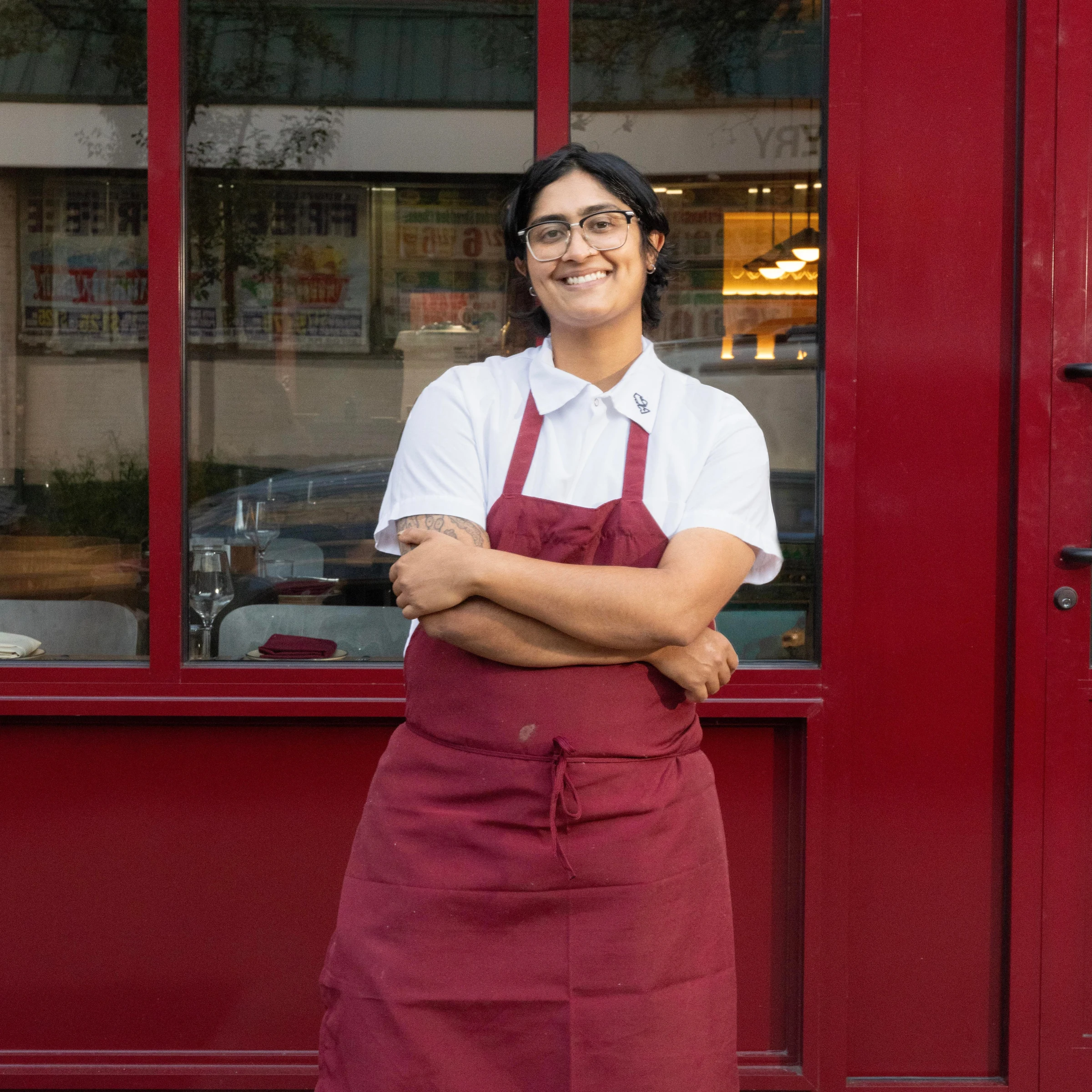
Maggie Frerejean-Taittinger is Co-Founder and CMO of French Bloom.1 Her station sits where language, ritual, and wine method meet. French Bloom does not ask to be read as juice in a flute. It starts from organic wines and gives organic Chardonnay a central role in the collection.1 The program asks whether a bottle without alcohol can still carry acidity, aroma recovery, oak, vintage, and the table grammar of sparkling wine.
French Bloom has been nominated for Innovator of the Year at the Wine Enthusiast Wine Star Awards in 2026.1Frerejean-Taittinger herself has also been nominated for Innovator of the Year in Wine Enthusiast's 2026 Wine Star Awards.3 Awards can blur the work if they arrive before the method, but here they point back to a practical decision: French Bloom treats non-alcoholic sparkling wine as a cellar problem, a service problem, and a cultural problem at once.
USA TODAY 10BEST readers have voted French Bloom Best Non-Alcoholic Wine three times.1 For a sommelier, the useful test is whether the pour can sit beside the wine list without apology. For a guest, it is whether the glass can carry a toast. For the maker, it is whether the method holds after the alcohol leaves. Frerejean-Taittinger's work sits in that triangle.
For readers who follow how programs take shape across disciplines, the question is close to the one that runs through this Made By profile of kitchen leadership: who sets the method, and what does the station ask of them over time? In Frerejean-Taittinger's case, the station is a non-alcoholic sparkling house with French wine technique behind it and a market that still tests the category glass by glass.
How Maggie Frerejean-Taittinger Reached French Bloom
Before French Bloom, Maggie Frerejean-Taittinger worked on the international development of the Michelin Guide.4 That is not a cellar apprenticeship in the old sense, but it is time spent near standards, rankings, hospitality language, and the way dining rooms translate craft into trust. Michelin's world runs on inspection, repeatability, and the recognition of discipline from outside the pass. French Bloom asks a related question from the glass: how much structure does a guest need before a new category earns a place at the table?
Frerejean-Taittinger founded French Bloom with Constance Jablonski in 2019.5The house launched in 2021.1 The gap between founding and launch matters. Wine, even when the final bottle is non-alcoholic, resists the speed of concept. Fruit has to be chosen, base wine has to be made, alcohol has to be removed without stripping the bottle of its own breath. The long way is written into the process.
Jablonski had pursued a career as a top model.6She is Co-Founder of French Bloom.6 Read the pairing plainly. Frerejean-Taittinger brought hospitality and guide-world proximity. Jablonski brought a career formed around image, travel, and public ritual. French Bloom's subject is celebration, but its test is technical. Without the wine work, the bottle is packaging. Without the social understanding, the method stays bench-side and never reaches the toast.
Rodolphe Frerejean-Taittinger is CEO of French Bloom.6He is also CEO of Champagne Frerejean Frères, a maison based in Avize and focused on Grand Cru et Premier Cru Champagnes.6Rodolphe Frerejean-Taittinger and his two brothers founded Champagne house Frèrejean Frères in 2005.7 That lineage gives French Bloom a cellar reference point. It also makes the non-alcoholic work harder, because the house must answer to people who know what pressure, acidity, oak, and aroma are supposed to do.
The Cuvée Behind French Bloom's Nominated Wine
The most useful way to understand Frerejean-Taittinger's work is to stay with the cuvée. French Bloom's founding belief is that the essence of a great wine lies in complexity, depth, the emotions it arouses, and its central role in social life, while alcohol is secondary.3 That statement rejects a simple orthodoxy: that wine's meaning begins and ends with alcohol. French Bloom does not pretend alcohol was never central to wine culture. It argues that alcohol is not the only carrier of wine's social force.
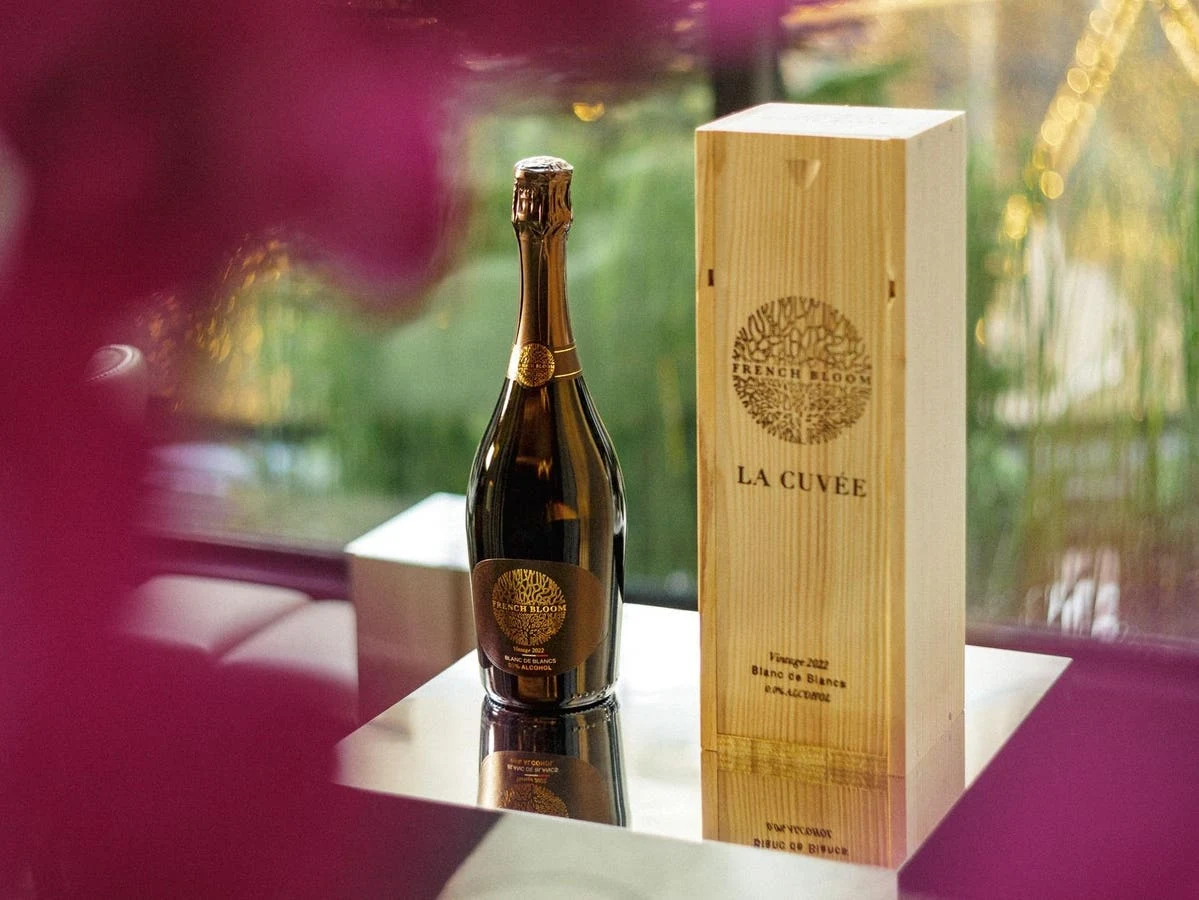
French Bloom's stated goal has been to reinvent the art of celebrating.5 The line could drift into lifestyle language if the cellar did not interrupt it. The method pulls it back. The organic Chardonnays are grown in Languedoc on high hillside plots to encourage concentration and aromatic complexity, and harvest takes place very early to preserve high acidity.2 Early picking changes the base. High acidity gives the later bottle a spine after dealcoholization, when sweetness, aroma, and texture can easily lose their place.
The clear juice is fermented, then aged for over six months in new oak barrels and, for a small part, in stainless steel tanks.2 The mix of oak and steel reads like a house choosing contact and restraint at the same time. Oak gives the base wine a frame; steel keeps part of the line clean. Dealcoholization follows through low-temperature vacuum distillation, with recovery of the wine's original aromas, in an exclusive method developed by French Bloom.2 Low temperature and recovery are the crucial words. Heat can flatten a wine. Aroma recovery is the difference between removing alcohol and erasing the material that made the wine worth handling.
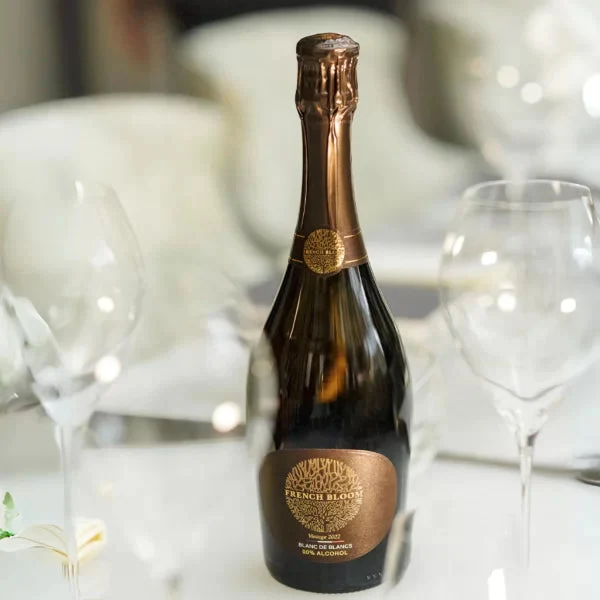
La Cuvée Vintage 2023 is made from 100% organic Blanc de Blancs, with the wine aged in oak.1 That bottle makes the house's argument in a narrower register. Blanc de Blancs puts Chardonnay alone under pressure. Oak asks the dealcoholized wine to carry wood influence without alcohol's usual breadth. Choose it if you want the French Bloom argument closest to wine language rather than fruit soda cues.
Cuvée Vintage 2022 was produced in 17,000 bottles.2 A production number gives shape to the work. It is large enough to leave the experimental corner, small enough that the house still has to account for each decision in the base wine. French Bloom acquired its own vineyard in Limoux in the South of France.8That estate covers 25 hectares and is planted with Chardonnay and Pinot Noir.9 Estate fruit changes the discipline. A brand can buy inputs; a house with vines must answer to pruning, picking dates, disease pressure, and the slow correction of mistakes.
The same attention to who controls the program runs through Made By's wider profiles of craft leadership. With Frerejean-Taittinger, the craft is not a single hand turning a loaf or plating at the pass. It is the insistence that a non-alcoholic cuvée deserves the same questions wine people ask of any bottle: what fruit, what site, what vessel, what dwell time, what is lost, what is recovered?
The People Around Maggie Frerejean-Taittinger at French Bloom
Constance Jablonski is Co-Founder of French Bloom.6She founded the house with Maggie Frerejean-Taittinger in 2019.5 The partnership gives the brand its first axis: a hospitality-trained co-founder working beside a co-founder formed in fashion's public-facing discipline. Their shared subject is the public moment, but the bottle only survives if the cellar method holds.
Rodolphe Frerejean-Taittinger is CEO of French Bloom.6He oversees the winemaking of La Cuvée.7His Champagne Frerejean Frères role ties him to a maison in Avize focused on Grand Cru et Premier Cru Champagnes.6 That is a particular kind of proximity: Champagne knowledge brought into a house that cannot rely on alcohol to carry weight.
Carl Héline, former head of Krug Champagne in France and the USA, brought his knowledge of French savoir-faire in sparkling wine production to French Bloom.10 His presence places another named practitioner beside the program. The non-alcoholic category is often discussed as consumer behavior. French Bloom's circle brings it back to production knowledge: cuvée construction, sparkling wine expectation, and the pressure of a category that invites comparison to Champagne without being Champagne.
Moët Hennessy became a minority investor in French Bloom.1 Investment is not craft, but it can change the room around craft. For Frerejean-Taittinger, the useful reading is not scale for its own sake. It is that a non-alcoholic sparkling house has drawn attention from one of the major names around wine and spirits, while still having to prove the liquid on the pass, in the lounge, and at the table.
Where to Taste Maggie Frerejean-Taittinger's French Bloom
French Bloom is present in more than 70 countries.1It is served in Michelin-starred restaurants and luxury hotels worldwide.4It is also featured in La Première lounges and the Delta One Lounge at John F. Kennedy International Airport in New York City.3In the United States, French Bloom has expanded through on-premise listings across all current Soho House locations and several Auberge Collection properties.3
The bottle to study is the cuvée work itself, especially La Cuvée Vintage 2023, made from 100% organic Blanc de Blancs and aged in oak.1 French Bloom is available at3 French Bloom's own site. French Bloom does not publish a cellar-visit or reservation system on its consumer site; ask the house directly if you want to understand whether the Limoux estate can be visited.
French Bloom signed a 10-year partnership with Formula 1 in 2025 for all Formula 1 events.9It is the official partner of every Formula 1 Grand Prix for the next ten years.4 That setting is not a tasting room, but it tells you where Frerejean-Taittinger wants the category tested: in public celebration, at speed, with the glass doing social work.
Why Maggie Frerejean-Taittinger's French Bloom Work Matters
Maggie Frerejean-Taittinger matters because she has treated non-alcoholic sparkling wine as a wine problem, not a substitute problem. As Co-Founder and CMO of French Bloom,1 she works at the point where the house explains itself to drinkers, sommeliers, hotels, and critics. Her 2026 Wine Enthusiast Innovator of the Year nomination3 recognizes the public edge of that work, but the deeper claim sits in the method: early-harvest organic Chardonnay from high hillside Languedoc plots,2 fermentation and more than six months of aging in new oak with a small stainless-steel part,2 then low-temperature vacuum distillation with aroma recovery.2 If you follow the category, watch the makers who can give absence a structure worth returning to.
Frequently Asked Questions
Who is Maggie Frerejean-Taittinger at French Bloom?
Maggie Frerejean-Taittinger is Co-Founder and CMO of French Bloom.1She founded the house with Constance Jablonski in 2019.5
What is Maggie Frerejean-Taittinger known for?
She has been nominated for Innovator of the Year in Wine Enthusiast's 2026 Wine Star Awards.3French Bloom has also been nominated for Innovator of the Year at the Wine Enthusiast Wine Star Awards in 2026.1
What did Maggie Frerejean-Taittinger do before French Bloom?
Before French Bloom, Maggie Frerejean-Taittinger worked on the international development of the Michelin Guide.4