Meet Jean-Michel Perruchon, the Pastry Chef Who Made École Bellouet Conseil
Meet Jean-Michel Perruchon, the Pastry Chef Who Made École Bellouet Conseil
Jean-Michel Perruchon worked the demonstration bench outside France for about 160 days a year, including 42 trips to Japan.
HM
Director of Editorial Standards
Hugo Marchetti
Filed November 23, 2026
9 min read
Jean-Michel Perruchon worked the demonstration bench outside France for about 160 days a year, including 42 trips to Japan.1 He co-founded Bellouet Conseil with Joël Bellouet in 1989,1 and earned the Meilleur Ouvrier de France title in 1993.1 He focused on transmission through the individual dessert, the working recipe, and Bellouet Conseil.
Perruchon after the École Bellouet Conseil bench
Perruchon now stands in pastry as a maker whose station became a school, then a lineage.He directed the Parisian school Bellouet Conseil for over 30 years.2 Perruchon's work stayed on the bench in demonstrations, books, the school's method, and the pastry chefs who passed through his orbit.
The Sunday email
Get new Made By stories every Sunday.
Every Sunday we send a lead story and up to four more about the chefs, winemakers, sommeliers and hoteliers behind the restaurants, bars, wineries and hotels we cover.
Free. One email a week, and you can unsubscribe from any issue.
Perruchon announced his retirement,3 and Jonathan Mougel is the current director of Bellouet Conseil, following Perruchon's retirement.2 Mougel is one of the 2018 Meilleurs Ouvriers de France.2 He is another maker with a tested craft language, carrying a school that Perruchon and Joël Bellouet built as a place for professionals.
Perruchon is known for a shift in pastry format. Mougel states that Jean-Michel left his mark on the evolution of patisserie, especially by developing the individual dessert.2 Developing the individual dessert is a technical contribution. An individual dessert asks the chef to compress architecture: biscuit, cream, insert, glaze, garnish, portion weight, and service life all have to survive at a smaller scale. Perruchon's authority sits there, at the point where a showpiece discipline becomes a repeatable object in a shop case.
The institution around him has also changed hands. In early 2025, Puratos acquired École Bellouet Conseil.3 Perruchon was to collaborate with Puratos and remain actively involved until the end of that year.3 Perruchon's later career is one of succession with supervision: he steps back, the school continues, and the method remains the thing to protect.
Perruchon's apprenticeship from Lamballe to Fauchon
Perruchon began his apprenticeship at age 14 in Lamballe, Brittany.1 He began his apprenticeship at age 14 in Lamballe, Brittany. It places him inside the discipline young enough for repetition to do its work, the daily folding, cutting, glazing, tempering, cleaning, and starting again that make a pastry cook before reputation arrives.
He gained experience at establishments such as Constant, Fauchon, and Lenôtre.1 Constant, Fauchon, and Lenôtre are Parisian houses where the bench has to answer to the shop, the gift box, the salon, the counter, and the customer who returns expecting the same cut and finish. Perruchon worked alongside Berton at Fauchon,1 and Fauchon invited him back to serve as an assistant to Pierre Hermé.1 As an assistant, he was close enough to see decision-making, close enough to learn when a recipe changes because the fruit, the cream, the room, or the service rhythm demands it.
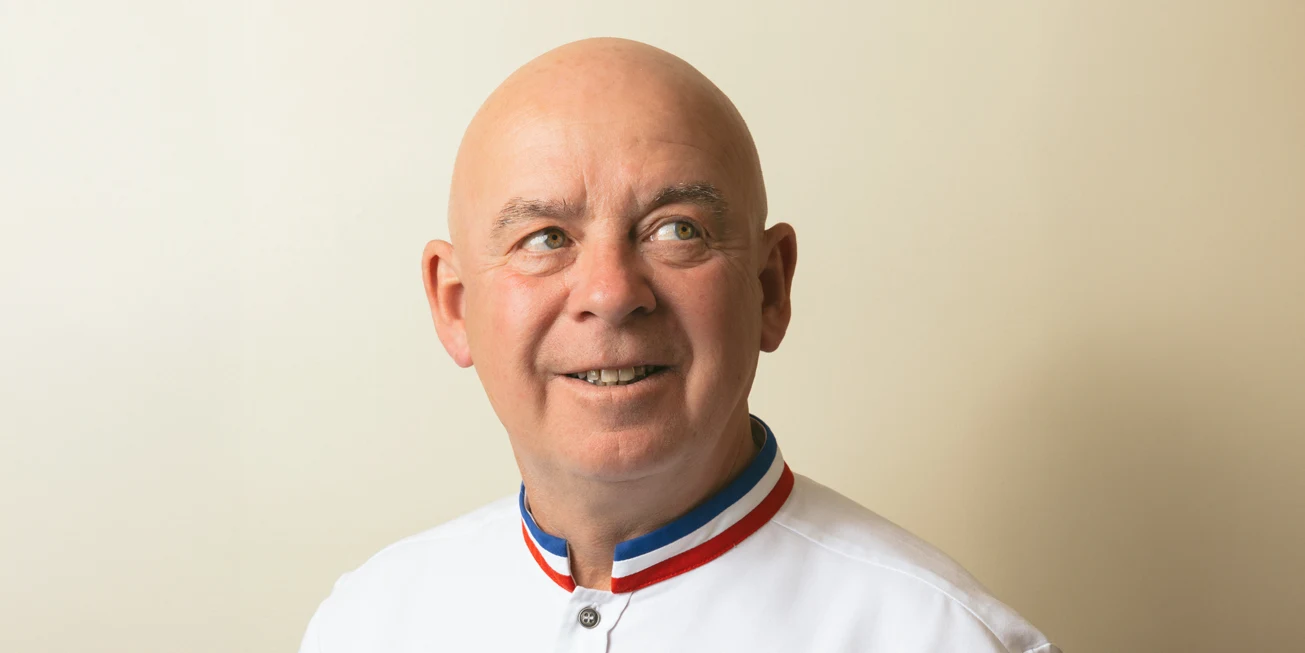
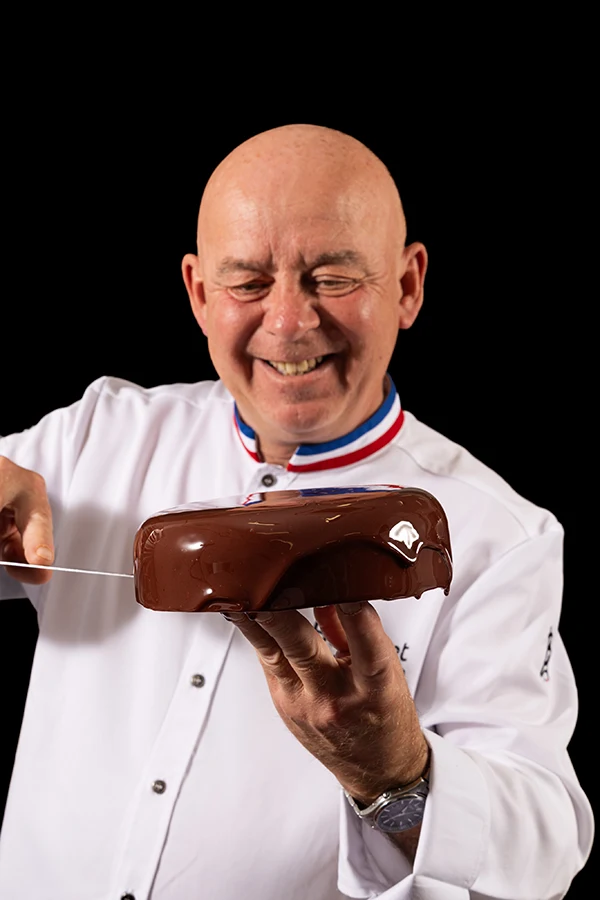
A bald chef in a white chef's coat with red-white-blue collar trim (French MOF insignia) holds a glossy pastry.
Perruchon won the Charles Proust competition in 1984.1 He co-founded Bellouet Conseil with Joël Bellouet in 1989.1 He earned the Meilleur Ouvrier de France title in 1993.1 Perruchon's path ran from the 1984 competition to the 1989 school and the 1993 national title, then into a long directorship. Perruchon converted pastry into a teaching program.
He has written more than ten books on pastry.4 Books fix ratios, order, finish, and sequence for pastry cooks. In pastry, one missed degree can dull chocolate and one short rest can make dough fight the pin, so the written method becomes part of the apprenticeship.
Perruchon's individual desserts and the working method
Jonathan Mougel states that Jean-Michel left his mark on the evolution of patisserie, especially by developing the individual dessert.2 Individual portions expose every millimeter. A large entremets allows a broad slice; an individual portion exposes every millimeter. The biscuit cannot be too thick, the cream cannot slump, the insert has to sit centered, and the glaze must cover the sides without eating the form.
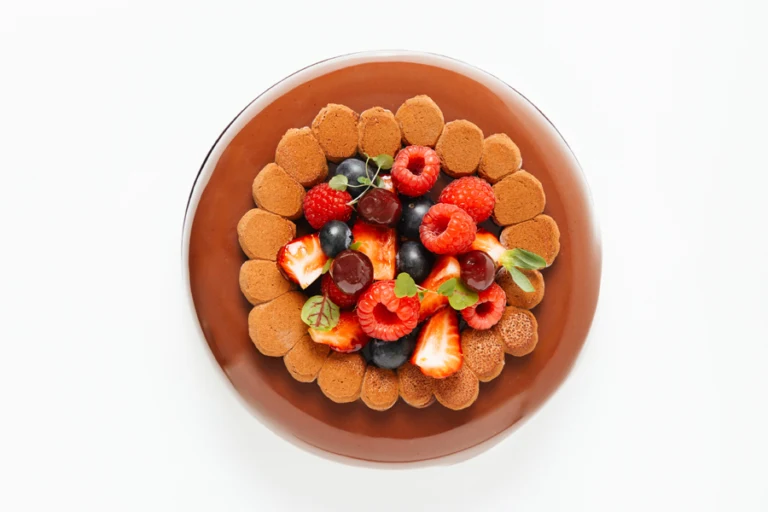
A professionally photographed pastry dessert with ladyfinger cookies arranged in a circle around fresh.
Perruchon's contribution reaches beyond appearance in the shop. The individual dessert changed the relationship between the chef's idea and the shop's daily production. It asked pastry cooks to think in units: how many molds fit a rack, how long the freezer needs to set the insert, how the garnish survives the case, how the customer eats the piece without a pastry chef standing beside it. The individual dessert had consequences for labor, storage, service, and teaching.
Julien Álvarez states that Jean-Michel has known how to stay in tune with the reality of a business, both in the choice of ingredients and techniques, so that everything can be applied in day-to-day operation.2 Álvarez is pastry chef at Maison Ladurée.2 A formula that works only when the chef is present has limited value. Perruchon's method, as Álvarez frames it, belongs to the day's production list: ingredients a team can source, techniques a station can repeat, finishes that can carry through service.
Perruchon spent about 160 days a year outside of France doing demonstrations, including 42 trips to Japan.1 A demonstration chef has to make method portable. The bowl changes, the flour changes, the water changes, the students' habits change. The craft has to survive translation.
Bellouet Conseil is located in Paris,4 and Perruchon's work reached outward through school, books, demonstrations, and chefs who speak of him as a predecessor.
Perruchon's people: Bellouet, Hermé, Mougel and the Fauchon line
Joël Bellouet was his first collaborator. Perruchon co-founded Bellouet Conseil with Joël Bellouet in 1989,1 and he is named co-founder of École Bellouet Conseil with Joël Bellouet. A school carries decisions about repetition, correction, and professional practice.
Fauchon gives the next layer of names. Perruchon worked alongside Berton at Fauchon.1 Fauchon invited him back to serve as an assistant to Pierre Hermé.1 During that period, Perruchon mentored Christophe Felder, Frédéric Bau, and Christophe Adam at Fauchon.1
The circle around Perruchon also includes makers who have spoken to his place in the craft. Jonathan Mougel is one of the 2018 Meilleurs Ouvriers de France,2 and he is the current director of Bellouet Conseil following Perruchon's retirement.2 Arnaud Larher is 2007 Meilleur Ouvrier de France in pastry,2 and collaborates with Fauchon as a pastry chef.2 Stéphane Glacier is a Meilleur Ouvrier de France in 2000.2 This is the company in which Perruchon's work is discussed: chefs for whom a title, a school, and a repeatable method all carry weight.
Where Perruchon's École Bellouet Conseil work is met in Paris
Bellouet Conseil is in Paris.4 Jonathan Mougel is the current director.2 Perruchon has written more than ten books on pastry.4
Why Perruchon still matters to pastry
Perruchon matters because he treated pastry as a discipline that must be teachable under pressure. His work sits at the point where French craft leaves the competition table and enters the daily station: the individual dessert, the business-aware formula, the demonstration that can travel and still hold its method.Mougel's account of Perruchon's role in developing the individual dessert2 and Álvarez's account of his day-to-day practicality2 point to the same hand. A cook tracking lineage across disciplines can place him beside Naohiko Noguchi at the Noguchi Naohiko Sake Institute, Lisa Goodwin-Allen at Northcote, and Bobby Stuckey at Frasca Food and Wine. The common question is who carries the method when the maker steps back, and Perruchon's answer is still working at the bench.
Frequently Asked Questions
Who is Jean-Michel Perruchon?
Jean-Michel Perruchon co-founded Bellouet Conseil with Joël Bellouet in 1989,1 directed the Parisian school for over 30 years,2 and was awarded the Meilleur Ouvrier de France title in 1993.3
Where did Jean-Michel Perruchon train and work before Bellouet Conseil?
Perruchon began his apprenticeship at age 14 in Lamballe, Brittany.1 He later gained experience at Constant, Fauchon, and Lenôtre,1 and Fauchon invited him back to serve as an assistant to Pierre Hermé.1
What is Jean-Michel Perruchon known for in modern pastry?
Jonathan Mougel states that Perruchon left his mark on the evolution of patisserie, especially by developing the individual dessert.2 Julien Álvarez states that Perruchon kept his ingredient choices and techniques tied to day-to-day business reality.2
Did Jean-Michel Perruchon retire from Bellouet Conseil?
Perruchon announced his retirement,3 and Jonathan Mougel is the current director of Bellouet Conseil following Perruchon's retirement.2
How many pastry books has Jean-Michel Perruchon written?
Perruchon has written more than ten books on pastry.4
The Sunday email
Get new Made By stories every Sunday.
Every Sunday we send a lead story and up to four more about the chefs, winemakers, sommeliers and hoteliers behind the restaurants, bars, wineries and hotels we cover.