At Myšák near Prague Castle, Ambiente head of coffee Ondra Štökl calibrates espresso by taste, mood, and a 17g-in recipe.
HM
Director of Editorial Standards
Hugo Marchetti
Filed November 14, 2026
8 min read
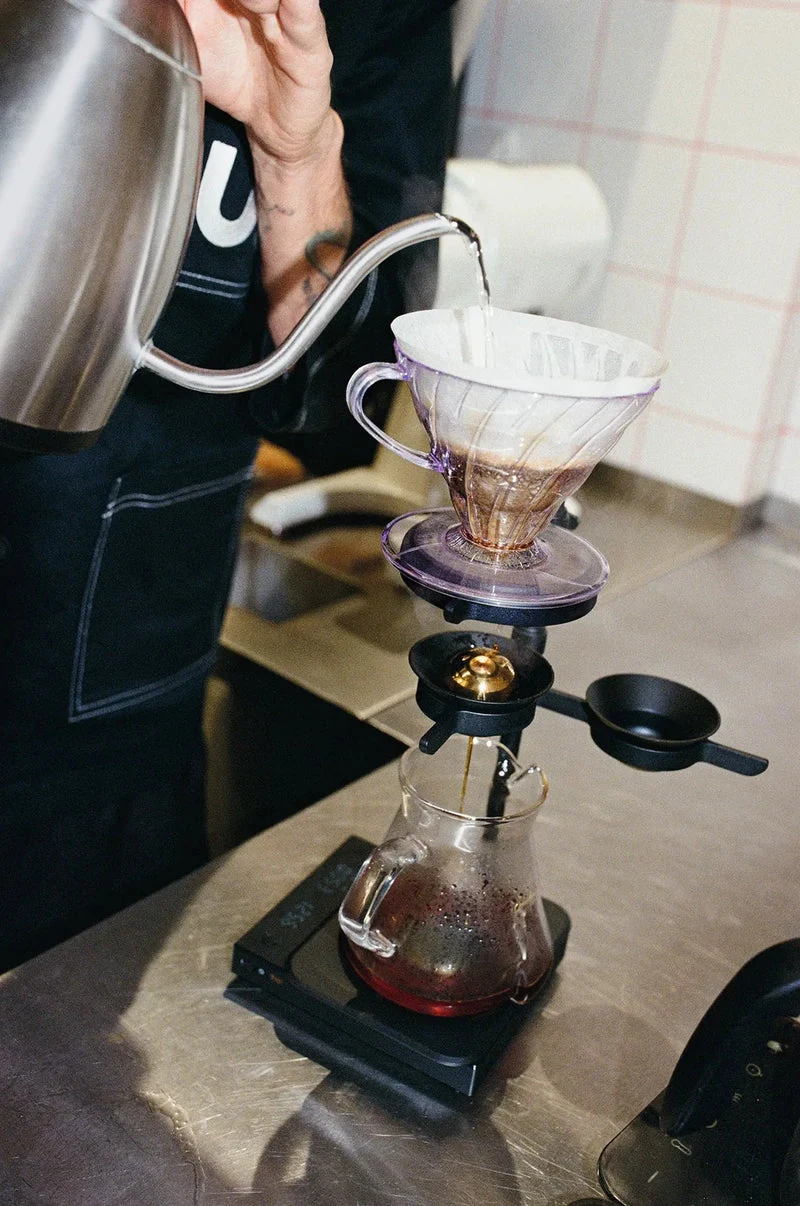
The shot lands at Myšák in a small cup, 17g of ground coffee in and 44g out in 26 seconds, and Ondra Štökl tastes before he changes anything. Ondra Štökl's coffee work at Ambiente spans more than 30 Prague venues. The station is new, the bar team is still settling into its workflow, and the patisserie sits inside the Renaissance-era Schwarzenberg Palace near Prague Castle, where the third Myšák in the city has opened with a two-group La Marzocco KB90 and a Mahlkönig E80 Supreme on the bench.
Štökl does not begin with a lecture. He steps behind the bar, pulls a shot, sips, and asks the barista to taste with him. The first notes named at the counter are caramel and chocolate. He listens, then considers whether a small adjustment could draw out apple. Štökl judges espresso by tasting it with the barista at the machine.
The Sunday email
Get new Made By stories every Sunday.
Every Sunday we send a lead story and up to four more about the chefs, winemakers, sommeliers and hoteliers behind the restaurants, bars, wineries and hotels we cover.
Free. One email a week, and you can unsubscribe from any issue.
Inside Ondra Štökl's Coffee Work at Myšák
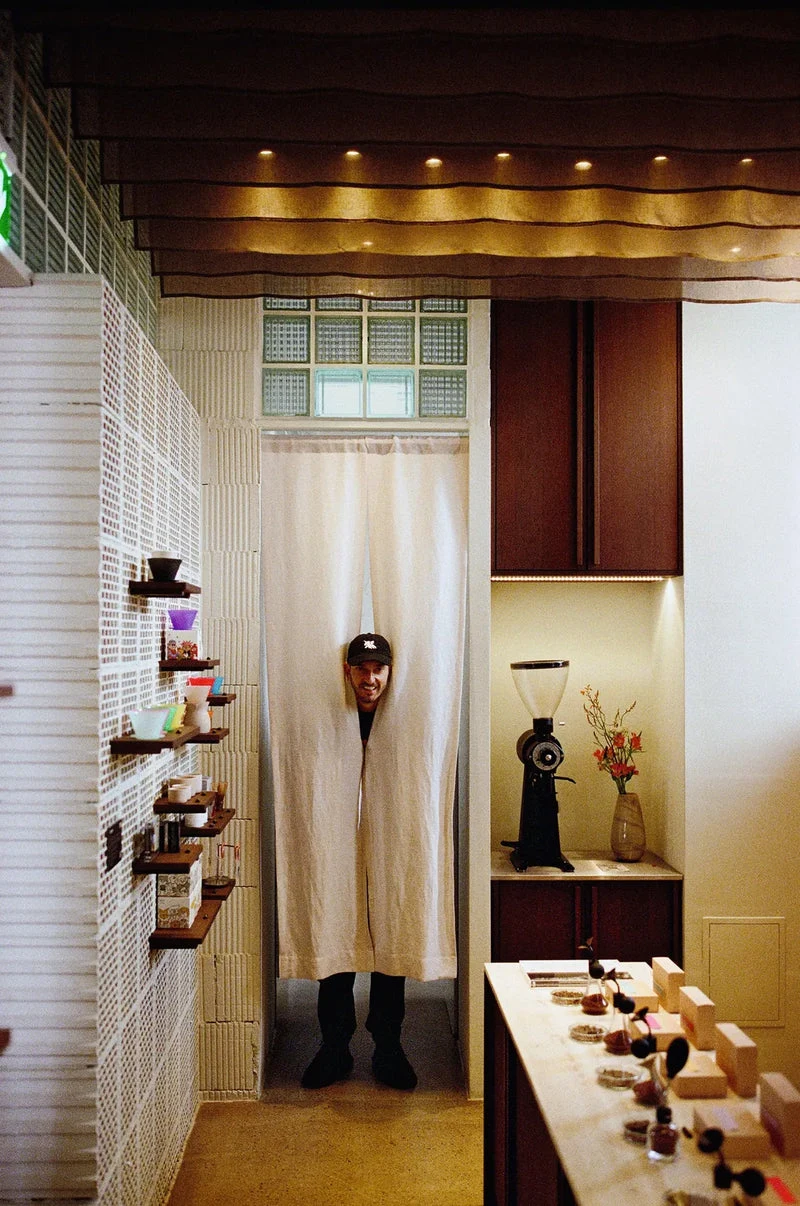
Myšák gives Štökl a new room to read. The coffee station stands beside a vitrine of Czech patisserie, větrníky, věnečky, laskonky, cakes, and chlebíčky. The espresso is served alongside cream, pastry, sugar, and open sandwiches. At this counter, coffee is matched to the sweets.
A person stands behind a white curtain in a small specialty coffee shop with warm lighting.
The espresso at Myšák is a washed blend of caturra and catuaí, chosen by Štökl and general manager Matěj Pína in Guatemala the previous year. At the station, it becomes service craft. A blend selected with a general manager in Guatemala must still work through a grinder in Prague, through a new machine, through new hands, during a morning when guests are looking at pastry before they think about extraction.
The recipe, 17g in, 44g out, in 26 seconds, gives the barista a shared starting point. It does not finish the job. Štökl and the barista taste the result, check sweetness, consider acidity, and decide whether the grind should move finer or coarser. Štökl and the barista taste the result because the number can drift from the cup.
There is a working station with a new KB90, an E80 Supreme, a barista naming chocolate and caramel, and Štökl looking for the point where a washed caturra and catuaí blend can carry apple without becoming sharp beside pastry.
Tomáš Karpíšek, the group's founder, once told me that even when an ingredient isn't local, we must treat it as if it were, giving it the utmost care.1
Ondra Štökl, Head of Coffee
The Espresso Question That Guides the Day
Štökl’s question at each bar is a sensory test and a training method. Asking the barista what they taste tells him whether the person on the machine can locate the cup before changing the grinder. If the answer is vague, the adjustment risks becoming habit. If the answer is specific, caramel, chocolate, apple, acid, length, weight, the next move has a reason.
That method gives Ondra Štökl coffee work its discipline. He tailors the coffee to each venue. He matches the coffee to the venue. He has said that a place with richer, heavier food often calls for a simpler profile, chocolate, caramel, nougat, while more modern places can take fruitier coffee, including a higher-acidity Kenya. Myšák, with traditional Czech patisserie at the counter, asks for sweetness and enough lift to keep the cup from becoming heavy.
The sensory stakes are small and constant. A shot can coat the mouth and fade cleanly, or it can flatten after the first sip. A grinder setting can protect sweetness or mute the coffee. A longer yield can open texture or pull the espresso away from the pastry it is meant to accompany. Štökl works inside those margins because thousands of small cups define the programme.
Štökl tastes before he corrects the coffee. Hold the dose steady long enough to understand what changed. Štökl uses yield and time as tools, then returns to the cup. Štökl asks the person on the station to name what they taste because language is part of calibration. A barista who can name caramel, chocolate, apple, acid, length, or weight can begin to control it.
From Myšák to Eska, Consistency Across Ambiente
Across Ambiente’s more than 30 locations, coffee use amounts to nearly five tons a year, about 290,000 shots at 17 grams per double. That scale changes what consistency means. A single good espresso at Myšák proves little unless the method can survive another venue, another rush, another machine, another barista, another guest expectation.
The day moves from Myšák toward Karlín and Eska. The route crosses the Vltava River on the number 12 tram. His bench stretches across Prague. He joined Ambiente in 2015 and received responsibility for the coffee programme on day one (Standart Mag2).
A blurred selfie-style photo showing a person in the foreground with apartment buildings visible.
Eska is where the programme began for him. The vast industrial space carries the scent of bread and coffee, and it remains a place he returns to within the group. The coffee programme outgrew Eska, and the method still follows work learned bench-side: taste, adjust, teach, repeat.
The stakes sit in the repetition. Specialty coffee has become established in Prague; Štökl has said the current test is maintaining the quality and standards customers expect. Maintaining the quality and standards customers expect is now the test for the programme. Maintenance requires visits. Maintenance depends on a head of coffee noticing when a recipe has become mechanical, when a barista has stopped tasting, or when a drink still meets the number but misses the room.
The Mood Check Before the Grinder Check
When Štökl arrives at a venue, he checks the mood before he treats the coffee as a technical fault. He looks at how the barista talks, how they approach guests, how they manage the rush, and whether something in the service environment is not working. The cup carries some of that pressure. A person under strain can pull longer, avoid tasting, or cling to the recipe even when the cup asks for a small change.
Coffee management includes people and extraction. A new station like Myšák concentrates variables: new workflow, new colleagues, new equipment, new guests, new traffic through the room. Repetition is the only way to learn which problem belongs to the grinder, which belongs to the hand, and which belongs to the service pattern around the bar.
Štökl also functions as the person who receives urgent problems when they appear. Unexpected situations arise, and he has to address them immediately. In a restaurant group, a coffee machine failure can slow the whole establishment. The person responsible for the programme needs to understand the machine, the drink, the barista, and the guest waiting for a cappuccino.
Cappuccinos are Ambiente’s commonest coffee order, while espresso-based drinks still dominate and filter coffee continues to increase in popularity. That mix places pressure on the station in different directions. Milk texture, speed, espresso clarity, and filter coffee training all matter. A head of coffee has to keep those demands connected without letting one format flatten the others.
Why the Prague Coffee Standard Now Depends on Maintenance
Štökl’s work points to a mature stage in Prague’s specialty coffee scene. Earlier, his job involved introducing specialty coffee, experimenting, and persuading managers why the investment mattered. Now the harder task is maintenance. Guests arrive with expectations already formed. The programme has to meet them across its rooms, not once at a flagship bar.
Maintenance asks for time on the tools. At Myšák, Štökl and the barista work from a precise recipe. At Eska, the programme carries the memory of his first Ambiente station. At UM, Ambiente’s test kitchen, classroom, and innovation hub, he has a professional home for teaching and development. The route between those places is the shape of the job.
The cues are visible from the customer side of the counter. The barista may taste when changing the recipe or adjust by habit. The espresso has to fit the food beside it. The station has to recover after a rush. The person on the machine needs enough language to name caramel, chocolate, apple, acidity, or weight. Štökl’s method gives those questions practical form.
Ondra Štökl coffee work treats consistency as a living practice. The third Myšák will settle into its new equipment and workflow. The washed caturra and catuaí blend will keep moving through different hands. The question at the bar will remain the same, and the answer will tell whether the programme is holding.
The Sunday email
Get new Made By stories every Sunday.
Every Sunday we send a lead story and up to four more about the chefs, winemakers, sommeliers and hoteliers behind the restaurants, bars, wineries and hotels we cover.