Chef Andy Baraghani Will Open Ditto as Personal Counter
Andy Baraghani’s Ditto near Union Square will turn his Persian-speaking Bay Area childhood, cookbook palate, and grief into counter food.
HM
Director of Editorial Standards
Hugo Marchetti
Filed November 13, 2026
11 min read
Andy Baraghani stood across a stainless-steel prep table in his kitchen on the first cold morning of autumn, ready to test salty-sweet scones with dates and lemon zest, then stopped because the cream had to be bought first. Andy Baraghani Ditto is the chef-writer's forthcoming counter-service café near Union Square, built with restaurateur Michael Silber around breakfast, lunch, seasonal vegetables, Persian flourishes, and the sharp register of tart and sour flavors. The pause for cream matters. Baraghani's cooking has long turned on the errand before the method, the shallot before the sauce, the market table before the finished plate.
Ditto sits a few blocks from the Union Square Greenmarket, in a former Agnès B. storefront on 16th Street. That geography gives the project its daily rhythm before any menu line does. Greenmarket shoppers are the imagined regulars; breakfast and lunch are the first services; dinner remains a later possibility. The counter will carry California-ish sides and salads, counter pastries, and marketplace provisions such as tahini, harissa, and dates. For now, no tinned fish.
The Sunday email
Get new Made By stories every Sunday.
Every Sunday we send a lead story and up to four more about the chefs, winemakers, sommeliers and hoteliers behind the restaurants, bars, wineries and hotels we cover.
Free. One email a week, and you can unsubscribe from any issue.
Baraghani arrives at that counter after a public decade: Bon Appétit visibility, a New York Times bestselling debut cookbook, a James Beard Award, restaurant time at Frej, Corton, and Estela, and the long transfer from recipe developer to author to operator. Ditto asks whether that public voice can hold in a room where guests point, order, wait, taste, and return.
Why Andy Baraghani’s Ditto Feels Like a Turning Point
Baraghani has said he fears stagnancy, defining it as a life without learning, movement, or evolution as a writer, cook, and gay person. That fear gives Ditto its stakes. The café follows a cookbook with more than 100 recipes, a media career that made his palate legible to home cooks, and a year of private loss: in 2024, his father died after small-cell lung cancer. The restaurant gathers those strands without turning them into a speech. It gives them a station, a counter, a prep list (Penguinrandomhouse3).
Michael Silber is Baraghani's partner in Ditto, which is planned as a working restaurant. The model Baraghani names is counter service of a specific lineage: Gjusta in Los Angeles and City Bakery in New York. Those references point to food that sits in trays, moves through hands, and serves repeat use. A guest might stop for a pastry, a salad, or a jar of harissa; the food has to read from behind glass and still hold when taken away.
Baraghani has described the food at Ditto with confidence. He has spent years acknowledging that his cooking can run lemony, herb-heavy, and pointed. At Ditto, that register becomes the method. Seasonal vegetables carry Persian flourishes, aromatics are central to the cooking, and sourness is used in the line cooking.
The opening also brings Baraghani back to restaurant work after years when his work circulated through screens and books. He was born Andisheh Baraghani on November 27, 1989, raised in the San Francisco Bay Area, and grew up speaking Persian. Ditto, near Union Square, gives that history a room in New York, close enough to the Greenmarket for produce to remain an active collaborator rather than a theme (Wikipedia4).
The Bay Area Bench, Chez Panisse, and a Persian-Speaking Home
Baraghani's first job as a teenager was at Chez Panisse in Berkeley, where he peeled hundreds of onions. That is the right place to begin the apprenticeship, because onion work teaches scale without glamour. The cook learns repetition, trim, waste, speed, and the smell that stays in the hands after the shift. Chez Panisse also placed a Bay Area teenager inside a produce-driven kitchen before that language became a media shorthand.
His parents had emigrated from Iran to Berkeley in 1977. Baraghani grew up in a Persian-speaking home and in a Bay Area immigrant community where other families invited his family into celebrations and kitchens. The palate that now turns toward tart, sour, aromatic food has roots in that social education, as much as in restaurants. It also has roots in movement: after moving to New York, Baraghani traveled alone through Southeast Asia in his early twenties and later drew on travel abroad alongside Iranian heritage and restaurant training.
The family history also carries the pressure of translation. Baraghani has written about growing up Iranian in post-9/11 America, about going by Andy rather than Andisheh, and about learning to understand his sexuality in kitchens where he rarely encountered other gay men. It left the work unfinished.
"So as nice as it would be for this story to end with that Iran feature or getting my dream job at Bon Appétit, the truth is that I’m still trying to figure things out. It’s not always steady progress."1
Andy Baraghani, chef and writer, Bon Appétit
A counter-service café can sound simple until a cook loads it with biography: Bay Area produce, Persian language, New York restaurant labor, a cookbook readership, a father gone, a husband at home, a storefront near a market. Baraghani shares his home with Keith Pollock, whom he met while both worked at Condé Nast; the domestic kitchen where he tested scones and shot his second cookbook now sits a few blocks from the public counter he is building with Silber.
From Saveur and Estela to Bon Appétit Visibility
Baraghani studied at New York University, where he worked as an editor for Saveur while studying food studies and cultural anthropology. The pairing matters. Saveur gave him editorial training while New York kitchens gave him the body memory of service. After university, he worked at Frej, Corton, and Estela. After graduation, David Tanis, his former boss and mentor, told him to work at Estela if he was going to work in restaurants. Baraghani worked there for about eight months and honed his salad-making skills (Greatjonesgoods5).
Estela's place in this lineage is practical. Salad is knife work, seasoning, acid judgment, and timing. Leaves wilt while a cook decides, herbs bruise, and salt pulls water. A salad station teaches a cook to make freshness feel composed without draining the life from it. Baraghani's later recipes, with their herbs, alliums, lemon, and crunch, carry that bench-side education.
He transitioned into media in 2013, then joined Bon Appétit in 2015 as senior food editor. By 2016, he was one of seventeen chefs operating a Manhattan pop-up restaurant by Google that ran for four days in April. In 2019, Baraghani and Baz held cooking demonstrations at Outside Lands Music and Arts Festival in San Francisco. The public profile kept widening. In early 2020, Out called him "the internet boyfriend of our dreams." In June 2020, after Bon Appétit editor-in-chief Adam Rapoport resigned, Baraghani posted an Instagram statement apologizing for ways he had "undermined" and "hurt" BIPOC coworkers (Wikipedia4).
He is a chef and writer whose face, recipes, apologies, and preferences have circulated widely. The counter at Ditto will test something different from a video frame. Food at a café gets judged through repeat proximity: the second breakfast, the lunch eaten standing up, the salad carried back to a desk, the jar bought because last week's jar ran out.
The Cook You Want to Be: Everyday Recipes to Impress was published in 2022 by Lorena Jones Books. The book became a New York Times bestseller and won a James Beard Award in the general cookbook category in 2023. Those credentials can attract readers to Ditto. A restaurant guest returns to the counter with memory and expectation.
The Cookbook Palate: Lemon, Herbs, and the Sour Register
Baraghani's palate has never hidden its acid. His pork larb recipe from Greenmarket work uses garlic, shallots, scallions, herbs, lemongrass, and fish sauce; he has described that dish as spicy, a little sour, salty, and fresh. Those words form a useful grid for understanding Ditto's planned food, even though the café's final menu should not be presumed before service begins. The known direction is seasonal vegetables, Persian flourishes, tart and sour flavors, and aromatics.
"I know that my food may be a touch too lemony for some"2
Andy Baraghani, chef and cookbook author, Bon Appétit
In a cookbook, the amount of lemon can be adjusted. At a counter, Baraghani and his cooks make the call before the guest sees the plate. The acid level becomes house style. The amount of herbs becomes labor. The aromatics become ordering language, because the person behind the counter has to describe the food in a few words while the line moves.
Ditto's planned rotisserie oven gives the method a second anchor. Baraghani and Silber invested in a shiny rotisserie oven for what they call a beyond chicken program, with plans for spit-roasted porchetta, romanesco, and cabbage. The list is telling because it moves the spit away from a single default protein. Cabbage on a rotisserie asks for time, surface heat, and enough confidence to treat a vegetable as the center of the station. Romanesco asks for char without collapse. Porchetta brings fat, salt, and a different kind of patience.
The marketplace shelf extends the same palate into provisions: tahini, harissa, dates. They are working materials, ready for toast, dressings, sweets, marinades, and the kind of home cooking that Baraghani has taught through books and videos. Ditto can place them within reach of a Greenmarket shopper carrying vegetables a few blocks from the stalls.
Ditto's Counter-Service Method Near Union Square
The 16th Street storefront gives Baraghani a specific service problem: how to make personal food accessible without sanding away its point of view. Breakfast and lunch are unforgiving services. Guests arrive with different clocks, different budgets, and less ceremony than dinner. Counter pastries need to be legible at a glance. Salads and sides displayed Ottolenghi-style need color, structure, and holding power. A dish has to survive the moment between desire and transaction.
Gjusta and City Bakery are useful predecessors because they built followings around counters where abundance met self-direction. Baraghani's admiration for those places suggests a service style in which a guest composes a meal from what the counter offers. That format suits a cook whose recipes often begin with recognizable structures and then turn them a few degrees through acid, herbs, aromatics, or texture.
Union Square also supplies a practical audience. The Greenmarket brings cooks, shoppers, office workers, chefs, and neighbors into the same orbit. Baraghani lives nearby, and the market is part of his daily map. The former Agnès B. storefront places Ditto within a neighborhood where someone can buy produce, stop for lunch, take home provisions, and return another morning for pastry.
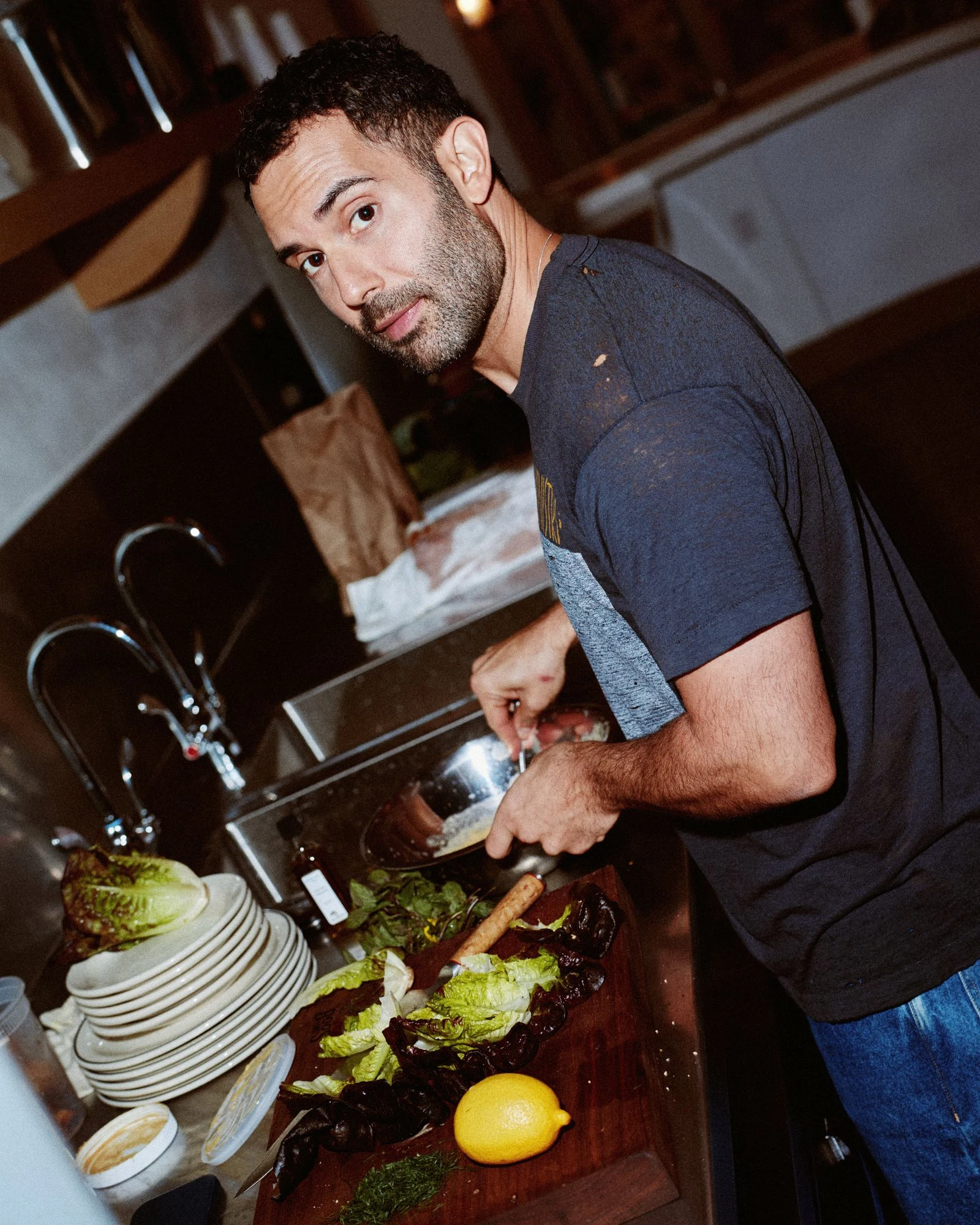
A man in a navy t-shirt preparing food in a residential kitchen.
The planned food at Andy Baraghani Ditto reads as a translation of his working habits into a public counter. Seasonal vegetables do the leading; Persian flourishes tune the seasoning; tart and sour flavors keep the food awake. The result will depend on cooks who can repeat the hand behind the recipe. A café with trays and rotisserie items needs station discipline: the pastry case stocked, the salad display refreshed, the spit watched, the provisions arranged, the line answered without losing the food's edge.
Grief, Stagnancy, and the Next Service
Baraghani's father died in 2024 after small-cell lung cancer, and Baraghani has spoken about the loss as a void one learns to live with rather than solve. That understanding sits close to the restaurant's emotional center. Ditto is planned at a moment when he is juggling the opening, a second cookbook shot in his apartment, and a remodel below his home kitchen. He has said he feels calm because he is clear on what he wants to achieve.
Clarity matters here because Baraghani has already received the forms of approval that can freeze a cook: a bestselling book, a James Beard Award, a large audience, recognizable references, the public affection that comes from video work. His stated fear is stagnancy, and Ditto gives him a daily way to work against it. A restaurant resists fixed identity because service repeats with variation. The same cabbage cooks differently from week to week. The same guest returns with a sharper memory. The same counter has to be reset tomorrow.
The people around him will shape whether the idea holds. Silber is the operating collaborator. Pollock is part of the domestic life from which the project has been observed and tested. Tanis remains a mentor in the lineage that pushed Baraghani toward Estela. The unnamed cooks who take stations at Ditto will become the hands that turn Baraghani's cookbook palate into service food. Their repetition will decide what the café becomes after the first wave of attention passes.
Ditto may add dinner later, and the early test is daytime food near Union Square: pastries, salads, sides, provisions, rotisserie work, and vegetables sharpened by sourness and aromatics. Andy Baraghani Ditto matters because it moves a known palate from page and screen back onto the bench, where the food has to be made again tomorrow.
The Sunday email
Get new Made By stories every Sunday.
Every Sunday we send a lead story and up to four more about the chefs, winemakers, sommeliers and hoteliers behind the restaurants, bars, wineries and hotels we cover.