Grace Cacciato Wins S.Pellegrino Young Chef U.S. Final
Grace Cacciato’s roasted squab, chanterelles, buckwheat and purées earned the Saga senior sous chef the U.S. title and Milan place.
HM
Director of Editorial Standards
Hugo Marchetti
Filed November 12, 2026
11 min read
Grace Cacciato sent roasted squab, chanterelle mushrooms, toasted buckwheat, black raspberry purée, and Swiss chard purée into the final judging after five hours on the clock. Cacciato, senior sous chef at Saga in New York, won the 2026-2027 S.Pellegrino Young Chef Academy U.S. Regional Final in New York City and earned the American place at the 2027 Grand Finale in Milan. She had already stood inside this competition once, reaching the U.S. Regional Final in the 2022-23 cycle. This time, with Saga executive chef Charlie Mitchell as mentor, she left the Bon Appétit Test Kitchen with the U.S. title (Bon Appétit1).
Cacciato built the plate around squab, mushrooms, buckwheat, black raspberry, Swiss chard, ginger, and bordelaise work drawn from the Saga kitchen. The dish put sauce work, fruit acidity, grain texture, vegetable purée, and game cookery in front of the judges at once. In a room where 10 chefs had five hours to cook for E.J. Lagasse, Fariyal Abdullahi, Isabel Coss, Jon Yao, and Ryan Ratino, Cacciato gave the panel several tests at once: game cookery, sauce discipline, vegetable purée, grain texture, fruit acidity, and the steadiness to land all of it under a clock.Bon Appétit).
The Sunday email
Get new Made By stories every Sunday.
Every Sunday we send a lead story and up to four more about the chefs, winemakers, sommeliers and hoteliers behind the restaurants, bars, wineries and hotels we cover.
Free. One email a week, and you can unsubscribe from any issue.
The Squab, the Purées, and the Clock
The S.Pellegrino Young Chef U.S. Regional Final came down to one chef from a field of 10, each working with a signature dish developed over several months alongside a mentor. Nilou Motamed hosted the competition and named the academy’s three pillars, Community, Competition, and Mentorship (Bon Appétit1).
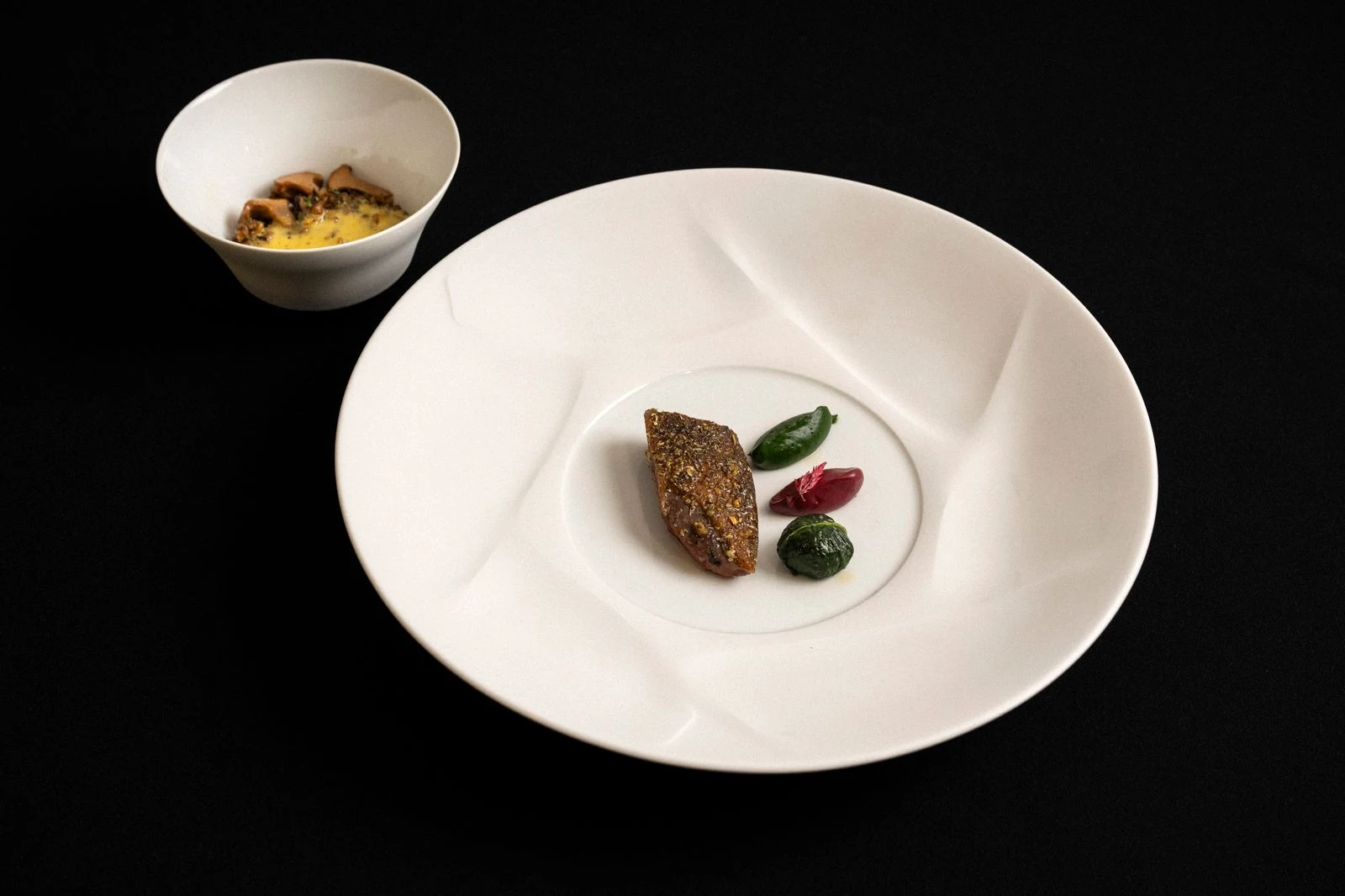
A plated dish featuring a seared protein with microgreens and garnishes, accompanied by a small bowl with a golden-topped preparation.
Cacciato represented Saga in New York, where she is senior sous chef and works alongside Mitchell. He returned for his second year as a mentor, this time with a chef who had already lived through one S.Pellegrino Young Chef Academy cycle. Mitchell said, “It was nice to see how her brain works…getting her perspective was inspiring.” Cacciato’s own line on the competition was shorter and less guarded: “It’s the best competition, and everyone wants to be a part of it.”
The official winning dish was roasted squab with chanterelle mushrooms and toasted buckwheat, black raspberry, and Swiss chard purées. Behind that title sat a family prompt. Cacciato changed direction after her great-aunt sent her a photo of a black raspberry bush growing behind her house. The fruit pulled the dish back toward the women in Cacciato’s family, a lineage she has traced through recipes rather than formal inheritance: church cookbooks, torn recipe cards, Post-it notes, and Greek dishes adapted by earlier generations to what they could find and grow in rural Ohio.
Her mother was Annie.Cacciato cooked for flavor, not just to impress a panel. She has described her approach as “flavor over flair,” and she has said satisfying the diner is the measure of whether she has done the job correctly.The squab plate combined family memory and competition technique. Its center was black raspberry, poultry, mushroom, green, grain, and sauce.
The Squab, the Purées, the Five-Hour Window
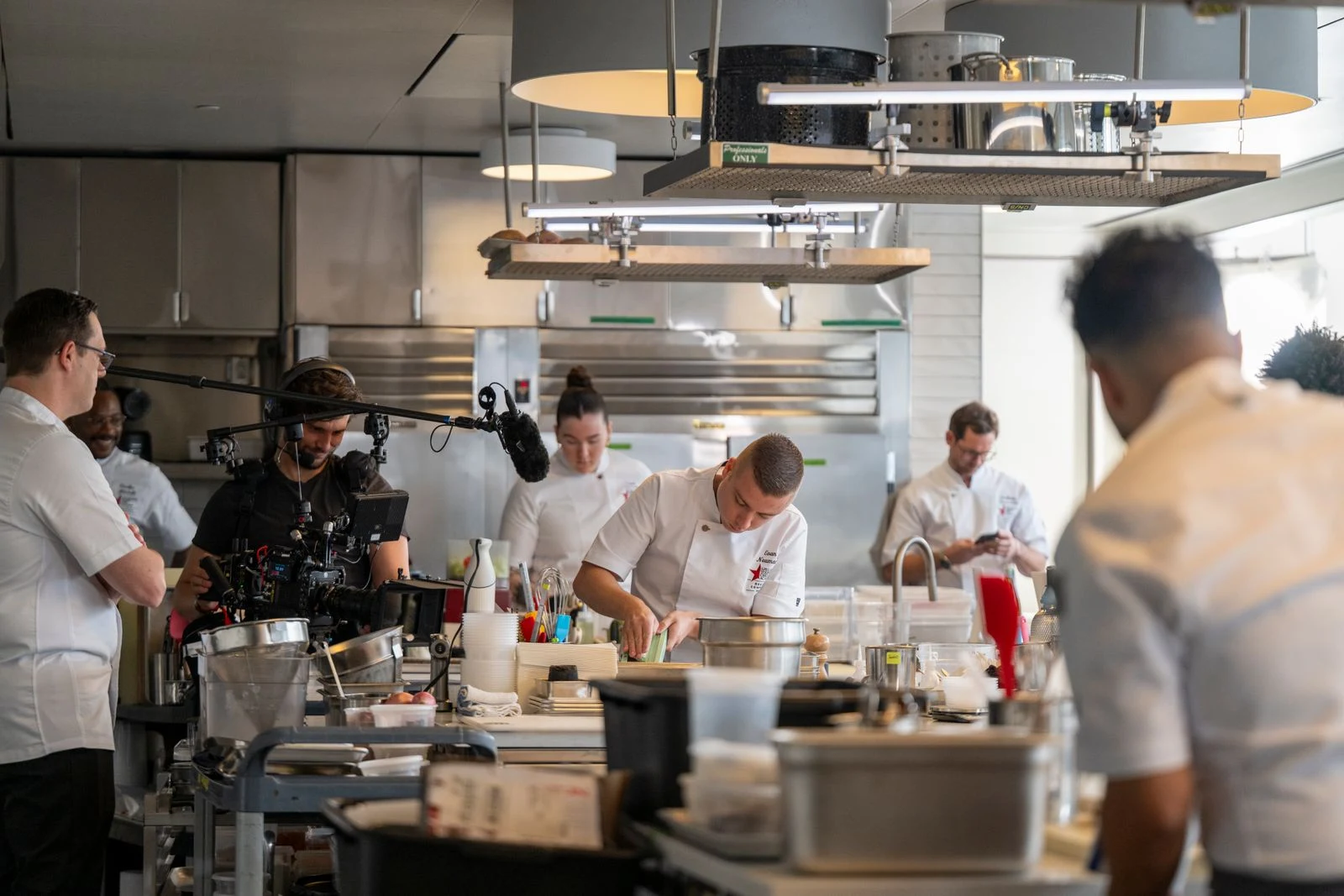
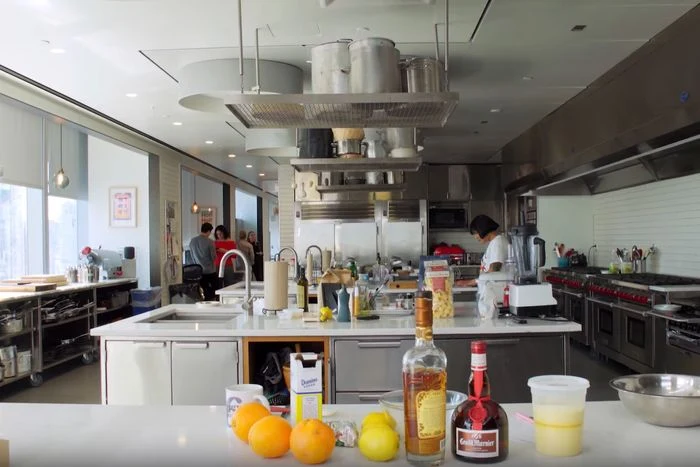
The 10 chefs cooked on Monday in the Bon Appétit Test Kitchen in New York City. That separation gave the day two tempos: the first ruled by timers, induction, pans, trays, labels, plating spoons, and server pickups; the second shaped by the formal announcement and the room’s public recognition of the work.
A professional kitchen workspace with ingredients and bottles arranged on a counter, including citrus fruits, oils, and spirits, with multiple chefs working in the background.
The competition gave the chefs five hours to cook. Squab must arrive at the judges with its cook intact. Chanterelles punish slack handling. Buckwheat can read as grain, toast, or filler depending on how the cook treats it. Purées need body without weight, and a bordelaise needs a hand willing to reduce, taste, and correct. Cacciato’s dish had the most components in the competition, so every station decision carried exposure. One late sauce, one cold purée, or one texture that eats soft against the bird can expose the dish.
The final hour shifted the room. Guests mingled over food and drinks while the competitors moved toward the finish. Rachel Bindel, a 2022 U.S. Finalist, served rye toast piled high with Maryland blue crab, horseradish crème, and pickled green tomato. Akshay Kumar, a 2024 finalist, tucked Kumamoto oysters into pani puri with cucumber gel and lemon foam. Tomato pie from Philadelphia ’s Pizza Freak Co., spoonfuls of Petrossian caviar, wines, S.Pellegrino beverages, and cocktails filled out the reception.Crab, horseradish, oyster, cucumber, lemon, tomato, caviar, bubbles, glassware, and pass traffic moved around chefs trying to finish dishes that would define their place in the cycle.
Each chef’s arrival to the judges came with a burst of music and a live video feed from the Test Kitchen. A fleet of servers collected the finished plates and delivered them to the panel.That handoff is where a competition plate stops belonging to the cook. The chef can no longer adjust a sauce line or move a garnish by a centimeter. The dish travels, sits, lands, and gets read by five judges whose own kitchens span New Orleans, New York, Washington, D.C., and Los Angeles.
The Family Recipes Behind the Squab Plate
Cacciato’s culinary identity begins in rural Ohio with women whose recipes connected her to generations she did not have the chance to meet. Church cookbooks, torn recipe cards, and Post-it notes gave her a way to study family through ingredients, substitutions, and handwriting.That is a different kind of apprenticeship from the restaurant line, but it still teaches sequence: what to begin first, what can wait, what a dish should feel like when it reaches the table.
The black raspberry entered the competition dish through a family image, not a market trend. Her great-aunt’s photo of the bush behind the house changed the direction of the plate. Cacciato carried that fruit into a composition that also drew on Saga’s kitchen language. Toasted buckwheat, chanterelles, and ginger reinterpreted the restaurant’s variations on dirty rice. The bordelaise brought traditional sauce work into view. The Swiss chard purée gave the plate another register of green bitterness and body, at least by the structure of the dish as named.
Cacciato did not serve a family recipe. She used family memory as one axis, Saga’s fine-dining discipline as another, and the competition format as the constraint. The result was a dish with enough components to risk losing clarity. The judges’ response to the sauce work and bold flavors suggests that the plate held its argument.
Mitchell was the mentor. A mentor can shape thinking over months, then stand in the Test Kitchen and not cook.The boundary kept Mitchell from cooking at the station. Cacciato had to execute the squab, the mushrooms, the buckwheat, the purées, and the sauce herself within the five-hour window. Mitchell could watch how she organized the work, and he could not cook at her station. His comment about seeing how her brain works lands because this format reveals process under pressure.
The Judges, Host, and Chefs Who Shaped the Regional Final
The judging panel gave the U.S. result its particular weight. E.J. Lagasse, chef and co-owner of Emeril’s in New Orleans, sat alongside Fariyal Abdullahi, executive chef and partner of Hav & Mar in New York City; Isabel Coss, executive chef at Pascual and founding pastry chef at Lutèce in Washington, D.C.; Jon Yao, head chef and owner at Kato in Los Angeles; and Ryan Ratino, executive chef and owner at Bresca and Jônt in Washington, D.C. Motamed held the room as host, naming the structure and guiding the competition’s public face.
Adolfo Pucci of Ariete in Miami opened with Three Shores, One Table, a dish connecting Venezuelan heritage, Southern Italian family roots, and his current home in Miami. The plate included lamb ragù inspired by his grandmother’s cooking and lacto-fermented Florida blueberries. The first presentation connected personal history and technique for the panel (Bon Appétit1).
Amit Kumar of Eleven Madison Park in New York presented the competition’s only fully vegan dish, Sunchoke with Banana Blossoms, Chanterelles, and Sherry. He drew on memories of the banana trees he grew up with in India, combining banana blossoms, sunchoke purée, chanterelles, and a ragù of sherry and banana flowers. Abdullahi called it “a very successful dish, not just a very successful vegan dish.” That sentence matters because it refuses to judge the dish by exception. It had to eat as a dish first.
Evan Neumann, representing Auro at Four Seasons Resort and Residences Napa Valley, brought From the Valley to the Shoreline, shaped by Northern California and Provence, where he grew up. Kombu-poached wild razor clams met Napa verjuice and coastal seaweeds. Neumann won the S.Pellegrino Social Responsibility Award for his approach to social responsibility and sustainable practices. Lucy Field of Per Se was the youngest competitor at 21. Her Pekin Duck, Cherry, Plum used only six components.
Marcus Osorio, chef de cuisine at Living Room in Los Angeles, cooked Tamal de Pollo, drawing from Salvadoran and Indigenous roots. The dish used corn sourced from Somos Maíz, the company founded by his mentor, Ron Oliver, and a mole poblano the two developed together. Coss noted the challenge of preparing a mole within the time limit. Mole does not bend easily to a five-hour competitive clock.
Nickolas Abbott, from Waynesville, North Carolina, and Chop Shop Butchery in Asheville, presented Smoked Pork Loin, Fennel & Cheese Slaw, Sweet Potato, Asparagus, Fried Sausage, Pork Sauce Robert. Natasha Daniels of Providence in Los Angeles cooked The Whole Bird, The Whole Garden, using every part of a chicken across four preparations with vegetables and herbs inspired by her time working at The Chef’s Garden. Nicolas Lopez of 888 in Nashville arrived with minutes to spare and a dish called Pozole or Chawanmushi…?. Juwon Lee of Octavia in San Francisco closed with Curry and Quail with Ingredients My Mother Said Were Healthy, drawn from memories of Indonesian fried chicken and his mother’s insistence on vegetables at family dinners. “I believe in the term happy food,” Lee said. “There are no restrictions other than bringing joy to the eater and the chef.”
The Other Awards Around Cacciato’s Win
Cacciato won the U.S. Regional Final, and two other chefs received awards that evening. Evan Neumann won the S.Pellegrino Social Responsibility Award. Natasha Daniels received both the Acqua Panna Connection in Gastronomy Award and the Fine Dining Lovers Award.
The Acqua Panna award was voted on by regional mentors and recognized the dish that best connected culinary traditions. Daniels’s The Whole Bird, The Whole Garden also resonated with Fine Dining Lovers insiders, who selected her for the award honoring “a chef’s expression of personal belief.” Her dish’s structure, every part of a chicken across four preparations, set belief inside butchery, station organization, and vegetable work. Nothing in that format rewards a vague statement.
The Gala menu placed past and present competitors in the same room. Garrett Brower, the 2024-25 U.S. winner and chef de cuisine at Bresca in Washington, D.C., helped craft the menu with global mentor chef Aisha Ibrahim. Bindel and Akshay Kumar fed the reception. That is the academy’s mentorship pillar in practice: finalists, winners, mentors, and judges remain in circulation around the next group. A young chef enters with a dish, but the room is built by people who have already stood near the same pressure.
What Milan Asks of Cacciato Next
Cacciato will represent the United States at the 2027 S.Pellegrino Young Chef Academy Grand Finale in Milan. A regional win settles one question and opens another: how a dish built from rural Ohio memory, Saga’s kitchen discipline, and a New York competition station will read on the Grand Finale stage.
The competition’s structure rewards chefs who can speak through a plate without letting the explanation carry the cooking. Cacciato’s clearest signal from the U.S. final was the way her dish tied personal history to classical and restaurant technique. The black raspberry came from family. The buckwheat, chanterelles, ginger, and dirty-rice reference came through Saga. The bordelaise placed sauce work at the center. The squab required cookery that could withstand delay, scrutiny, and the final walk from kitchen to judges.
Cacciato is now the American cook to track through the Grand Finale. The sauce work comes first. The black raspberry remains an anchor or becomes one component among many. Mitchell’s mentorship continues without overtaking the dish. Results from the Milan Grand Finale will move through S.Pellegrino Young Chef Academy channels and @sanpellegrino_us.
Frequently Asked Questions
Who won the 2026-2027 S.Pellegrino Young Chef Academy U.S. Regional Final?
Grace Cacciato, senior sous chef at Saga in New York, won the 2026-2027 S.Pellegrino Young Chef Academy U.S. Regional Final. Her win earned her the American place at the 2027 Grand Finale in Milan.
What did Grace Cacciato cook for the s.pellegrino young chef regional final?
Cacciato’s winning dish was roasted squab with chanterelle mushrooms, toasted buckwheat, black raspberry purée, and Swiss chard purée. The plate also drew on sauce work and flavor ideas connected to the Saga kitchen.
Where was the s.pellegrino young chef U.S. Regional Final held?
The cooking portion took place at the Bon Appétit Test Kitchen in New York City. The winner was announced the following evening at the U.S. Regional Final Gala & Awards.
Who mentored Grace Cacciato for the competition?
Cacciato was mentored by Charlie Mitchell, executive chef at Saga in New York. Mitchell returned for his second year as a mentor in the S.Pellegrino Young Chef Academy competition.
Who judged Grace Cacciato’s dish in New York?
The judging panel included E.J. Lagasse, Fariyal Abdullahi, Isabel Coss, Jon Yao, and Ryan Ratino. The chefs had five hours to cook their signature dishes for the panel.
The Sunday email
Get new Made By stories every Sunday.
Every Sunday we send a lead story and up to four more about the chefs, winemakers, sommeliers and hoteliers behind the restaurants, bars, wineries and hotels we cover.