Inside a Sakai Forge: What the Bench Actually Looks Like
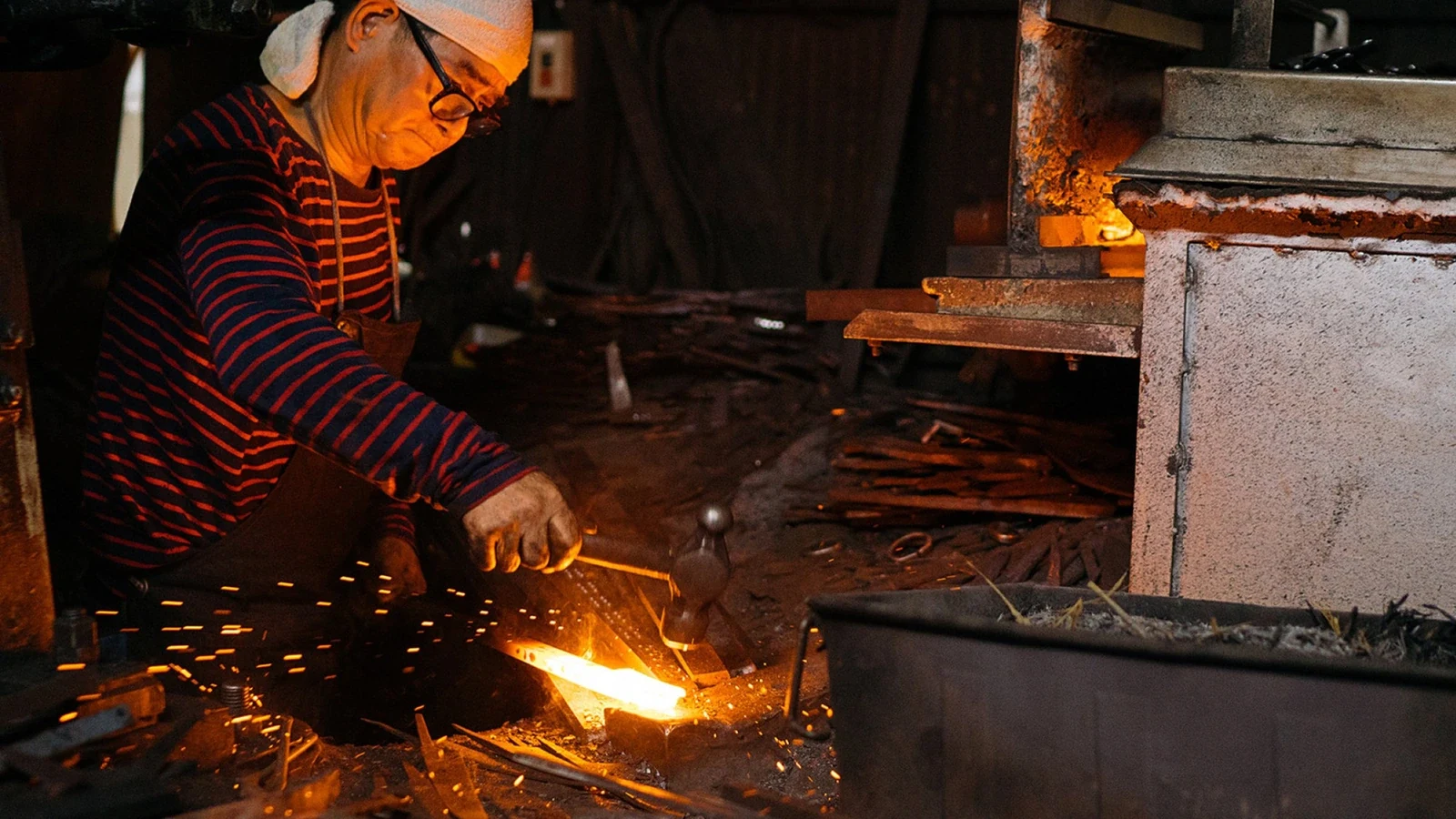
Sakai's knife-making tradition is divided across specialists. A single blade passes through the hands of a kajiya (the blacksmith who forges and shapes the steel), a togi-shi (the sharpener and polisher), and a saya-shi (the handle maker) before it leaves the city. This division of labour, refined over roughly 600 years of production, means that visiting "a forge" is not one experience but three, and the most serious workshops will show you at least two of those stations in sequence. At the forging stage, you watch the kajiya work high-carbon steel, often a laminate of hard hagane over softer jigane, at temperatures that colour the metal a specific orange before the hammer falls. The rhythm is not theatrical; it is calibrated. Each strike lands at an angle chosen to move metal in a particular direction, and the smith reads the colour of the steel the way a baker reads the crust. At the sharpening station, the togi-shi works a series of progressively finer whetstones, sometimes finishing on a natural stone from the Nakayama or Ohira quarries, holding the blade at an angle that can be as acute as ten to fifteen degrees on the single-bevel knives Sakai is known for. The sound changes at each stone: coarse, then medium, then a near-silence at the finishing stage. Most forge visits run between thirty minutes and ninety minutes depending on the operator and the depth of access arranged. Some workshops include a sharpening demonstration where visitors can try a whetstone under supervision. A smaller number offer hands-on forging experiences, though these are typically booked separately and well in advance. The workshops themselves are compact, often family-scale, with the tools and the person using them occupying the same small room for decades. You are not watching a performance; you are standing at the edge of someone's working day. Sakai's knife district is concentrated in the city's Mihara and Mozu areas, accessible from Osaka by the Nankai Koya Line to Sakai-Higashi Station or by local bus. The city's tourism infrastructure has grown to accommodate international visitors, and several retailers along the main shopping street maintain display floors where finished knives can be handled and purchased alongside the forge visits.Why Getting Substantive Access to Sakai's Forges Takes Planning
The difficulty is not scarcity in the way a Michelin-starred counter is scarce. It is a question of language, protocol, and the fact that most of Sakai's master smiths are running production workshops, not visitor programmes. Cold-walking into a forge and expecting a guided demonstration is unlikely to work; the kajiya is at the anvil, not at the door. The deeper workshops, those run by smiths in their third or fourth decade on the tools, are often the hardest to access independently. Some operate entirely through wholesale channels and have no retail presence at all. Others work with a single retailer who acts as the point of contact for any visitor enquiry. The city's most senior craftspeople, some of whom trained under smiths who themselves trained under the generation that rebuilt the trade after the Second World War, are not inaccessible, but they are not waiting to be found by a visitor who has not done the groundwork. Visiting craftsmen workshops in Sakai requires making an appointment at Sakai Hamono1 first. Language is the practical barrier for most international visitors. Japanese is the working language of every forge in Sakai, and while some retailers employ English-speaking staff, the smiths themselves rarely do. A guided tour with an interpreter, or a visit arranged through a retailer who has an existing relationship with the workshop, resolves this almost entirely.When Sakai Forge Visits Are Available and How to Confirm
The forges of Sakai do not publish a unified booking calendar, and individual workshops set their own availability. Some close on Sundays and national holidays; others close during the hottest weeks of summer or around the New Year period. The Sakai City Tourism Association and several of the city's established knife retailers maintain booking enquiry pages, but specific availability windows are not published in advance in any centralised system. Confirm directly with the operator or retailer you intend to book through before planning travel around a specific date. Guided group tours through tourism operators tend to have more predictable scheduling, with departures on fixed days of the week during the main travel seasons. These are the most reliable option for visitors who cannot read Japanese or who do not have an existing contact in the trade.The Channels That Actually Work
Through a Sakai knife retailer. Several of the city's established retailers, including shops that have been operating for multiple generations, offer forge visit arrangements as part of a purchase or as a standalone booking. This is the route that gets you closest to the working bench, because the retailer has an ongoing relationship with the smith and can frame the visit appropriately. Enquire directly by email or through the retailer's contact page; do not expect a same-day response. Through a guided tour operator. Osaka-based tour operators and Japan-specialist travel companies offer half-day and full-day Sakai knife itineraries that include forge visits, sharpening demonstrations, and retail time. These tours are conducted in English and are the most accessible entry point for first-time visitors. One well-documented option is the Wabunka-lux private experience at Wada Shouten,2 which is private, accommodates one to eight guests, runs 120 minutes,2 includes an English-speaking guide,2 and starts from $358 per person.2 Guests choose from three knife types: Deba, Sashimi, and Santoku.2 Search for operators who specify forge access rather than showroom visits; the distinction matters. Through the Sakai City Tourism Association. The city's tourism body maintains information on forge visits and can direct enquiries to appropriate contacts. This is a slower channel but useful for visitors who want to arrange something outside the standard tour formats. Direct contact with a workshop. Possible, but requires Japanese-language communication and an understanding of the protocols involved. Wada Shoten can be reached by telephone at 072-232-1886.3 Note that an English guide at Wada Shoten requires advance reservation and carries a separate fee.3 Arriving unannounced at a working forge is not recommended and is likely to result in a polite refusal.Cost Breakdown Across the Visit
Guided forge tour costs vary by operator and format. The Wabunka-lux private experience at Wada Shouten is priced from $358 per person2 and can be cancelled free of charge up to 15 days prior.2 Wada Shoten accepts payment by cash, credit card (VISA, Mastercard, American Express), and PayPay.3 For other operators, specific pricing is not uniformly published and changes by season and group size; confirm current pricing directly with the operator at the time of booking. Knife purchases, if you choose to make them, are the most significant cost of the visit. Hand-forged single-bevel knives from Sakai's working smiths range from entry-level pieces to blades that represent many hours of a master's time, and the price reflects that directly. There is no obligation to purchase, but the retailers who arrange forge access do so partly because the visit creates informed buyers, and that context is worth understanding before you go.Mistakes That Cost People the Access
Arriving without an arrangement. The forges are working production environments. Showing up at the door of a workshop you found on a map, without a prior introduction or booking, is the single most reliable way to be turned away. The smiths are not being unfriendly; they are at the anvil. Booking a showroom tour and calling it a forge visit. Some operators offer "knife experiences" that take place entirely in a retail or demonstration space, with no access to a working forge. Read the itinerary carefully. If it does not specify that you will be in a production workshop watching a smith at work, it probably will not happen. Underestimating the language barrier. Even with a guide, the technical conversation about steel types, heat treatment, and sharpening angles is richer when someone in your group has enough Japanese to ask follow-up questions. If you have any Japanese, use it; it changes the register of the visit. Treating the visit as a shopping trip with a factory tour attached. The smiths and retailers who open their workshops to visitors do so because they want the work to be understood, not just purchased. Visitors who engage with the process, who ask about the steel, the lineage, the training, get more from the visit and leave a better impression for the next person who comes through.Who Should Make the Trip and When
Sakai is worth the journey for any cook who uses knives seriously and wants to understand what they are holding. It is worth it for anyone who has spent time at a whetstone and wants to watch a togi-shi work a natural finishing stone. It is worth it for the student of craft who wants to see a production system that has divided labour across specialists for six centuries and still produces blades that no factory process has matched for edge geometry on a single-bevel knife. It is not the right trip for someone who wants a passive experience or who is not prepared to engage with the work on its own terms. The forges are not set up for spectators; they are set up for production. The visitor who gets the most from Sakai is the one who arrives having already spent time with a Japanese knife, who knows the difference between a yanagiba and a deba, and who has at least one specific question ready before the smith picks up the hammer. The best seasons are spring and autumn, when the heat of the forge is not compounded by Osaka's summer humidity and when the city's tourism infrastructure is running at full capacity. The Sakai Traditional Crafts Museum (Sakai Denshokan) has free admission4 and is open Monday through Sunday, 10:00 AM to 5:00 PM,5 making it a useful orientation stop before or after a forge visit. On weekends, knife sharpening and maintenance demonstrations are held at the museum,6 which gives visitors a grounded sense of the craft before they step into a working workshop.Alternatives When the Forge Visit Doesn't Come Together
Sakai Forge Visits vs. Comparable Knife Craft Experiences in Japan
| Experience | Access Difficulty | Language Barrier | Hands-On Option | How to Book |
|---|---|---|---|---|
| Sakai forge visit (guided tour, e.g. Wabunka-lux at Wada Shouten2) | Low to moderate | Managed by guide | Yes (Deba, Sashimi, or Santoku by arrangement)2 | Tour operator or retailer |
| Sakai forge visit (independent/direct, e.g. Wada Shoten direct3) | High | Japanese required; English guide available at extra fee with advance reservation3 | Possible with prior arrangement | Direct contact, Japanese language |
| Eric Chevalier blacksmithing tour, Sakai | Moderate | Japanese, English, and Traditional Chinese available7 | N/A | Japan Roots Guide enquiry page |
| Seki City knife workshops (Gifu Prefecture) | Low to moderate | Some English available | Yes (knife-making classes available) | Seki City tourism operators |
| Tokyo knife retailers (Kappabashi district) | Very low | English widely available | Sharpening demonstrations only | Walk-in |
Worth the Journey?
Yes, and the guided tour route is the one that reliably delivers what the trip promises. The independent approach, arriving with a name and a contact and enough Japanese to explain yourself, is more rewarding when it works, but it requires preparation that most visitors have not done. The tour operator route places you inside a working forge, in front of a smith who is actually at the anvil, with someone beside you who can translate the technical conversation. That is the experience. The showroom alternative is not. Book early if you are travelling in spring or autumn. Confirm the itinerary in writing before you pay: the phrase "forge visit" should appear, not just "knife experience" or "knife district tour." If you are serious about the craft, ask the operator which smith or workshop you will be visiting and do some reading before you arrive. The visit is richer when you already know the difference between the steel types and can ask a specific question about the laminate. With advance reservation at Wada Shouten, the knife can be finished with the visitor's name and prepared ahead of time,2 a detail that speaks to how seriously the workshop takes the relationship between maker and recipient. For the cook who wants to understand what a hand-forged single-bevel knife actually is, Sakai is the answer. The city has been making these blades for six centuries, and the hands doing the work today trained under the hands that trained under the hands that built the tradition. That lineage is visible in the workshop if you know to look for it, and the looking is what makes the journey worth taking.Frequently Asked Questions
Can you walk into a Sakai knife forge without a prior booking?
In most cases, no. The forges of Sakai are working production workshops, not visitor centres, and arriving unannounced is likely to result in a polite refusal. Visiting craftsmen workshops in Sakai requires making an appointment at Sakai Hamono first. A small number of workshops attached to retail operations may allow walk-in visits to their showroom floors, but access to the working forge itself requires a prior arrangement, either through a tour operator, a retailer, or direct contact in Japanese.
How far ahead should you book a Wada Shoten or Wabunka-lux forge experience?
The forges do not publish a unified booking calendar, and availability varies by workshop and season. For guided group tours through established operators, the operators themselves do not publish a fixed lead-time requirement; confirm availability directly with the operator before finalising travel plans. The Wabunka-lux private experience at Wada Shouten can be cancelled free of charge up to 15 days prior, which gives some flexibility once a date is secured. The Sakai City Tourism Association can advise on current availability for other formats.
Does the Wada Shoten experience include a hands-on knife-making component?
Yes. The Wabunka-lux private experience at Wada Shouten allows guests to choose from three knife types (Deba, Sashimi, and Santoku) and, with advance reservation, the knife can be finished with the visitor's name and prepared ahead of time. The session runs 120 minutes and accommodates one to eight guests. Other guided tour formats may include supervised sharpening demonstrations; confirm with your specific operator which hands-on elements are included.
Is English spoken at the Sakai knife forges?
Not typically at the forge itself. The smiths work in Japanese, and most workshops do not employ English-speaking staff. The Wabunka-lux experience at Wada Shouten includes an English-speaking guide. At Wada Shoten directly, an English guide requires advance reservation and carries a separate fee. If you are arranging a visit independently, Japanese-language communication is effectively required. The Eric Chevalier blacksmithing tour in Sakai can be inquired about in Japanese, English, and Traditional Chinese.
What is the difference between visiting a Sakai forge and browsing Kappabashi knife shops in Tokyo?
Kappabashi is a retail district where finished knives, including those made in Sakai, are sold by specialist retailers with English-speaking staff. You can handle knives, ask about specific smiths, and make an informed purchase. A Sakai forge visit places you in the production workshop where the knives are made, watching the smith at the anvil and the sharpener at the stone. The two experiences are complementary rather than interchangeable; Kappabashi is the easier entry point, Sakai is where the craft is actually happening.