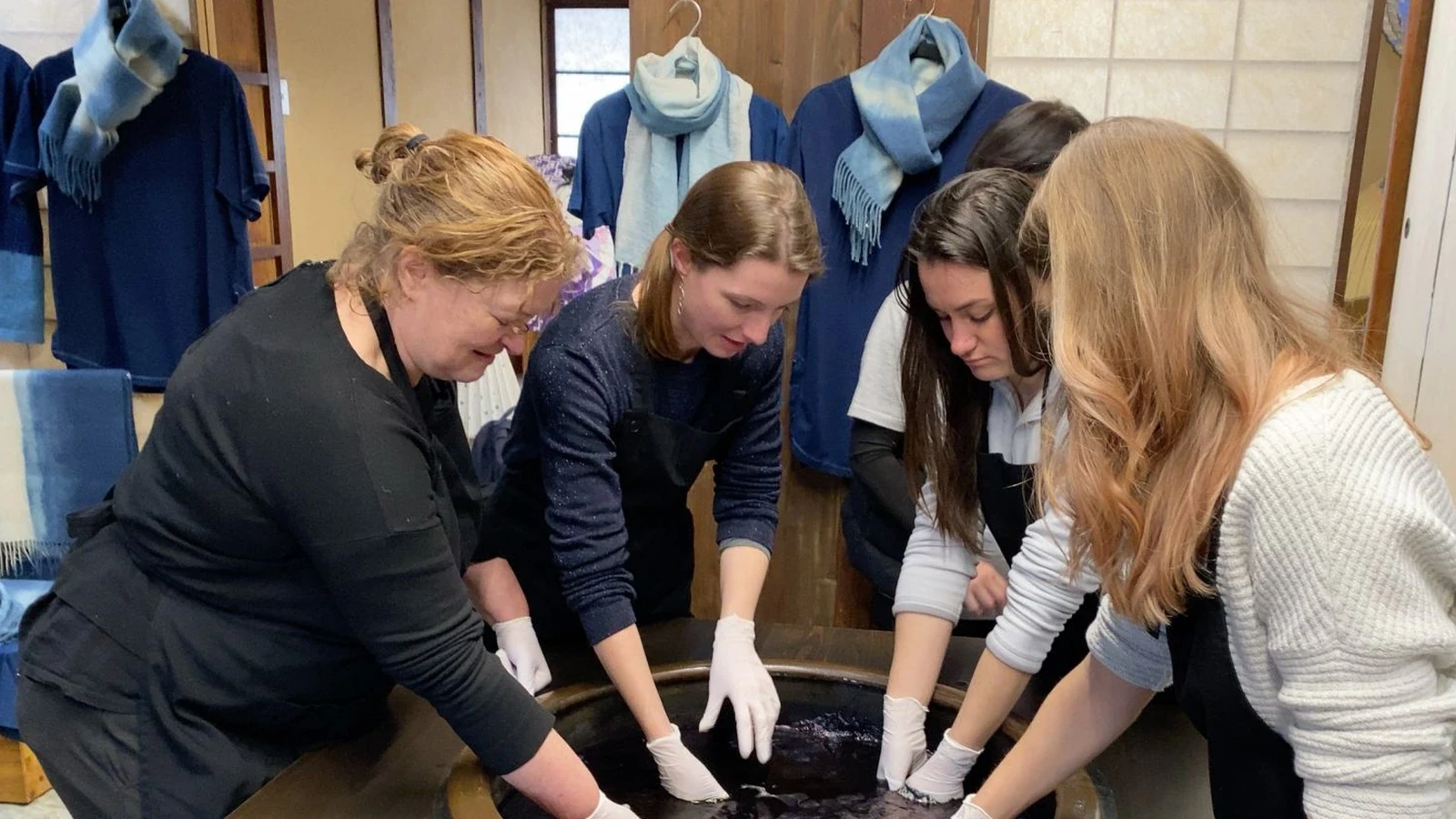
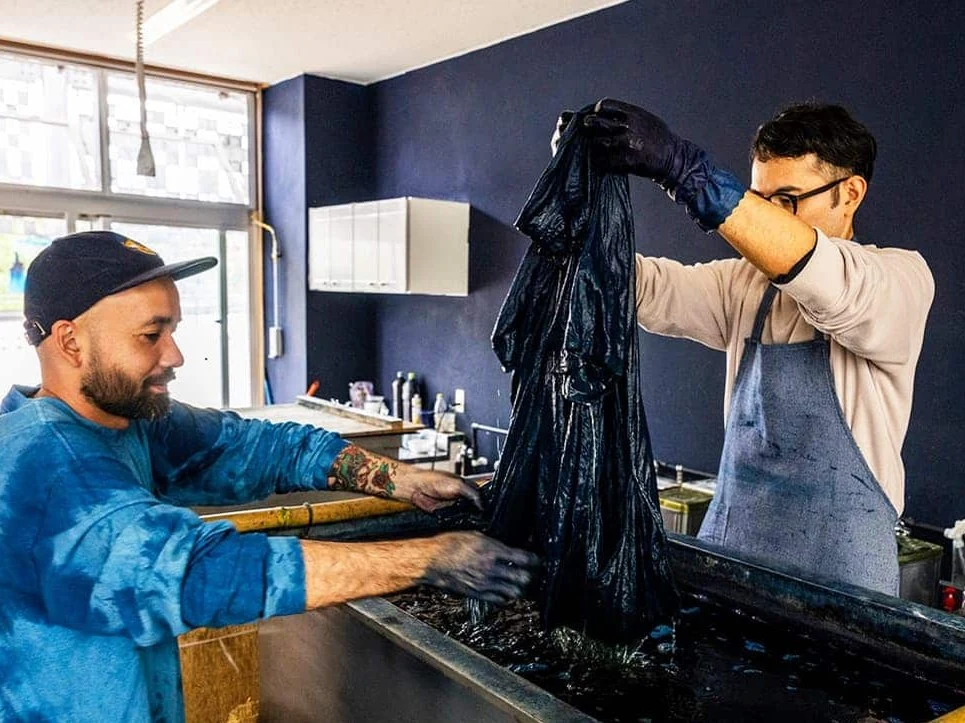
Kiyoshi Hayashi draws a length of cotton through a vat of fermented sukumo paste, lifts it into the air, and waits. The cloth is green when it surfaces. Thirty seconds of oxidation turns it blue. This is the moment that has defined the Awa region of Tokushima Prefecture for nearly eight centuries, and it is the moment you are coming to see. Access to working aizome studios in Tokushima is possible for the prepared visitor, but it requires advance contact, some Japanese-language navigation, and a clear understanding that these are production workshops, not heritage museums. The studios that accept visitors typically require prior arrangement by email or phone; walk-in access is not standard practice at most working dye houses.
Inside the Vat: What a Studio Visit Actually Looks Like
The working studios of Tokushima's Awa Indigo tradition are concentrated in the Yamakawa and Kamiita districts, where the climate and the Yoshino River basin historically supported both the cultivation of tade ai (Japanese indigo, Persicaria tinctoria) and the composting process that converts dried leaf into sukumo, the fermented dye base that distinguishes Awa indigo from synthetic or fresh-leaf methods. The sukumo fermentation alone takes roughly one hundred days, managed by a shokunin who turns and waters the composting mass daily, reading its temperature by hand.
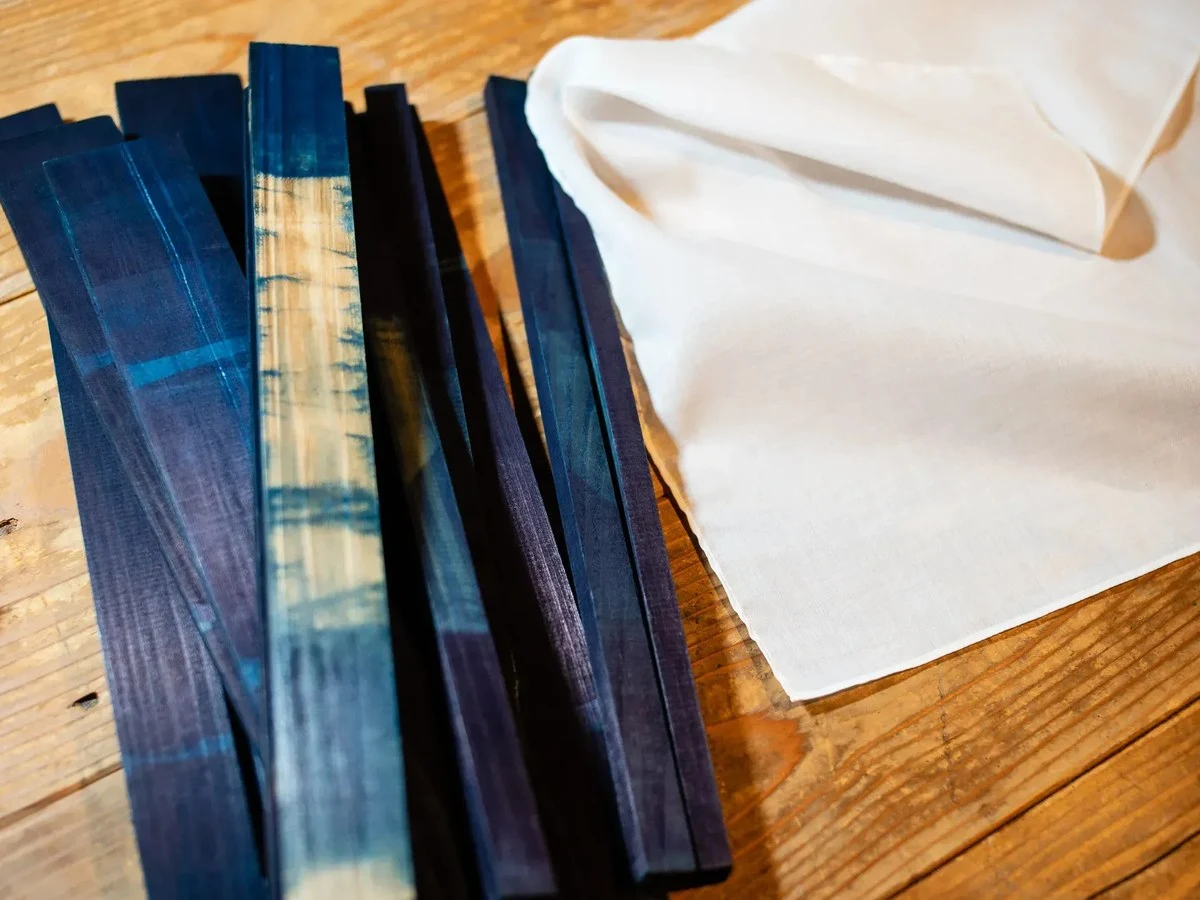
At studios that accept visitors, the format is typically a guided workshop rather than a passive tour. You work at a dye vat alongside the artisan or an apprentice, folding and binding cloth before immersion, then cycling the fabric through repeated dips and oxidation sequences. The depth of color is a function of dip count: a pale sky tone requires three to five immersions; a deep navy, sometimes twenty or more, each followed by full oxidation in open air. The vat itself is maintained at a specific alkaline pH, traditionally balanced with wood ash lye, wheat bran, and limestone, and the shokunin monitors its health by smell, color, and the behavior of the foam at the surface.
Workshop sessions at studios offering hands-on dyeing typically run between ninety minutes and two hours or more, depending on the program. The indigo dyeing experience at AoAwo Naruto Resort, for instance, lasts an estimated 90 to 120 minutes.1 Participants generally dye one or two small pieces, most commonly a handkerchief or a length of fabric suitable for a small accessory. The finished piece leaves with you, still faintly damp, the color continuing to deepen slightly as it dries and oxidizes further over the following hours. The studios are working spaces: concrete floors, wooden vat frames, the faint mineral-organic smell of the ferment, natural light from high windows or open doors. There is no theatrical staging. The craft is the staging.
Some studios also offer observation of the sukumo production process, which is seasonal (see the calendar below), and a small number of more advanced programs allow multi-day study of the full process from leaf to finished cloth. These longer programs are arranged individually and are not publicly listed with fixed pricing or schedules; the studio's own communication is the only reliable channel.
Capacity at any single studio is genuinely limited. The AoAwo Naruto Resort's indigo dyeing experience, for example, is capped at a maximum of four people per time slot.1 Working studios operate under similar constraints: the vat itself and the artisan's ability to supervise technique set a hard ceiling, and studios do not publish seat counts or booking calendars in the way a restaurant does.
Why Getting into a Working Awa Indigo Studio Takes Planning
The studios operating in Tokushima's Awa indigo tradition are small family or single-artisan operations. They are not structured around visitor throughput. The shokunin managing a fermentation vat cannot pause the process for an unannounced group; the vat's microbial culture requires consistent attention on its own schedule, not the visitor's. This is the core access constraint: the work does not accommodate the tourist calendar, and the artisans who have spent years, in some cases decades, developing their fermentation practice are not primarily in the hospitality business.
A secondary constraint is language. Most working studios in the Yamakawa and Kamiita districts conduct their business in Japanese. Studios that have developed English-language visitor programs are a subset of the total, and even those often prefer initial contact in Japanese or through a Japanese-speaking intermediary. Tokushima Prefecture's tourism infrastructure has grown around this gap, and several regional tourism organizations and craft-focused travel operators now offer facilitated access, but the independent visitor who contacts a studio directly in English should expect slower response times and occasional non-response.
Workshops at studios such as Aiyakazou are held only infrequently and irregularly; it is best to consult with the shop before making plans.2Aiyakazou is open from 9:30 to 17:002 and can be reached at 179 Aza-Maesunishi, Tokumei, Aizumi-cho, Itano-gun, Tokushima; telephone +81-(0)88-692-8723.2 This pattern, open daily but workshops by irregular arrangement, is representative of how many smaller studios manage visitor access across the region.
When Studios Open Their Doors (and When They Don't)
The studios that accept visitors do not publish a unified booking calendar, and release windows for workshop slots are not standardized across the region. Availability is managed on a rolling, inquiry-by-inquiry basis at most studios. Confirm dates directly with the studio or a regional tourism intermediary before planning around a specific date.
What is documented is the seasonal rhythm of the craft itself, which shapes when visits are most and least productive:
- Late spring through early summer (May to June):Tade ai seedlings are in the ground and the fields are active. This is a good period to see cultivation alongside dyeing.
- Late summer (August to September): Leaf harvest and the beginning of the sukumo composting cycle. The most process-rich period for a visitor interested in the full chain from plant to vat.
- Autumn through early winter (October to December): Active sukumo fermentation management. The vat work is at its most intensive and the artisans are at their most occupied; some studios reduce visitor availability during this period.
- Winter (January to March): Quieter in the fields, but the dye vats continue. Some studios find this the most available period for longer, more focused visits or study programs.
- Golden Week (late April to early May) and Obon (mid-August): Domestic tourism peaks sharply; studios that do accept visitors may be fully booked weeks in advance, or may close entirely for family observances.
How to Actually Make Contact and Book
The most reliable channels, ranked by what they realistically yield for an international visitor:
1. Tokushima Prefecture's official tourism resources and regional craft organizations. The Tokushima Prefectural Tourism Association and the Awa Indigo promotion bodies maintain updated lists of studios accepting visitors and, in some cases, facilitate introductions or provide contact templates in Japanese. This is the most practical starting point for a visitor without existing connections in the region. The Association for Indigo Industry3 maintains a public-facing web presence documenting the regional craft and its practitioners.
2. Craft-focused travel operators with established studio relationships. Several Japan-specialist travel companies have built working relationships with specific Awa indigo studios and can arrange visits as part of a broader Tokushima itinerary. This route costs more than direct contact but substantially improves the odds of a confirmed booking, particularly for non-Japanese speakers. It also typically includes interpretation.
3. Direct studio contact in Japanese. For visitors with Japanese-language ability or access to a translator, direct email or phone contact with a studio remains the most flexible route and the one most likely to yield access to less-visited, non-tourist-facing workshops. A polite, specific inquiry stating your interest in the craft (not just a "cultural experience"), your dates, and your group size will be received better than a generic tourism request. Studios respond to people who have done the reading.
4. On-site inquiry at Tokushima craft centers. The Awa Indigo Museum (Ai-no-Yakata) in Aizumi-cho, Itano-gun, and related prefectural craft facilities offer their own dyeing workshops and can sometimes facilitate introductions to working studios. These institutional workshops are more accessible and require less advance planning than private studio visits, though they operate at a remove from the production environment. The Aizome hands-on facility in Mima city can be contacted directly at 0883-76-0713.4
There is no unified online booking platform for Awa indigo studio visits, no Resy or Tock equivalent. Contact is direct and personal.
How to Improve Your Odds: What Insiders Do Differently
Contact well in advance. Studios that accept visitors are managing their production calendar alongside visitor inquiries. Arriving with a request only two weeks before your travel dates means competing with visitors who planned further ahead, and the artisan has no structural incentive to prioritize the late inquiry.
Frame your interest in the craft, not the experience. Inquiries that mention specific aspects of the process, the sukumo fermentation, the alkaline vat chemistry, the regional cultivar of tade ai, the difference between Awa indigo and Chinese or Indian indigo, signal a visitor worth the artisan's time. Studios that have been approached by visitors who treat the workshop as a photo opportunity have learned to screen for that.
Learn a few words of craft vocabulary in Japanese.Sukumo, tade ai, aizome, shokunin: using these terms correctly in an inquiry email signals that you have done more than a surface search. It is a small gesture, but in a tradition where the long way is the only way, small gestures of preparation are read correctly.
Consider arriving via Tokushima city and building in a day at Ai-no-Yakata first. The institutional facility gives you a baseline understanding of the process before you enter a working studio. Artisans who have hosted visitors from Ai-no-Yakata report that those visitors ask better questions and require less foundational explanation, which makes the studio visit more productive for both parties.
Mistakes that cost people access:
- Contacting studios during Golden Week or Obon without accounting for closures and peak demand.
- Sending a group inquiry without first confirming that the studio can accommodate that number; most working vat workshops cap groups at a small number of participants, as documented at resort-based programs like AoAwo Naruto.
- Requesting a visit during the peak sukumo fermentation management period (October to December) without acknowledging that the artisan's primary obligation is to the vat, not the visitor.
- Assuming that a studio listed on a tourism website is currently accepting visitors; listings are not always current, and a direct confirmation is always necessary.
Who Should Make This Trip
The visitor who gets the most from an Awa indigo studio visit is someone already working in textiles, natural dyeing, or a related craft, or someone with a sustained interest in Japanese material culture who is prepared to engage with the process rather than observe it from a distance. The workshop format rewards participants who ask questions and pay attention to the vat's behavior, not those who are primarily there for the finished piece.
It is also a trip worth making for anyone studying the relationship between agriculture and craft: the fact that the dye base is a fermented agricultural product, not a mined or synthesized pigment, places Awa indigo in a lineage that connects soil management, seasonal labor, and textile production in ways that are increasingly rare anywhere in the world.
It is not the right trip for someone looking for a polished cultural tourism experience with English-language interpretation, a gift shop, and a fixed schedule. Those elements exist at the institutional facilities, and they are fine for what they are. The working studios are something else.
Awa Indigo Access: Studio Visit vs. Institutional Workshop vs. Facilitated Tour
| Access Route | Difficulty | Lead Time | English Support | Craft Depth | How to Book |
|---|---|---|---|---|---|
| Working studio (direct contact) | High | Unverified; confirm directly with studio | Limited / variable | Highest | Direct email/phone in Japanese |
| Ai-no-Yakata / prefectural facility | Low | Days to 1-2 weeks | Available | Moderate | Prefectural tourism portal / on-site |
| Craft-focused tour operator | Medium | N/A | Included | High (operator-dependent) | Operator booking page |
| Multi-day study program (studio) | Very high | Months; arranged individually | Rare | Deepest | Direct studio contact only |
| BUAISOU Brooklyn5 (introductory workshop) | Low to medium | N/A | Yes (English-language studio) | Moderate | Tuesdays, Saturdays, and by appointment |
Where Else to Go If the Studios Are Closed
Ai-no-Yakata, Aizumi-cho. The prefectural indigo dyeing facility offers hands-on workshops that do not require the same advance planning as a private studio visit. The craft depth is lower, but the process is genuine and the facility's staff can sometimes facilitate introductions to working studios for visitors who demonstrate serious interest.
Buaisou, Tokushima. A younger studio that has built an international profile through its work with global fashion brands; Buaisou has offered workshop and visit programs and maintains an English-language presence. Their availability and current program offerings should be confirmed directly through their published channels, as program formats change. For those outside Japan, BUAISOU's Brooklyn studio is located at 117 Grattan Street at the Venus Knitting Mills Building,5 where appointments are available for visitors who want to bring their own garments to be dyed.6
Natural dye studios in Kyoto. For visitors who cannot reach Tokushima, Ai no Yakata dyeing studio in Kyoto requires reservations and is open 10:00am to 5:00pm, closed every Tuesday and year-end and New Year holidays.7 The tradition is different, the sukumo fermentation process is not always present, but the hands-on dyeing experience is accessible and the craft lineage is serious.
Textile museums in Osaka and Tokyo. The Textile Museum in Osaka and the Textile Museum in Hachioji hold documented collections of Awa indigo cloth and related materials. These are reference points, not substitutes for the vat, but they provide context that sharpens a subsequent studio visit.
Worth the Planning?
Yes, for the right visitor, and the planning is the point. The Awa indigo tradition of Tokushima is one of the few places in the world where you can stand next to a fermentation vat that has been maintained by the same family or the same method for generations, watch a length of cloth turn from green to blue in open air, and understand, in your hands, why the long way produces something that the short way cannot. That is not a claim about aesthetics. It is a claim about chemistry, agriculture, and accumulated knowledge.
The access is not difficult in the way that a three-Michelin-star reservation is difficult, a matter of timing and luck against a large field of competitors. It is difficult in the way that any serious craft encounter is difficult: it requires preparation and a willingness to engage on the craft's own terms rather than the visitor's convenience. Studios that have been approached correctly, with advance notice, a specific account of your interest in the process, and some effort at the language, tend to be generous with their time.
The direct, prepared inquiry is the route here, not an allocation list or a booking platform. For most visitors, the institutional facilities are the practical starting point, and the working studio visit is the reward for doing the groundwork first. madeby follows the people who do the work; in Tokushima, the people worth finding are the ones still managing the vat by hand, reading the ferment by smell, and pulling cloth through a process that has not needed improving in four hundred years. That kind of discipline, patient and unglamorous and entirely absorbed in the material, is what makes the trip worth planning for.
Frequently Asked Questions
Can you walk into an Awa indigo studio in Tokushima without a prior appointment?At most working studios in the Yamakawa and Kamiita districts, walk-in visits are not standard practice. These are production workshops, not open heritage sites, and the artisans managing fermentation vats cannot accommodate unannounced visitors without disrupting the work. Ai-no-Yakata in Aizumi-cho is the most accessible option for visitors without a prior arrangement; it accepts visitors with less advance notice than private studios.
How far ahead should you contact an Awa indigo studio to arrange a private visit?Studios do not publish a unified booking calendar or a fixed lead-time requirement; confirm directly with the studio before planning around a specific date. As a practical matter, arriving with a request only two weeks before your travel dates means competing with visitors who planned further ahead. Contacting during Golden Week (late April to early May) or Obon (mid-August) without accounting for closures and peak demand is one of the most common planning mistakes.
Do Tokushima's working indigo studios offer English-language workshops?A small number of studios have developed English-language programs or work with English-speaking intermediaries. Buaisou is among the studios with an established international presence. For studios without English-language capacity, a craft-focused tour operator with Japanese-language support is the most reliable route for non-Japanese speakers. Direct contact in Japanese, or through a Japanese-speaking intermediary, remains the broadest access channel across the region.
What is the best time of year to visit Tokushima's indigo dyers to see the full production process?Late summer, from August through September, covers both the leaf harvest and the beginning of the sukumo composting cycle, making it the period with the most visible production activity. Visitors interested specifically in the fermentation management process will find October through December the most active period at the vat, though some studios reduce visitor availability during this intensive phase. Winter, from January through March, is often the quietest period for domestic tourism and can yield more focused access for visitors who have arranged visits in advance.
Is there a multi-day study program available at Tokushima's Awa indigo studios for practitioners?Some studios offer multi-day or extended study programs covering the full process from leaf cultivation to finished cloth. These programs are arranged individually, are not publicly listed with fixed pricing or schedules, and require direct contact with the studio well in advance, typically months rather than weeks. They are the deepest access available and are suited to practitioners in textiles or natural dyeing rather than general visitors. The BUAISOU internship program, as one documented example, requires applicants to possess substantial knowledge in indigo dyeing and proficiency in Japanese or English.8