World Class National Finals Names 15 U.S. Bartenders
Fifteen U.S. bartenders head to Chicago for the 2026 World Class National Finals, with a new Tales Scholars path to New Orleans.
HM
Director of Editorial Standards
Hugo Marchetti
Filed June 28, 2026
9 min read
Judges remade the drinks first. Before the World Class National Finals bring 15 U.S. bartenders to Chicago from May 11-13, 2026, Tales of the Cocktail Foundation Presents World Class Sponsored by DIAGEO cut a Top 100 field by rebuilding the submitted cocktail recipes. For a bartender, that means the first gate did not rest on a clean photograph, a clever drink name, or a written spec alone. Another set of hands had to measure the drink, build it, taste it, and score the work on creativity, technique, flavor, and overall execution.
That detail matters because cocktail competitions can drift toward performance once the lights come up. Here, the first test returned to the glass. A submitted recipe had to survive distance from its maker: the dilution, the temperature, the chosen spirit, the souring line, the sweetening line, the garnish if there was one. The drink had to read when someone else made it, away from the bartender who wrote it.
The Sunday letter
Get our new stories in your inbox every Sunday.
One email with our newest profiles and guides. See a sample before you subscribe.
The March 18 announcement sets the U.S. road for 2026: Chicago first, New Orleans next through the new Tales Scholars benefit, then one U.S. representative moving toward the DIAGEO World Class Global Finals in fall 2026. The structure gives the Top 15 more than a competition slot. It gives them rooms in which to keep studying after the first judged pour.
The World Class National Finals Field Is Set
Tales of the Cocktail Foundation Presents World Class Sponsored by DIAGEO has named the Top 15 U.S. Finalists for the 2026 competition. Those finalists advance to the World Class 2026 U.S. National Finals in Chicago, Illinois, from May 11-13, 2026. One finalist will later be crowned the 2026 World Class U.S. Bartender of the Year.
The recipient, in this case, is not one maker but a field of 15. That fits a competition built around the station rather than the shelf. A bartender works in repetitions: the same jigger lift across a long service, the same stir counted by feel, the same short exchange with a guest who does not yet know what they want. The application round reduces that daily labor to a recipe and a set of decisions. The National Finals put the hands back in front of judges.
The Top 15 roster includes Alexis Ortega of Philadelphia, Becky Rose of Aurora, Bridget Ramsey of East Brunswick, Colin Williams of New Orleans, Elliott Reibert of Chicago, Gonzalo Ramos of New York, Jason Briseno of Los Angeles, Jeff Banks of Decatur, Kai Lucas of Brooklyn, Kyler Nolan of Brooklyn, Makenzie Helem of Seattle, Michelle Freed of Los Angeles, Peter Hannah of Kissimmee, Sierra Knight of Cincinnati, and Taylor Jamison-Parrish of Chicago.
The competition name carries two institutions with different kinds of weight. Tales of the Cocktail Foundation is a non-profit organization focused on education, advocacy, and community support for the hospitality industry. DIAGEO sponsors World Class and brings a global beverage alcohol platform. The named leadership around the announcement includes Charlotte Voisey, Executive Director of Tales of the Cocktail Foundation, and Erin Creighton, Director of Marketing for On-Premise at DIAGEO.
What the Judges Tested Before Chicago
The Top 15 did not arrive by résumé alone. Judges recreated and evaluated original cocktail recipes submitted by the Top 100 competitors as part of the initial World Class application. Each recipe was assessed on creativity, technique, flavor, and overall execution. Those four categories cover the span from idea to service: what the bartender imagined, how the drink was built, how it tasted, and whether the whole spec held together.
Recipe recreation is a hard kind of pressure. A drink written for competition has to communicate across distance. The builder cannot stand beside the judge and adjust the shake. The spec has to tell the truth about volume, ratio, temperature, and intended texture. If the recipe depends on a house prep, the instruction has to carry enough clarity. If it depends on a narrow margin of dilution, the method has to point the next hand toward that margin.
For bartenders reading the list, this is the useful part. The early selection favored drinks that could be remade. That does not flatten personality; it asks personality to pass through structure. A quarter ounce out of place can push a drink into sugar, heat, or acid. A garnish can explain an aroma or pull attention away from the glass. The judges used the recipes themselves as the first bench.
Why the Tales Scholars Benefit Changes the Stakes
For the first time, each of the Top 15 Finalists will receive a Tales Scholarship to attend Tales of the Cocktail 2026 in New Orleans. Tales of the Cocktail 2026 is scheduled from July 19-24, 2026, and the scholarship places the finalist class inside the 2026 cohort of Tales Scholars.
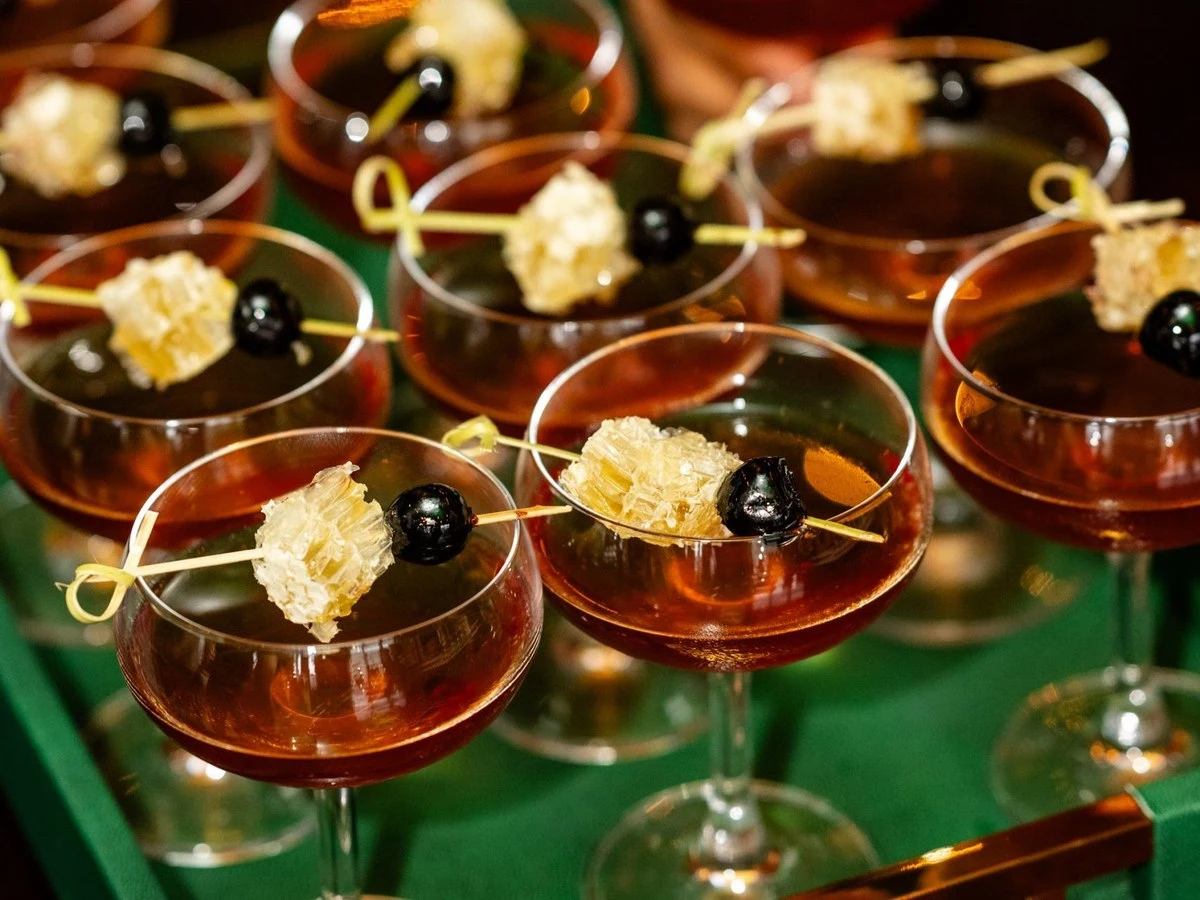
Multiple Tales of the Cocktail seminar drinks, each garnished with honeycomb and a black cherry.
"We are incredibly proud to welcome this year’s Top 15 World Class U.S. Finalists into the Tales of the Cocktail Foundation family as Tales Scholars," said Charlotte Voisey, Executive Director of Tales of the Cocktail Foundation.1
The benefit matters because it extends finalist status beyond the ranking. Only one bartender can leave the U.S. competition with the national title. All 15 will leave with access to Tales of the Cocktail 2026. Tales Scholars provides full scholarships to bartenders and hospitality professionals who demonstrate an interest in education and advancing the industry. For the Top 15, that means seminars, workshops, tasting events, and time with a global network of peers and mentors.
Competitions can create a short burst of visibility, then leave the bartender to translate that attention alone. A scholarship tied to education gives the finalist class another room to work in. It puts them beside educators, spirits professionals, bar operators, and other bartenders who may be working through the same questions: how to build a drink list that can survive service, how to train a younger station, how to keep learning after a competition season ends.
The timing changes the arc. Chicago comes in May. New Orleans comes in July. A finalist who does not take the national title still has a place on the calendar where the work continues. That matters for a craft built through repetition and correction. A bartender can lose a round and still bring a clearer method back to the pass.
From Chicago to the Global Finals
The Chicago stage narrows the field again. At the World Class 2026 U.S. National Finals, the Top 15 will compete in person through challenges designed to test craft, creativity, and performance under pressure. A Top 5 will be named during the National Finals. Those five will then face additional in-person challenges before the 2026 World Class U.S. Bartender of the Year is selected.
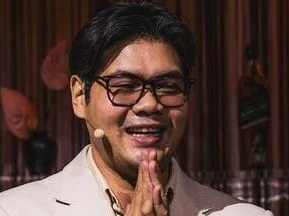
World Class 2025 features a Southeast Asian bartender making a gratitude gesture at the Global Finals.
The progression is simple on paper and demanding in practice: 100 submitted recipes, 15 national finalists, 5 final-round competitors, 1 U.S. Bartender of the Year. Each cut asks a different question. The first asks whether the drink holds. The second asks whether the bartender holds. The last asks whether the national winner can carry the U.S. into a global field.
The 2026 World Class U.S. Bartender of the Year will represent the United States at the DIAGEO World Class Global Finals in fall 2026. That global final will include national champions from more than 50 countries. For the U.S. winner, Chicago is not a finish line. It is the handoff.
That is why the World Class National Finals matter to anyone who follows bar programs closely. A bartender who performs well in this setting has shown more than the ability to make one drink. They have worked through recipe development, technical judging, in-person pressure, and the public language of craft. Those skills travel back into menus, prep systems, staff training, and the small decisions that happen between a guest’s first question and the drink landing on the coaster.
Who to Watch Among the Top 15
Read the list as a set of hands, not as a map graphic. Each name belongs to someone who wrote a recipe that judges could recreate and score against the same framework. That is the first craft fact we have. The second is that each now moves into an in-person format, where the drink is only one part of the work. Bartending under competition conditions asks for pace, explanation, station order, and the ability to keep the drink intact while being watched.
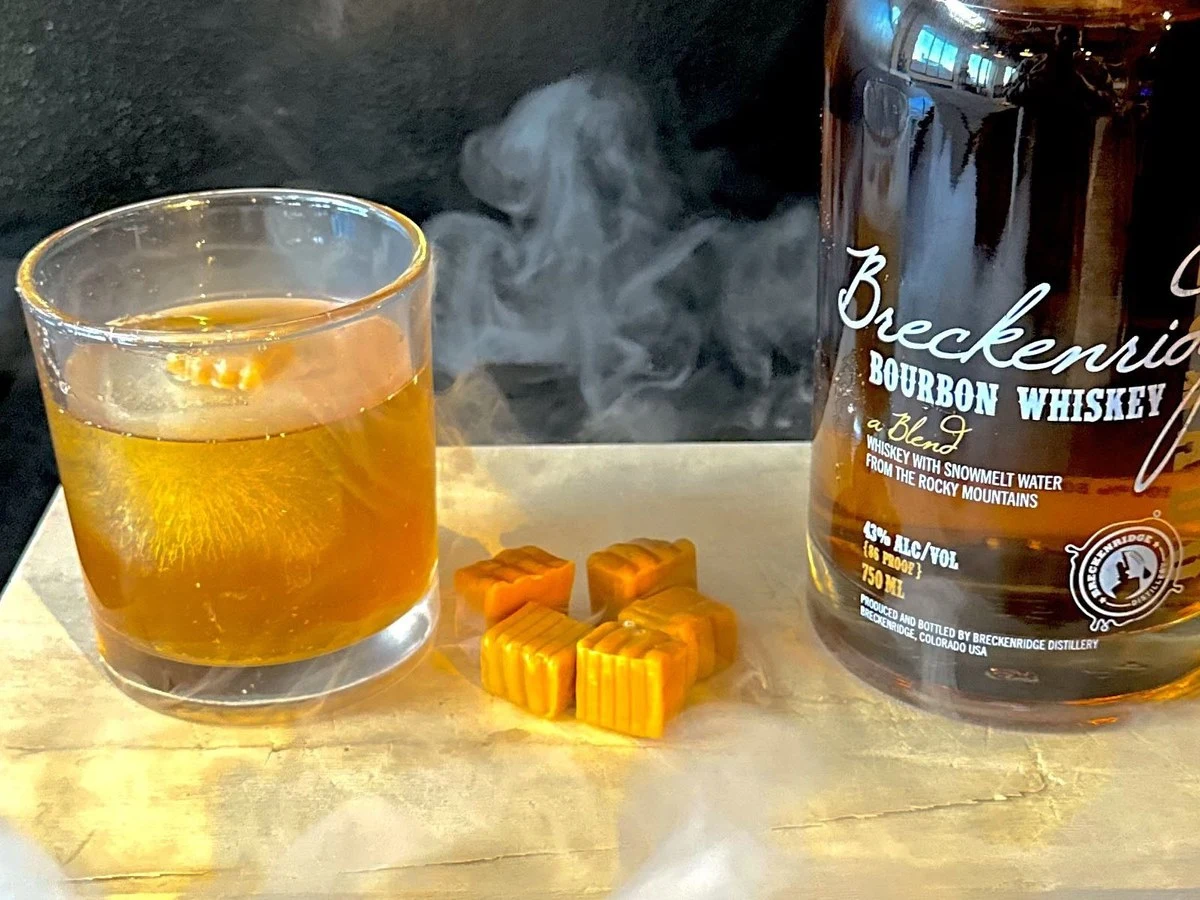
Kai Lucas's Breckenridge Bourbon Whiskey, a blend with snowmelt water from the Rocky Mountains.
Alexis Ortega of Philadelphia is one name to carry forward from this announcement because the city is named and the finalist status is now fixed. Colin Williams of New Orleans carries another calendar note, since New Orleans will host Tales of the Cocktail 2026 from July 19-24. Elliott Reibert and Taylor Jamison-Parrish of Chicago will compete in the city where the National Finals take place. Those are not predictions. They are points of contact for following the next stage.
The two Brooklyn finalists, Kai Lucas and Kyler Nolan, sit alongside Gonzalo Ramos of New York, adding three New York-listed names to the field. Los Angeles has Jason Briseno and Michelle Freed. The rest of the roster stretches through Aurora, East Brunswick, Decatur, Seattle, Kissimmee, and Cincinnati. World Class will now place those bartenders in the same room and ask the work to sort itself through the challenges.
For drinkers, the useful move is not to crown a favorite from a list. It is to learn the names and watch what happens after Chicago. Competition results often become visible later in quieter places: a tighter menu format, a clearer training language, a guest-facing drink that carries the discipline of a judged spec without announcing itself as a competition drink.
What This Recognition Means After the Final Pour
Recognition in bartending has a different texture from recognition in wine or restaurants. There is no vintage to allocate, no bottle to cellar, no dining room reservation that captures the whole result. The work happens again every night. A bartender can win a title and still has to show up for the next guest, the next ticket, the next citrus order, the next new hire who needs to learn where the station breathes.
That is why the Tales Scholars addition is the part of the 2026 announcement to keep close. It gives all 15 finalists a second form of recognition, one tied to education and access rather than only the podium. The winner will continue to the DIAGEO World Class Global Finals in fall 2026. The full finalist class will still have a professional development path through July.
For bar owners, beverage directors, and young bartenders deciding whose work to study, this list is a starting sheet. Follow the Top 15 through Chicago from May 11-13, 2026. Watch who reaches the Top 5. Watch who earns the 2026 World Class U.S. Bartender of the Year title and moves toward the global final against national champions from more than 50 countries. Then keep watching the rest of the class when they arrive in New Orleans as Tales Scholars.
The next useful dispatch will come from the competition station in Chicago, then from the education rooms in New Orleans, where the same 15 names will carry their recipes, losses, corrections, and questions into another setting. Made By follows the people who shape what you eat and drink. Subscribe, and the next dispatch from the bench, the cellar, or the kitchen comes to you.
The Sunday letter
Get the next Made By guide in your inbox.
We send one email every Sunday morning with the guides and profiles we published that week.