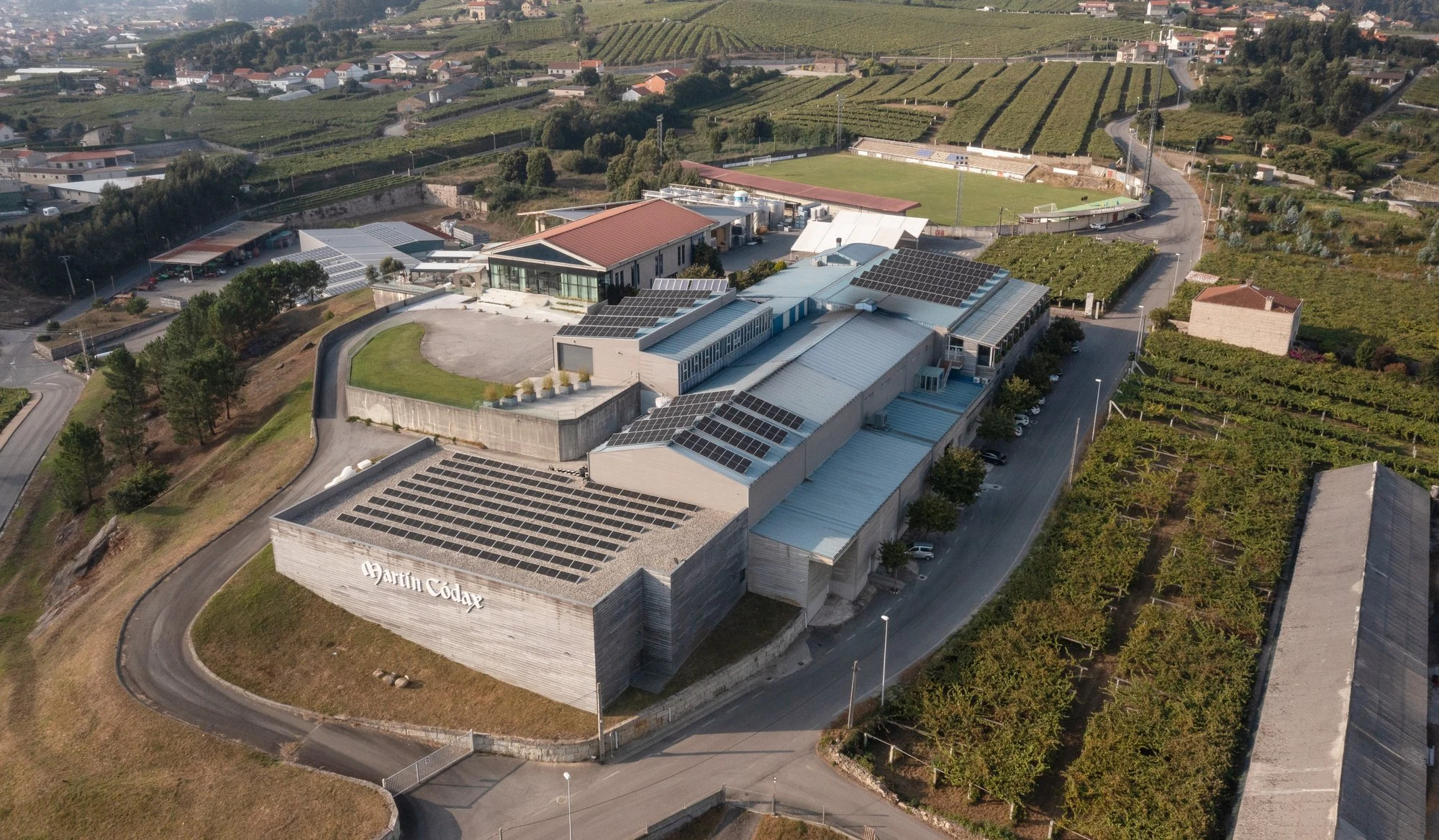
Bodegas Martín Códax operates from the granite-rooted Salnés Valley outside Cambados, at the centre of Spain's Rías Baixas DO. A Pearl 2 Star Prestige recognition from EP Club in 2025 places it in the assessed tier of Albariño producers maintaining genuine terroir expression at cooperative-origin scale. The Atlantic fingerprint, mineral salinity, high acidity, citrus-forward aromatics, is the measure by which the bodega earns its position in the appellation.
<h2>Where the Ría de Arousa Meets the Vine</h2><p>Stand at the edge of the Salnés Valley on a grey Atlantic morning and the logic of Albariño becomes immediately legible. The granite-laden soils drain fast, the ocean air keeps rot at bay, and the proximity to the Ría de Arousa lends a saline persistence to anything grown here that no winemaker fully controls and no winemaker fully deserves credit for. Rías Baixas, the DO that defines this corner of Galicia, is among the few Spanish wine regions where the terroir argument is not rhetorical, it is, quite literally, written into the stone underfoot. Bodegas Martín Códax, located at Burgáns 91 in Vilariño on the outskirts of Cambados, sits inside this conversation as one of the appellation's larger-scale producers, operating at a volume that raises the obvious question: can site expression survive commercial ambition? The answer here is more nuanced than the question implies.</p><h2>The Atlantic Signature in the Glass</h2><p>Albariño's identity is not accidental. The grape arrived in Galicia centuries ago, Cistercian monks are credited with early cultivation along the Camino de Santiago corridor, and it adapted over generations to a climate that punishes anything without thick skins and strong aromatics. The Salnés sub-zone, where Cambados sits, receives some of the highest rainfall of any Spanish wine region, sometimes exceeding 1,500mm annually. That moisture, combined with the maritime influence of the Atlantic and the free-draining granitic substrate, creates a growing season that demands precision: too much canopy and disease wins; too little and the fruit cooks on the vine in the drier summer windows.</p><p>The wines that emerge from this specific corner of Galicia carry a structural fingerprint: high natural acidity, moderate alcohol relative to other Spanish whites, and an aromatic profile that moves from stone fruit and citrus peel toward a distinctive mineral salinity that sommeliers often describe as the taste of the coast made liquid. That salinity is not a winemaking choice, it is a geological consequence, the result of vines drawing from granite soils that carry almost no clay buffer between root and rock. For a producer operating at the scale Martín Códax does, maintaining that terroir signature across volume is the central technical challenge, and the 2025 EP Club Pearl 2 Star Prestige rating signals that the appellation's character is holding in the bottle.</p><h2>Cambados and the Albariño Capital</h2><p>Cambados is the administrative and spiritual centre of Rías Baixas production. The town hosts the annual Festa do Albariño each August, drawing producers from across the DO and establishing a public identity closely tied to the grape. For visitors arriving from elsewhere in Spain, the town is roughly two hours north of Porto and around an hour south of Santiago de Compostela by car, Galicia's geography rewards those willing to commit to the drive rather than treating it as a stopover.</p><p>The wider Rías Baixas region positions itself differently from Spain's inland wine corridors. Where Rioja and Ribera del Duero trade on Tempranillo's age-worthiness and oak integration, Rías Baixas makes its case on freshness, food pairing, particularly with shellfish and seafood from the same Atlantic waters that shape its vineyards, and a regional identity that has become, over the past three decades, one of Spanish wine's clearer international success stories. Producers like <a href="https://www.enprimeurclub.com/wineries/bodegas-protos-penafiel-winery">Bodegas Protos in Peñafiel</a> and <a href="https://www.enprimeurclub.com/wineries/cvne-cune-haro-winery">CVNE (Cune) in Haro</a> represent how Spain's other major appellations built prestige through red wine programs; Rías Baixas built its reputation on a single white grape and a specific, repeatable sense of place.</p><p>For context on how Spanish wine regions are navigating scale without sacrificing identity, it is worth comparing approaches across the country. <a href="https://www.enprimeurclub.com/wineries/codorniu-sant-sadurn-danoia-winery">Codorníu in Sant Sadurní d'Anoia</a> manages volume at a category-defining level in Cava. <a href="https://www.enprimeurclub.com/wineries/lustau-jerez-de-la-frontera-winery">Lustau in Jerez de la Frontera</a> does it in Sherry. <a href="https://www.enprimeurclub.com/wineries/clos-mogador-gratallops-winery">Clos Mogador in Gratallops</a> takes the opposite route in Priorat, working at artisan scale with intense site focus. Martín Códax occupies a middle position, larger than a boutique estate, smaller than a category giant, and that positioning shapes every decision from vineyard sourcing to export strategy.</p><h2>Scale, Cooperative Roots, and Terroir Fidelity</h2><p>Bodegas Martín Códax was founded as a cooperative, and that origin still defines much of its structural character. Cooperative models in wine are often dismissed as quality-flattening, but in Galicia, where land fragmentation means the average grower works plots measured in hundreds rather than thousands of square metres, the cooperative structure is not a compromise but a practical necessity for aggregating fruit at meaningful volume. The challenge for any cooperative-origin producer aiming at premium recognition is translating consistent terroir character from dozens of small growers into a coherent wine identity.</p><p>That challenge is most visible in how Rías Baixas producers stratify their ranges. Entry-level bottlings prioritize the appellation signature, Atlantic freshness, aromatic lift, food-friendly acidity, while single-vineyard or barrel-aged tiers attempt to narrow the terroir conversation to specific parcels or winemaking choices. That recognition places Martín Códax in the assessed tier of producers working above the commodity level of Albariño that floods export markets, particularly in the United States, where the grape has become a restaurant-by-the-glass standard.</p><p>Among the Spanish wineries tracked by EP Club, producers working in established appellations with strong export track records include <a href="https://www.enprimeurclub.com/wineries/marques-de-caceres-cenicero-winery">Marqués de Cáceres in Cenicero</a>, <a href="https://www.enprimeurclub.com/wineries/emilio-moro-pesquera-de-duero-winery">Emilio Moro in Pesquera de Duero</a>, and <a href="https://www.enprimeurclub.com/wineries/abadia-retuerta-sardon-de-duero-winery">Abadía Retuerta in Sardón de Duero</a>, each navigating the tension between volume and quality in different red wine contexts. In white wine, Martín Códax is making a comparable argument for Albariño's capacity to carry prestige at scale.</p><h2>Visiting the Bodega</h2><p>The winery sits outside Cambados proper, in the rural parish of Vilariño, where the vineyard parcels supplied by grower members surround the production facility. Visits to the bodega are a logical extension of any serious Galician wine itinerary: the region's geography, with its network of estuaries and refined vine training on pergola systems (the traditional parrales that lift canopies above the damp ground), is best understood on foot among the vines rather than from a tasting room alone. Cambados itself offers accommodation and restaurant options that keep the focus on Galician seafood, percebes, zamburiñas, and the navajas that appear on every serious menu in the region, and the combination of wine and table is the natural argument for spending more than a single afternoon here.</p><p>Those building a broader Spanish winery circuit from this base should note the distance required to reach other EP Club-listed producers: <a href="https://www.enprimeurclub.com/wineries/bodegas-ysios-laguardia-winery">Bodegas Ysios in Laguardia</a> and <a href="https://www.enprimeurclub.com/wineries/bodegas-vivanco-valle-de-mena-winery">Bodegas Vivanco in Valle de Mena</a> represent the Rioja Alta end of a longer journey east, while <a href="https://www.enprimeurclub.com/wineries/arzuaga-navarro-quintanilla-de-onesimo-winery">Arzuaga Navarro in Quintanilla de Onésimo</a> and <a href="https://www.enprimeurclub.com/wineries/marques-de-grinon-dominio-de-valdepusa-malpica-de-tajo-winery">Marqués de Griñón (Dominio de Valdepusa) in Malpica de Tajo</a> anchor a Castilian leg. Internationally, the comparison set extends to producers like <a href="https://www.enprimeurclub.com/wineries/aberlour-aberlour-winery">Aberlour in Aberlour</a> and <a href="https://www.enprimeurclub.com/wineries/accendo-cellars">Accendo Cellars in St. Helena</a>, both operating in premium tiers where site identity and consistent quality assessment, rather than volume, define the conversation.</p><h2>Planning a Visit</h2><p>Advance contact with the bodega is advisable before visiting, as tour and tasting availability at producer-scale estates in Galicia tends to operate on appointment rather than walk-in terms. The August Festa do Albariño period brings the highest concentration of wine activity to Cambados but also the highest visitor volumes; the shoulder months of May, June, and September offer access to the vines at active growth or harvest stages with fewer logistical complications.</p><hr></hr>
Martín Códax operates on a working-winery model rather than a curated visitor-experience format. The estate sits in the rural parish of Vilariño, outside Cambados proper, surrounded by grower-member vineyard parcels. The atmosphere reflects the cooperative tradition at its core: functional, producer-focused, and grounded in the agricultural reality of Rías Baixas. It holds a Pearl 2 Star Prestige rating for 2025, which speaks to the quality behind that unshowy exterior.
Bodegas Martín Códax is located at Burgáns, 91, 36633 Vilariño, Cambados, Pontevedra, Pontevedra, Cambados.
Bodegas Martín Códax has received recognition including: Pearl 2 Star Prestige (2025).
The bodega's identity is built on Albariño from the Rías Baixas DO, the Atlantic-facing white grape that defines the Salnés Valley. Albariño here is shaped by granite soils and proximity to the Ría de Arousa, producing wines with the salinity and citrus tension the appellation is known for. Martín Códax's cooperative origins mean it draws on a wide network of grower parcels across the valley, giving it unusual breadth of terroir input at scale.
The most editorially significant aspect of Martín Códax is its ability to sustain appellation-level terroir expression despite operating at a scale that most small producers associate with homogenisation. Founded as a cooperative, it retains that structural model while achieving Pearl 2 Star Prestige recognition in 2025. In Galician wine, that combination of volume and quality fidelity is genuinely uncommon.
Access follows the standard model for producer-scale estates in Galicia: advance contact is advisable, as visits typically operate on an appointment basis rather than open-door hours. The bodega's address is Burgáns, 91, Vilariño, Cambados, and planning ahead before travel to Pontevedra is the practical approach. The estate is not a walk-in visitor centre, so spontaneous visits carry some risk of finding tours unavailable.
Cambados hosts the annual Festa do Albariño each August, and as one of the Salnés Valley's most prominent Rías Baixas producers, Martín Códax occupies a central position in the appellation ecosystem that the festival celebrates. The bodega's cooperative roots connect it to a wide network of local growers, making it representative of the valley's collective viticulture rather than a single-estate outlier. Timing a visit around the festival is a practical way to see Martín Códax alongside the broader Rías Baixas producer community, though the bodega's Pearl 2 Star Prestige 2025 recognition means it merits a standalone visit in its own right.
Burgáns, 91, 36633 Vilariño, Cambados, Pontevedra, Pontevedra
Cambados