Burg Restaurant
- 01CuisineClassic German Fine Dining
- 02CityGeisenheim, Germany
Castle dining above Rheingau vines
- Relais Chateaux Award · 2026
- Relais Chateaux Award · 2025
Holding the pass above the vines
The pass at Burg Restaurant asks for polish without stiffness. The kitchen in Geisenheim works a traditional regional German register with French structure behind it, and the room it serves is not neutral. Burg Restaurant sits inside the Burg Schwarzenstein estate, where romance, hotel service, wine-country expectation and traditional German cooking meet before a plate reaches the table. The food is classic German and regional, with execution credited to the kitchen collectively rather than to a named leader. The concept sits between Gut Bürgerlich cooking and fine dining, and reviews have noted the tension between those two registers.
The estate has been an upscale restaurant-hotel complex for decades, with 50 rooms, six conference spaces and Relais & Châteaux membership since 2007, and the dining room answers to all of it. Its task is not to make the setting louder. It is to hold the pass so the food can carry its own composure: a broth with duck and truffle, venison with beetroot and truffle sauce, asparagus with Hollandaise, or a poire belle Hélène that depends on timing rather than display. Geisenheim is known as Weinstadt, the wine town of the Rheingau-Taunus-Kreis, and the restaurant leans on that heritage with views over Mumm vineyards and the Rhine.
Classic German plates with cellar discipline
The menu works à la carte, with a traditional frame and a wine-country register. The kitchen moves through starters, soups, regional meats, truffle accents, cheese, and desserts rather than a fixed tasting sequence. Steak tartare arrives in marrow bone with goose liver ice cream and shaved truffle; venison takes a crêpe-style wrapping with beetroot, radish, and a truffle foie gras sauce. Wiener Schnitzel, asparagus with Hollandaise, Quiche Lorraine, and cheese keep the program grounded in dishes a guest can read before the first cut.
The measurements that define the place come from the building as much as the plate. Burg Schwarzenstein was built between 1874 and 1876 by Frankfurt architect F. Schädel for Hermann Mumm, who was raised to “Mumm von Schwarzenstein” in 1873. The estate stands at 212 meters above sea level, below Johannisberg, looking across Rheingau vineyards and the Rhine Valley. Hospitality became its central use in 1957, when Rudolf-August Oetker acquired the castle and winery and turned the house toward restaurant life. Later stewardship added the hotel layer: Georg and Magdalena Stark expanded the site around 1989, and the family foundation of Ernst Udo Grossman reopened the hotel in 2005 after renovation. The dining room carries all of that history without needing to explain it at the table.
The room keeps its castle tempo
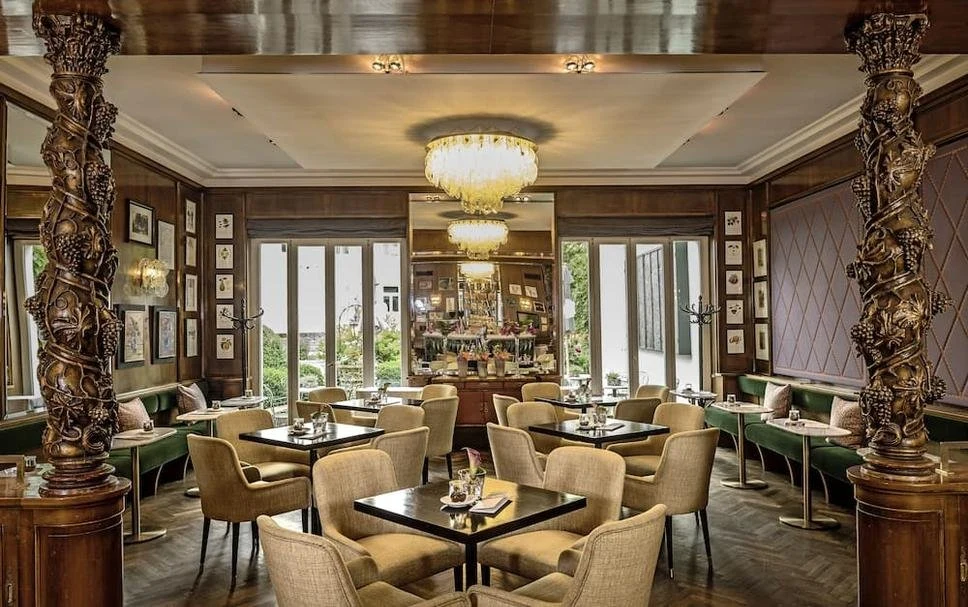
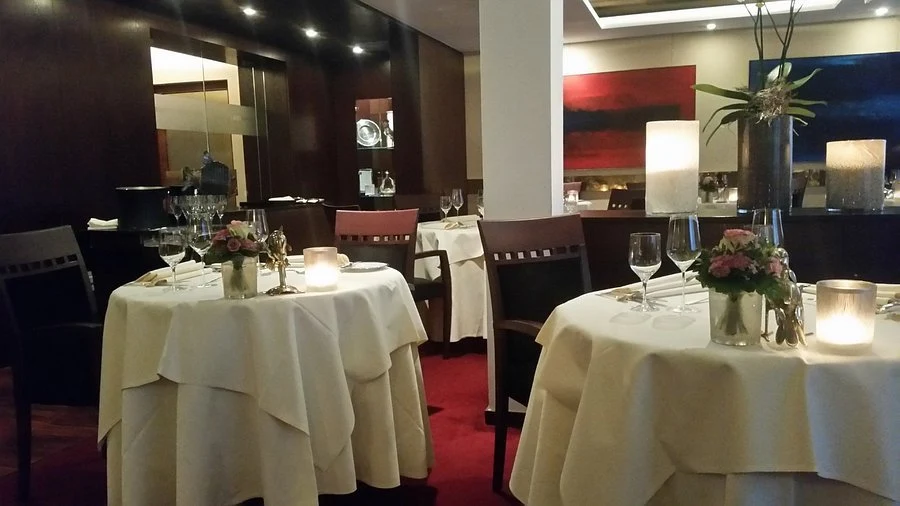
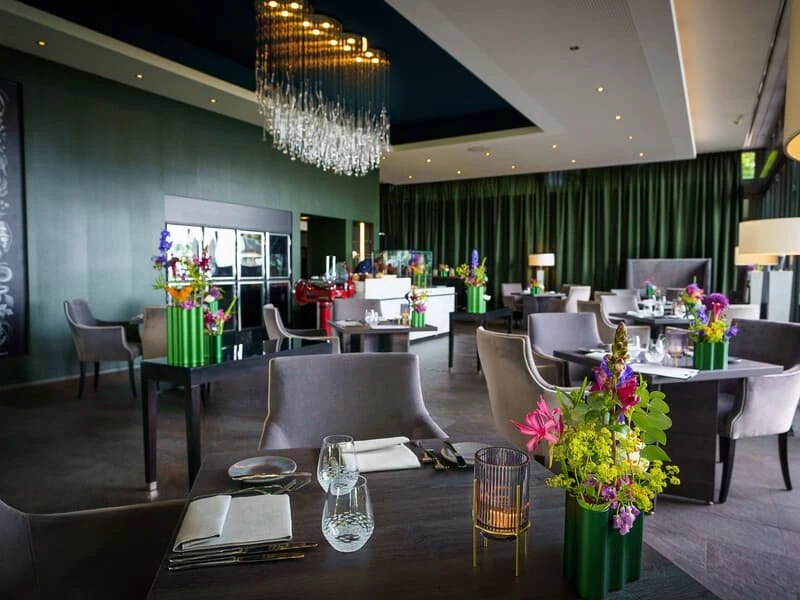
Service at Burg Restaurant moves in the old rhythm of a house that has learned hospitality room by room. The terrace catches the vineyards first, then the Rhine beyond them; inside, stone, beams, and the castle silhouette keep the meal from feeling detached from its hill. The room is classic rather than spare, with conversational sound and warm, professional service. It suits food that has been cut, sauced, folded, and carried with restraint.
The wine program stays close to the landscape outside the windows, with Rheingau bottles and Riesling naturally in the foreground. That matters here. A plate of asparagus with Hollandaise reads differently when the terrace is facing vines; so does venison, so does cheese at the end of the meal. Pricing runs high, and guests have called it justified for the taste and quality. If the next service offers the clearest measure of the house, it will come quietly, with the terrace filling and a glass of Riesling beside the marrow-bone tartare.
Questions
Frequently asked
What kind of restaurant is Burg Restaurant?
Burg Restaurant is a classic German fine dining restaurant in Geisenheim, with French structure behind the kitchen’s traditional regional approach.
What is the food like at Burg Restaurant?
The menu is à la carte and runs through starters, soups, regional meats, truffle accents, cheese, and desserts. Dishes mentioned include steak tartare in marrow bone with goose liver ice cream and shaved truffle, venison with beetroot and truffle foie gras sauce, Wiener Schnitzel, asparagus with Hollandaise, Quiche Lorraine, and poire belle Hélène.
Who is the chef at Burg Restaurant?
The kitchen is credited collectively rather than to a named leader.
Is booking recommended?
Reservations are recommended, and the venue uses OpenTable for booking.
What should I know about the setting and dress code?
The restaurant sits inside Burg Schwarzenstein in Geisenheim, above Rheingau vineyards and the Rhine. The dress code is smart casual, and there is an on-site parking lot.
The field
How it compares
| Place | Cuisine | Notes | Awards |
|---|---|---|---|
| Burg Restaurant | Classic German Fine Dining | Geisenheim, $$$ | · |
| Disfrutar | Avant-Garde Catalan Fine Dining | Barcelona | Michelin 3 Stars, World's 50 Best |
| Erbprinz | Classic German Fine Dining | Ettlingen | Michelin 1 Star |
| L'Enclume | Modern British Farm-to-Table | Cartmel | Michelin 3 Stars |
| Myojaku | Modern Minimalist Kaiseki | Tokyo | Michelin 3 Stars, World's 50 Best |
| Steinheuers Restaurant | Classic German Fine Dining | Bad Neuenahr-Ahrweiler | Michelin 2 Stars |
| Zur Tant | Classic German Fine Dining | Cologne | Michelin 1 Star |
Similar places
Avant-Garde Catalan Fine Dining
Disfrutar
Barcelona, Spain
★★★ · 50 Best
Classic German Fine Dining
Erbprinz
Ettlingen, Germany
★
Modern British Farm-to-Table
L'Enclume
Cartmel, United Kingdom
★★★
Modern Minimalist Kaiseki
Myojaku
Tokyo, Japan
★★★ · 50 Best
Classic German Fine Dining
Steinheuers Restaurant
Bad Neuenahr-Ahrweiler, Germany
★★
Classic German Fine Dining
Zur Tant
Cologne, Germany
★