Can Solé

In Residence
Mari Carmen Durán
Chef
- 01CuisineClassic Catalan Seafood Paella
- 02CityBarcelona, Spain
- Opinionated About Dining Casual in Europe Recommended · 2023
Where Barceloneta's Seafood Tradition Holds Its Ground
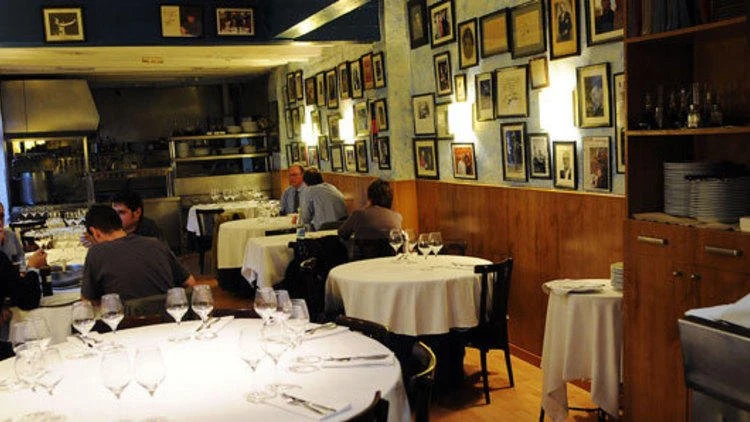
The walk down Carrer de Sant Carles from the Barceloneta metro exit takes you through a neighbourhood that has spent the last two decades lurching between tourist saturation and genuine local life. By the time you reach number four, the street has narrowed enough that the building's tiled facade reads as a kind of punctuation mark, a signal that something here has refused to move at the pace of the surrounding gentrification. Can Solé has long been part of Barcelona's dining landscape.
That longevity is not accidental. Barcelona's seafood dining has split into recognisably distinct tiers. At the upper end, places like Espai Kru by Rías de Galicia apply technical ambition to raw preparations and premium product, while Passadis des Pep operates its market-led, no-menu format for a largely local clientele. Closer to the waterfront, Xiringuito Escribà and Batea occupy the casual, terrace-forward end of the spectrum. Can Solé sits between these poles: more formally structured than a chiringuito, less technically driven than the creative seafood houses, and carrying external recognition from 2023.
The Classical Catalan Approach to Fish
In Catalonia, the dominant logic for cooking fish and shellfish has historically resisted the intervention impulse. The tradition favours heat control, quality sourcing, and the kind of sauce work, romesco, all-i-oli, sofregit, that frames the product rather than transforms it. This is a different culinary grammar from the Basque tradition of reduction-led sauces, and different again from the modernist deconstructions associated with Barcelona's higher-end creative dining at places like Disfrutar or El Celler de Can Roca in Girona. Under chef Mari Carmen Durán, Can Solé operates inside the classical register. The kitchen's credibility rests on sourcing and consistency across a lunch and dinner service that runs six days a week, closed Mondays.
That Tuesday-to-Sunday rhythm is worth noting for practical reasons. Lunch service runs 1 to 4 pm across the week, with dinner beginning at 8 pm on Tuesday through Thursday and 8:30 pm on Friday and Saturday. Sunday is lunch-only, closing at 4 pm. For visitors planning around a Barcelona itinerary, a Saturday lunch sits in the most useful window, the neighbourhood is active, the light off the water is at its finest, and the kitchen is running at full capacity rather than the compressed pace of a weeknight service.
Pairing the Mediterranean: Whites, Rosados, and the Logic of Proximity
The wine logic at a classical Catalan seafood house follows a geography that Barcelona's position makes almost automatic. Penedès sits forty kilometres southwest of the city, producing Xarel·lo, Macabeu, and Parellada that have been matched to this coastline's fish for generations. Albariño from Rías Baixas crosses the border from Galicia with enough saline mineral character to align naturally with grilled fish and shellfish preparations. And Priorat's white-wine production, still small relative to its Grenache-dominant reds, offers an oxidative, textured alternative for richer preparations involving cuttlefish or monkfish.
The pairing principle that applies here is one of mirroring proximity: wines grown near salt air tend to carry a mineral signature that amplifies rather than competes with the iodine notes in good shellfish. A well-aged Xarel·lo from Penedès, the grape responsible for the backbone of Cava but increasingly vinified as a still wine, develops a waxy, saline character that tracks alongside gambas or cloïsses in a way that an inland white, however technically correct, rarely manages. Whether Can Solé's list pushes into these finer distinctions or operates as a functional house-wine pairing programme is not verifiable from available data, but the category context is clear: any serious Catalan seafood house operating at this level will have access to the regional whites that make these pairings work. For visitors who want to explore the wine dimension further,
Rosado also deserves mention in this context. Catalonia produces Garnacha-based rosados from Empordà that are drier and more structured than the Provence-style models that have dominated the premium rosé conversation internationally. At a table of mixed shellfish, a chilled Empordà rosado performs a bridging function, mineral enough for the sea element, fruit-forward enough to handle a romesco, that neither a full white nor a light red quite achieves.
Can Solé in Barcelona's Wider Seafood comparable set
Placing Can Solé against Barcelona's broader seafood options clarifies what it offers and what it doesn't. Els Pescadors Barcelona, operating from the Poblenou neighbourhood, brings a similarly classical orientation but with a quieter, more residential setting. For travellers whose seafood interests extend beyond Barcelona, Aponiente in El Puerto de Santa María represents the furthest extreme of the creative-seafood spectrum in Spain, while Italy's coastal equivalents, Gambero Rosso in Marina di Gioiosa Ionica and Alici Restaurant on the Amalfi Coast, operate inside a different Mediterranean tradition but share the same foundational respect for proximity and product.
Within Barcelona's fine dining frame, Can Solé occupies a position well below the city's constellation of creative tasting-menu restaurants. Arzak in San Sebastián, Azurmendi in Larrabetzu, Martin Berasategui in Lasarte-Oria, and DiverXO in Madrid define a different register entirely. Can Solé signals something more specific: a room where the cooking meets a consistent standard at a moderate price point, without the ambition or the ceremony of the tasting-menu tier. That is a legitimate and distinct category, and in a neighbourhood as commodified as Barceloneta, a 120-year-old house that has earned external recognition for its cooking rather than its location is not a trivial thing.
Planning Your Visit
Can Solé is at Carrer de Sant Carles, 4, in the Ciutat Vella district of Barcelona, within walking distance of the Barceloneta beach front. The restaurant holds a Google rating of 4.3 across 1,841 reviews, which at that volume suggests consistent performance rather than outlier enthusiasm. The kitchen is closed on Mondays.
Questions
Frequently asked
Who works at Can Solé?
Made By profiles Mari Carmen Durán (Chef) at Can Solé.
How expensive is Can Solé?
Can Solé is listed at a price level of $$$.
Where is Can Solé and what does it serve?
Can Solé is in la Barceloneta, Barcelona, serving Classic Catalan Seafood Paella.
The field
How it compares
| Place | Cuisine | Notes | Awards |
|---|---|---|---|
| Can Solé | Classic Catalan Seafood Paella | la Barceloneta, $$$ | · |
| ABaC | Modern Catalan Fine Dining | Barcelona | Michelin 3 Stars |
| Alkimia | Modern Catalan Fine Dining | Barcelona | Michelin 1 Star |
| Cocina Hermanos Torres | Modern Spanish Fine Dining | Barcelona | Michelin 3 Stars, World's 50 Best |
| Disfrutar | Avant-Garde Catalan Fine Dining | Barcelona | Michelin 3 Stars, World's 50 Best |
| Lasarte | Modern Basque-Mediterranean Fine Dining | Barcelona | Michelin 3 Stars |
| Moments | Modern Catalan Fine Dining | Barcelona | Michelin 1 Star |
In residence
Similar places
Modern Catalan Fine Dining
ABaC
Barcelona, Spain
★★★
Modern Catalan Fine Dining
Alkimia
Barcelona, Spain
★
Modern Spanish Fine Dining
Cocina Hermanos Torres
Barcelona, Spain
★★★ · 50 Best
Avant-Garde Catalan Fine Dining
Disfrutar
Barcelona, Spain
★★★ · 50 Best
Modern Basque-Mediterranean Fine Dining
Lasarte
Barcelona, Spain
★★★
Modern Catalan Fine Dining
Moments
Barcelona, Spain
★