Castel Fragsburg
- 01CuisineAlpine-Mediterranean Fine Dining
- 02CityMerano, Italy
- Relais Chateaux Award · 2025
Above the Valley: Dining at Altitude in the South Tyrol
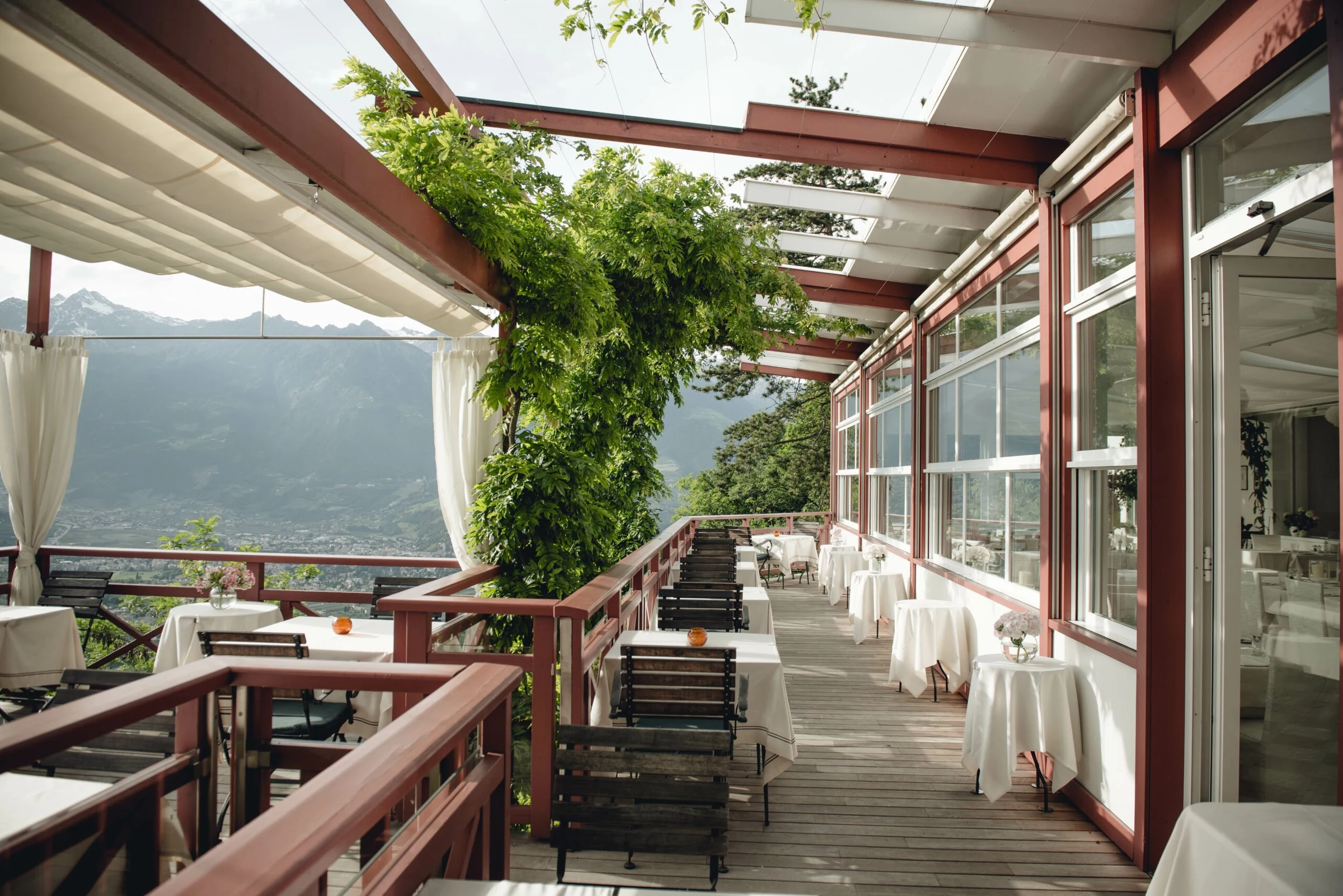
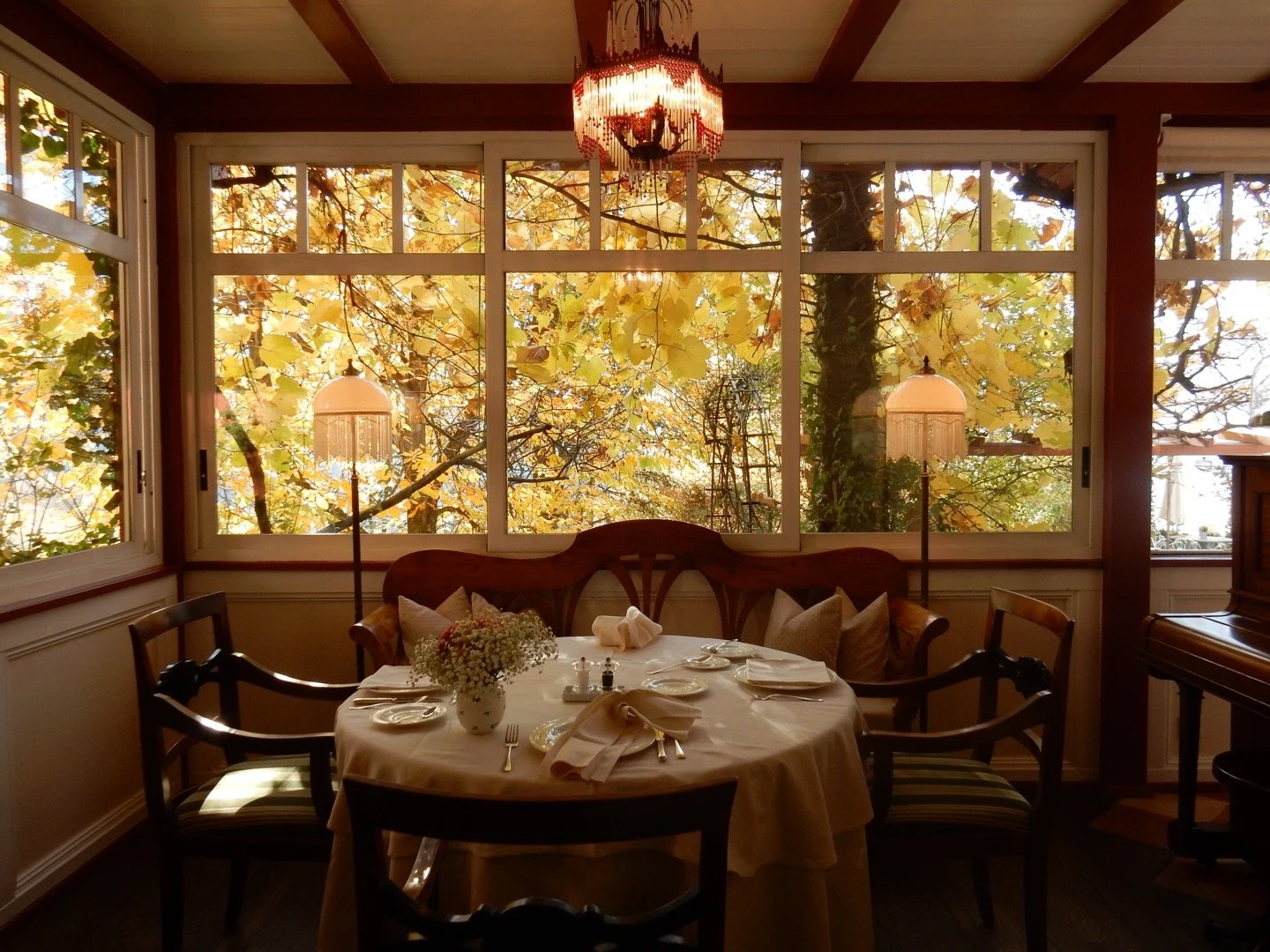
The approach to Castel Fragsburg requires commitment. The road from Merano's centre climbs steeply through terraced vineyards and chestnut forest, the valley floor dropping away behind you until the town looks like a scale model of itself. This is how Alto Adige operates at its most concentrated: the altitude is not incidental scenery but a condition that shapes everything, from the microclimate that determines what grows here to the particular mood a guest carries into the dining room. Arriving perched above the city, with the Adige valley spreading north toward the Ötztal Alps, the question of what to eat is already half-answered by where you are.
The South Tyrolean Table: A Region That Defies Simple Classification
Italian dining culture is often discussed through the lenses of Rome, Naples, Florence, or Milan, but Alto Adige sits outside those frameworks almost entirely. The cuisine here is the product of centuries of Austrian administration, a German-speaking majority population, and an agricultural tradition built around mountain pasture, game, freshwater fish, and orchard fruit rather than olive groves or coastal catches. The result is an Alpine-Italian register that has no direct parallel elsewhere in the country: speck, canederli, venison, fermented dairy, and apple-based preparations appear alongside Italian technique and northern European restraint. It is a tradition that rewards chefs willing to read it carefully rather than translate it into more familiar idioms.
This is the context in which Castel Fragsburg earns its two 2025 Michelin distinctions: a conventional Star and a Green Star, the latter reserved for restaurants demonstrating measurable commitment to sustainable gastronomy. The dual recognition places it in a small cohort of Alto Adige addresses that treat the regional larder as both a culinary and an environmental argument. For reference, that cohort includes Atelier Moessmer Norbert Niederkofler in Brunico, where mountain-product sourcing has been central to a Michelin three-star program. The Green Star signals a formal methodology, not a marketing position.
Chef Otto Nijenhuis and the Immigrant Precision Problem
One of the more interesting dynamics in contemporary Alto Adige dining is the presence of chefs who arrived from outside the region and ended up more rigorous about its traditions than many locals. Chef Otto Nijenhuis, the name behind the kitchen at Castel Fragsburg, operates in this vein: a Dutch-trained precision brought to bear on South Tyrolean ingredients and Alpine seasonal logic. The combination is less unusual here than it might appear. The region's Relais & Châteaux properties have historically drawn internationally trained talent, in part because the guest base is genuinely international and the quality standard demands it.
Nijenhuis's approach, to the extent it can be inferred from the restaurant's positioning, sits within the broader Alto Adige tendency toward ingredient focus over technique showmanship. Compared to the more urban register of Sissi in central Merano, or the creative experimentation at In Viaggio by Claudio Melis, Castel Fragsburg reads as especially rooted among the town's starred options, anchored by its setting and its Relais & Châteaux membership in a way that the more freestanding addresses are not.
Merano's Starred Tier in Context
Merano is a small city by most measures, but its dining density at the upper end is disproportionate. The town's spa and thermal tradition draws a European clientele accustomed to spending three or four nights rather than passing through, which creates the conditions for multiple restaurants to sustain Michelin-level programs simultaneously. Castel Fragsburg, Sissi, and In Viaggio each hold a Star; Gourmet Restaurant Prezioso rounds out the local upper bracket with an Italian Alpine focus. Within Italy's broader fine dining geography, that concentration rivals towns ten times Merano's size.
For the wider Italian Michelin picture, Castel Fragsburg's comparable set extends to addresses like Piazza Duomo in Alba, where regional identity is similarly the organizing principle, or to the more institution-status properties like Osteria Francescana in Modena and Dal Pescatore in Runate, where the setting-as-destination logic is equally pronounced. What distinguishes the Alto Adige addresses from those reference points is the Alpine constraint: the growing season is shorter, the ingredient palette is narrower, and the cuisine does not attempt to compensate by importing southern abundance. The discipline is built into the geography.
Elsewhere in the Italian fine dining canon, you can find the full-service urban luxury model at Enrico Bartolini in Milan, the Florentine cellar-and-technique tradition at Enoteca Pinchiorri, or the Campanian coastal register at Quattro Passi in Marina del Cantone. Each of those addresses is shaped by its regional logic in ways that make them non-transferable. Castel Fragsburg belongs to that same logic, but applied to a tradition that most Italian fine dining visitors have not fully explored.
The Setting as Practical Information
Castel Fragsburg functions as a hotel property, which changes the booking calculus. Guests staying in the castle have natural priority for the dining room, and the restaurant's profile attracts a reservation-heavy mix of hotel residents and outside diners. The property sits within the Relais & Châteaux network (contact via fragsburg@relaischateaux.com or +39 0473 24 40 71, or at fragsburg.com), which typically signals a service standard geared toward multi-night stays rather than single-meal visits. Approaching this as a dinner-only destination requires planning ahead, particularly in high season when the terrace above the valley is at its most compelling.
A guest who travels specifically to dine here is betting on a full evening, not a two-hour turnaround. The Dolomites are roughly an hour's drive, which makes the property a credible base for day excursions, the kind of programming that Relais & Châteaux properties in the region are well practiced at arranging.
Questions
Frequently asked
How expensive is Castel Fragsburg?
Castel Fragsburg is listed at a price level of $$$$.
Where is Castel Fragsburg and what does it serve?
Castel Fragsburg is in Fragsburg, Merano, serving Alpine-Mediterranean Fine Dining.
The field
How it compares
| Place | Cuisine | Notes | Awards |
|---|---|---|---|
| Castel Fragsburg | Alpine-Mediterranean Fine Dining | Fragsburg, $$$$ | · |
| Daniel | Modern French Fine Dining | New York City | Michelin 1 Star, World's 50 Best |
| Gourmet Restaurant Prezioso | Modern South Tyrolean Fine Dining | Merano | Michelin 1 Star |
| Jordnær | Modern Nordic Seafood Fine Dining | Gentofte | Michelin 3 Stars, World's 50 Best |
| Pujol | Modern Mexican Fine Dining | Mexico City | Michelin 2 Stars, World's 50 Best |
| Saison | Modern Fire-Forward Fine Dining | San Francisco | Michelin 2 Stars, World's 50 Best |
| The Clove Club | Modern British Fine Dining | London | Michelin 2 Stars, World's 50 Best |
Similar places
Modern French Fine Dining
Daniel
New York City, United States
★ · 50 Best
Modern South Tyrolean Fine Dining
Gourmet Restaurant Prezioso
Merano, Italy
★
Modern Nordic Seafood Fine Dining
Jordnær
Gentofte, Denmark
★★★ · 50 Best
Modern Mexican Fine Dining
Pujol
Mexico City, Mexico
★★ · 50 Best
Modern Fire-Forward Fine Dining
Saison
San Francisco, United States
★★ · 50 Best
Modern British Fine Dining
The Clove Club
London, United Kingdom
★★ · 50 Best