Fürstenfelder
- 01CuisineModern Organic German
- 02CityFürstenfeldbruck, Germany
Josper heat under monastery vaults
- Michelin Bib Gourmand · Michelin Guide
- Michelin Bib Gourmand · 2026
- Michelin Bib Gourmand · 2025
- Michelin Bib Gourmand · 2024
Organic produce under the cross vault
Seasonal vegetables reach the open kitchen before service; the Küchenteam at Fürstenfelder in Fürstenfeldbruck works within a restaurant built around organic regional sourcing, and the kitchen is credited collectively rather than to a single name. The setting asks for steadiness. The room sits in the Kreuzgewölbe of a former monastery cattle shed, part of the Fürstenfeld Abbey complex founded in 1258 by Duke Louis II of Bavaria, and the cooking has to hold its own against stone, light, and a building that was never designed for performance. What the house does make plain is its method: a modern organic German kitchen, visibly worked, with local produce, humane animal sourcing, and a menu that moves between buffet and à la carte without treating either format as secondary. Fürstenfelder holds a Michelin Bib Gourmand and a green Michelin star distinction for sustainable organic cuisine, recognitions attached to this house and its present program. The discipline is not a tasting-menu kind of austerity. It is closer to daily repetition: vegetables, meat, fish, soup, sweets, and the pressure of keeping a generous room aligned with a sustainable brief.
The Josper and the buffet bench
The kitchen’s most legible gesture is heat. Nackensteak and other Josper grill dishes give the menu its darker edge, with neck steak from the grill served with sauce and baked buttermilk crumbs among the dishes associated with the restaurant. The grill sits beside a broader organic program that includes seasonal vegetables, selected meats and fish, vegetarian and vegan cooking, and a crossover range that can move from alpine references to oriental inflection. That breadth matters because Fürstenfelder works in two registers. One is the self-service buffet, stocked with salads, soups, starters, hot dishes, and desserts, where abundance has to be kept fresh rather than merely full. The other is the à la carte pass, where the structure tightens into starters, soups, mains, and dessert. In both, the sourcing carries the argument. Organic and regional are not decorative words here; they shape the available produce, the animal buying, and the kitchen’s nose-to-tail position. A baked cauliflower with artichoke cream, pear chutney, and crisp leaves belongs to the same program as salmon trout with smoked burrata or a grilled meat dish. Each has to earn its place without breaking the house’s sustainable line.
A room made from monastic utility
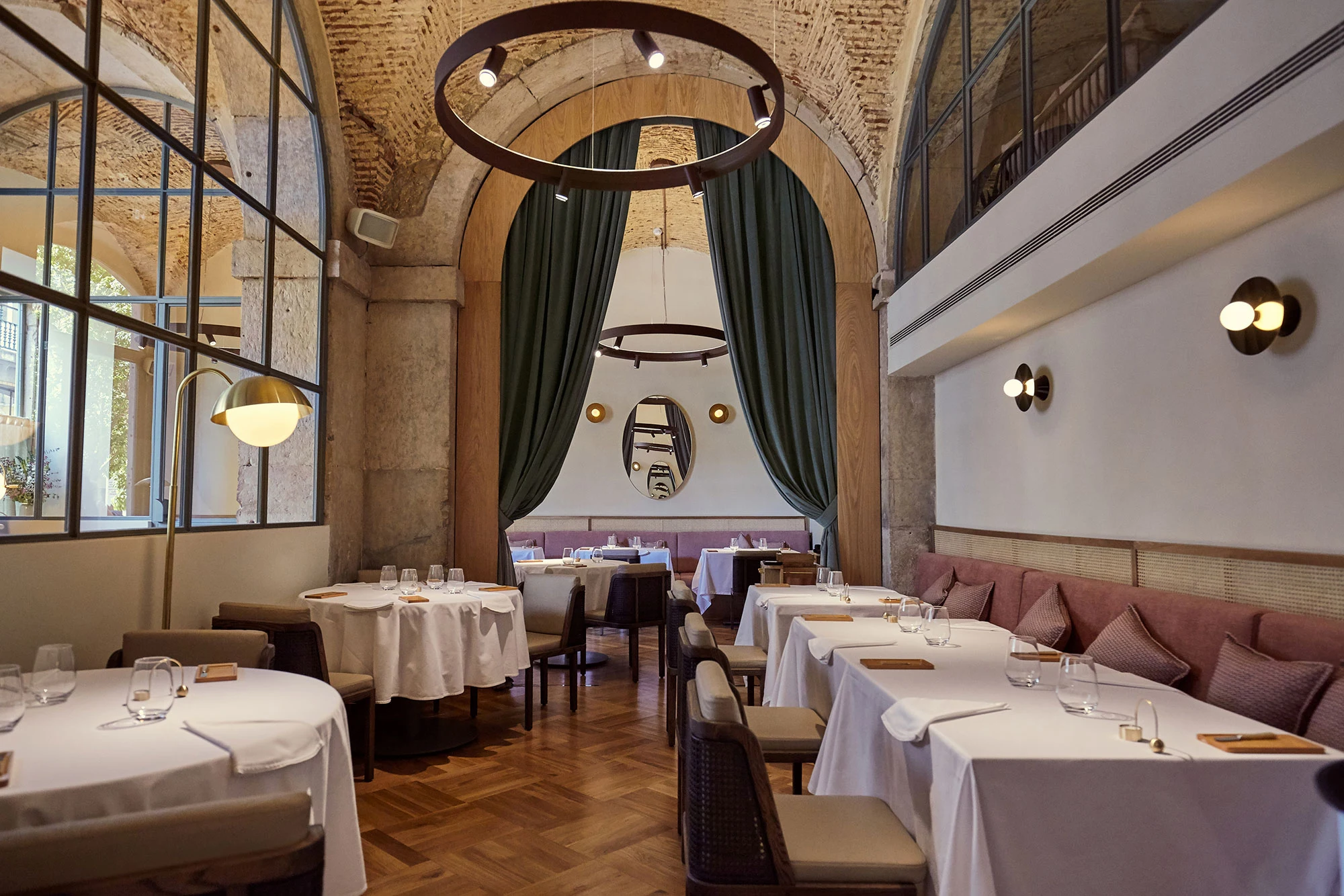
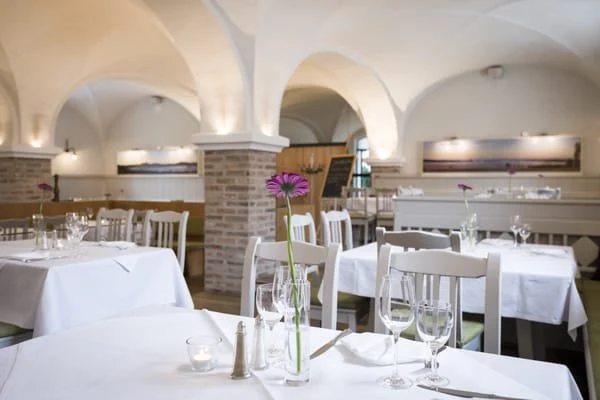
The room keeps the old volume but does not turn it into theatre. Vaulted ceilings, pale natural light, plants, timeless furniture, quiet nooks, and communal tables soften the former cattle shed without hiding it. Guests can see the open kitchen, which changes the register of the meal; the pass is part of the room’s rhythm, not a hidden engine behind it. Service sits in an upscale casual mode, conversational rather than hushed, and the dining format lets different appetites share the same architecture. A family can move through the buffet while another table waits on grilled fish or steak from the kitchen. Outside, the monastery complex gives the restaurant a larger frame, but the craft stays bench-side: cutting, grilling, replenishing, seasoning, and keeping the organic promise visible in the plate.
The monastery frame stays useful
Fürstenfelder matters because the old structure has not been left as scenery. The restaurant uses the abbey site as a working constraint: a modern open kitchen inside a cross-vaulted room, a sustainable organic program inside a place built for another century, a communal style that still leaves room for precision at the pass. If there is a next movement here, it is likely to come through the same materials rather than a public flourish. The concrete close is the Nackensteak, cooked on the Josper grill under the Kreuzgewölbe.
Questions
Frequently asked
What kind of restaurant is Fürstenfelder?
Fürstenfelder is a modern organic German restaurant in Fürstenfeldbruck, near Munich, with a menu built around organic regional sourcing.
What is the setting like?
The restaurant sits in the Kreuzgewölbe of a former monastery cattle shed, inside the Fürstenfeld Abbey complex, and it has vaulted ceilings, pale natural light, plants, timeless furniture, quiet nooks, and communal tables.
What is it known for on the menu?
The house is known for Josper grill dishes, including Nackensteak, alongside seasonal vegetables, selected meats and fish, and vegetarian and vegan cooking.
What kind of recognition does Fürstenfelder hold?
Fürstenfelder holds a Michelin Bib Gourmand and a green Michelin star for sustainable organic cuisine.
What should a booking there be like?
Reservation is recommended, and the dining room is described as upscale casual rather than formal.
The field
How it compares
| Place | Cuisine | Notes | Awards |
|---|---|---|---|
| Fürstenfelder | Modern Organic German | Fürstenfeldbruck, $$$ | · |
| Belcanto | Contemporary Portuguese Fine Dining | Lisbon | Michelin 2 Stars, World's 50 Best |
| Disfrutar | Avant-Garde Catalan Fine Dining | Barcelona | Michelin 3 Stars, World's 50 Best |
| Frantzén | Modern Nordic Fusion with Japanese Influences | Stockholm | Michelin 3 Stars, World's 50 Best |
| Kato | Modern Taiwanese Fine Dining | Los Angeles | Michelin 2 Stars, World's 50 Best |
| Quintessence | Modern French Fine Dining | Tokyo | Michelin 3 Stars |
| The Clove Club | Modern British Fine Dining | London | Michelin 2 Stars, World's 50 Best |
Similar places
Contemporary Portuguese Fine Dining
Belcanto
Lisbon, Portugal
★★ · 50 Best
Avant-Garde Catalan Fine Dining
Disfrutar
Barcelona, Spain
★★★ · 50 Best
Modern Nordic Fusion with Japanese Influences
Frantzén
Stockholm, Sweden
★★★ · 50 Best
Modern Taiwanese Fine Dining
Kato
Los Angeles, United States
★★ · 50 Best
Modern French Fine Dining
Quintessence
Tokyo, Japan
★★★
Modern British Fine Dining
The Clove Club
London, United Kingdom
★★ · 50 Best