Himitsu Do
- 01CuisineJapanese Shaved Ice / Kakigori Café
- 02CityTokyo, Japan
From the people index
Recommended by
One trusted voice points here.
- Tabelog 100 #52: 3.8pts · 2023
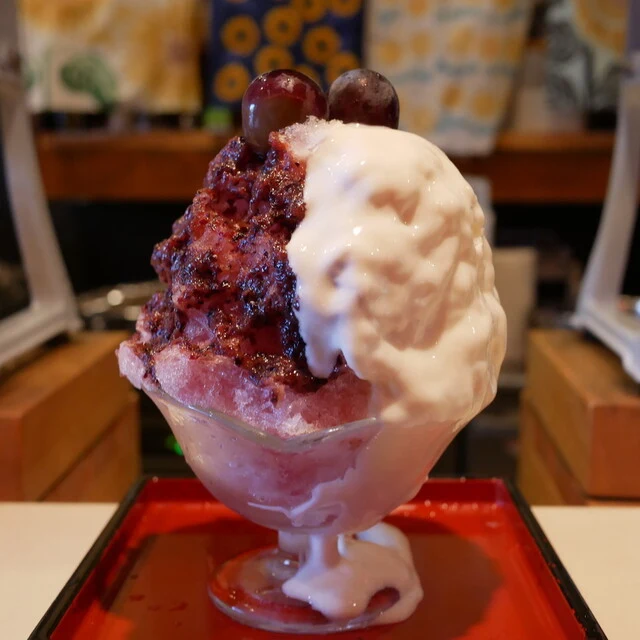
Yanaka sets a different rhythm from Ginza or Aoyama: low houses, temple lanes, old shopping streets, and a slower afternoon trade in sweets rather than luxury dining choreography. In that setting, kakigori reads less like a novelty dessert and more like a seasonal ritual. The draw is not ceremony for its own sake, but the pleasure of turning a brief stop into the anchor of a birthday afternoon, a family outing, or a quiet post-museum celebration.
Himitsu Do belongs to Tokyo’s serious shaved-ice conversation, a category that rewards texture, syrup balance, and timing rather than the formal signals of fine dining. Its selection for Tabelog Sweets TOKYO 100 in 2023 places it among the city’s closely watched sweets addresses, and the repeated Tabelog Sweets recognition listed across earlier years gives the shop a longer track record than a trend-led dessert counter. For travelers, that matters: kakigori has become a specialist format in Tokyo, and specialist formats are where small differences in execution define the experience.
Kakigori as occasion food, not an afterthought
Tokyo’s dessert scene has a habit of treating single-category shops with the seriousness other cities reserve for tasting menus. Ramen counters, fruit parlours, wagashi specialists, curry shops, and kakigori rooms all operate on that logic: narrow the field, repeat the craft, let regulars judge nuance. Himitsu Do fits that pattern through kakigori and Japanese sweets, which makes it a sharper choice for a daytime celebration than another all-purpose café.
The occasion angle is important. A milestone meal in Tokyo does not always need a white tablecloth, wine pairing, or late-night reservation. In neighbourhoods like Yanaka, the stronger move can be a focused stop that feels local to the area and specific to the season. Kakigori carries built-in theatre: ice, syrup, temperature, pace. The format gives children, friends, and multi-generation groups a shared centre without requiring the stamina of a long restaurant sitting.
That separates the experience from nearby café culture. HAGI CAFE sits in the same broader Yanaka orbit, while Waguri Ya Yanaka ten points toward the area’s Japanese sweets identity and French Gashi Patissier Chocolatier Inamura Shozo reflects Tokyo’s long appetite for patisserie precision. Himitsu Do occupies the shaved-ice lane inside that cluster. The comparison is useful because Yanaka rewards grazing, but a celebration needs a focal point; kakigori gives the day a clear reason to gather.
Yanaka's old-town setting changes the meal's tempo
The neighbourhood is part of the editorial argument. Tokyo often sells occasion dining through height, exclusivity, or counter access; Yanaka works through human scale. A sweets stop here pairs naturally with a walk from Nippori or Sendagi, and the route frames dessert as part of an afternoon rather than a separate errand. That makes the shop better suited to relaxed celebrations than business dining or late-evening restaurant hopping.
The practical signals also tell readers what kind of occasion to plan. This is not a reservation-driven omakase model, and it is not built for private-room entertaining. The format is closer to a focused counter-and-café visit, with no private rooms and a non-smoking room. Children are welcome, which widens its usefulness for family birthdays or low-pressure reunions. Payment is old-school: credit cards, electronic money, and QR code payments are not accepted, so cash planning is part of the experience rather than an afterthought.
Tokyo’s sweets map has many price tiers and moods. Kikumi Senbei Sohonten and Silk Road sit in a lower-cost everyday-snack register, while patisserie and wagashi specialists can turn into destination stops for travelers who structure days around dessert. Himitsu Do sits in the middle of that pattern: accessible in format, but serious enough in recognition to justify building an afternoon around it. That is the sweet spot for a celebration that should feel intentional without becoming formal.
How to place it within a Tokyo eating day
The stronger itinerary treats kakigori as the main daytime punctuation mark. Pair Yanaka with Ueno, Nezu, Sendagi, or Nippori rather than forcing it between far-apart reservations. A heavy lunch before shaved ice blunts the point; a lighter savoury stop, then sweets, makes more sense. For readers comparing Tokyo plans, Our full Tokyo restaurants guide gives the wider city context, while Our full Tokyo hotels guide, Our full Tokyo bars guide, Our full Tokyo wineries guide, and Our full Tokyo experiences guide help place the stop inside a broader trip.
For contrast, Tokyo’s occasion dining can run in many directions: the charcoal-and-seafood pull of. 鮪と炭火焼き うお炭 秋葉原店, the Shinjuku density around 12/10 Shinjuku ten, the skewered precision of 124. KAGURAZAKA (Yakitori), the graphic café staging of 2D Cafe, and the comfort-food specificity of 3 Chome no Curry Ya San. Against those choices, shaved ice offers a different kind of marker: shorter, brighter, more daytime, and often easier to fold into a walking neighbourhood plan.
The same logic applies beyond Tokyo. Travelers using Japan’s sweets and casual-dining scene as a thread might compare it with -Grilled beef Sukiyaki- KAMAKURA TANUKIAN 鎌倉 たぬき庵 in Kamakura,.cafe in Osaka,.know in Kumamoto, (Shoku) Vietnam in Kawasaki, [Curry Senmon Ten] Maruyama Kyoju. in Sapporo, and [ki:] in Kyoto. Across the Pacific, Jōdo Saké Bar in Los Angeles and Onigiri Time in Pasadena show how Japanese formats travel differently abroad. Himitsu Do’s value is tied to place: old-town Tokyo, specialist sweets culture, and a celebration that can happen in daylight without pretending to be dinner.
Questions
Frequently asked
How expensive is Himitsu Do?
Himitsu Do is listed at a price level of $$.
Where is Himitsu Do and what does it serve?
Himitsu Do is in Taitō, Tokyo, serving Japanese Shaved Ice / Kakigori Café.
The field
How it compares
| Place | Cuisine | Notes | Awards |
|---|---|---|---|
| Himitsu Do | Japanese Shaved Ice / Kakigori Café | Taitō, $$ | · |
| Den | Modern Japanese Kaiseki | Tokyo | Michelin 2 Stars, World's 50 Best |
| Florilège | Modern French-Japanese Plant-Based Fine Dining | Tokyo | Michelin 2 Stars, World's 50 Best |
| Narisawa | Modern Japanese Satoyama Fine Dining | Tokyo | Michelin 2 Stars, World's 50 Best |
| Quintessence | Modern French Fine Dining | Tokyo | Michelin 3 Stars |
| Sazenka | Modern Chinese Fine Dining | Tokyo | Michelin 3 Stars, World's 50 Best |
| Sézanne | Modern French Fine Dining | Tokyo | Michelin 3 Stars, World's 50 Best |
Similar places
Modern Japanese Kaiseki
Den
Tokyo, Japan
★★ · 50 Best
Modern French-Japanese Plant-Based Fine Dining
Florilège
Tokyo, Japan
★★ · 50 Best
Modern Japanese Satoyama Fine Dining
Narisawa
Tokyo, Japan
★★ · 50 Best
Modern French Fine Dining
Quintessence
Tokyo, Japan
★★★
Modern Chinese Fine Dining
Sazenka
Tokyo, Japan
★★★ · 50 Best
Modern French Fine Dining
Sézanne
Tokyo, Japan
★★★ · 50 Best