Hot Fish Club
- 01CuisineLowcountry Seafood
- 02CityMurrells Inlet, United States
Lowcountry seafood held in sequence
Separate cooking before the pass
The components stay distinct before they meet on the plate. Hot Fish Club in Murrells Inlet is a Lowcountry seafood room built around the marsh and the catch, and it names no chef behind the pass, so the method has to be judged from the menu rather than from a signature. The forms stay recognizable: lobster pot pie, hot fish sampler, lowcountry steampot. The past stays legible. The hand adjusts the weight.
Lowcountry seafood kept in its shape
The kitchen’s stated approach is traditional, and the useful work inside that word is restraint. Local sourcing matters here because the restaurant sits on Murrells Inlet, where seafood is not an imported idea but the material immediately outside the room. A lowcountry steampot asks for timing more than decoration; shellfish, seasoning, steam, and service have to arrive in the same breath. Lobster pot pie carries another kind of structure, with richness held in a familiar form rather than spread across the plate for effect.
The hot fish sampler works in the other direction, gathering several preparations onto one plate so that each has to survive comparison with the others. That is a harder brief than a single composed dish, because a sampler exposes any element that has been held too long or seasoned for a different plate. The kitchen has to bring several fish, several coatings and several temperatures to the same window. At Hot Fish Club, the a la carte seafood menu is less about disguise than handling. The plate can be generous without becoming loose. The pass has to hold both the old appetite for a marsh-front seafood supper and enough discipline to keep each element in its place.
The marsh at the edge of the room
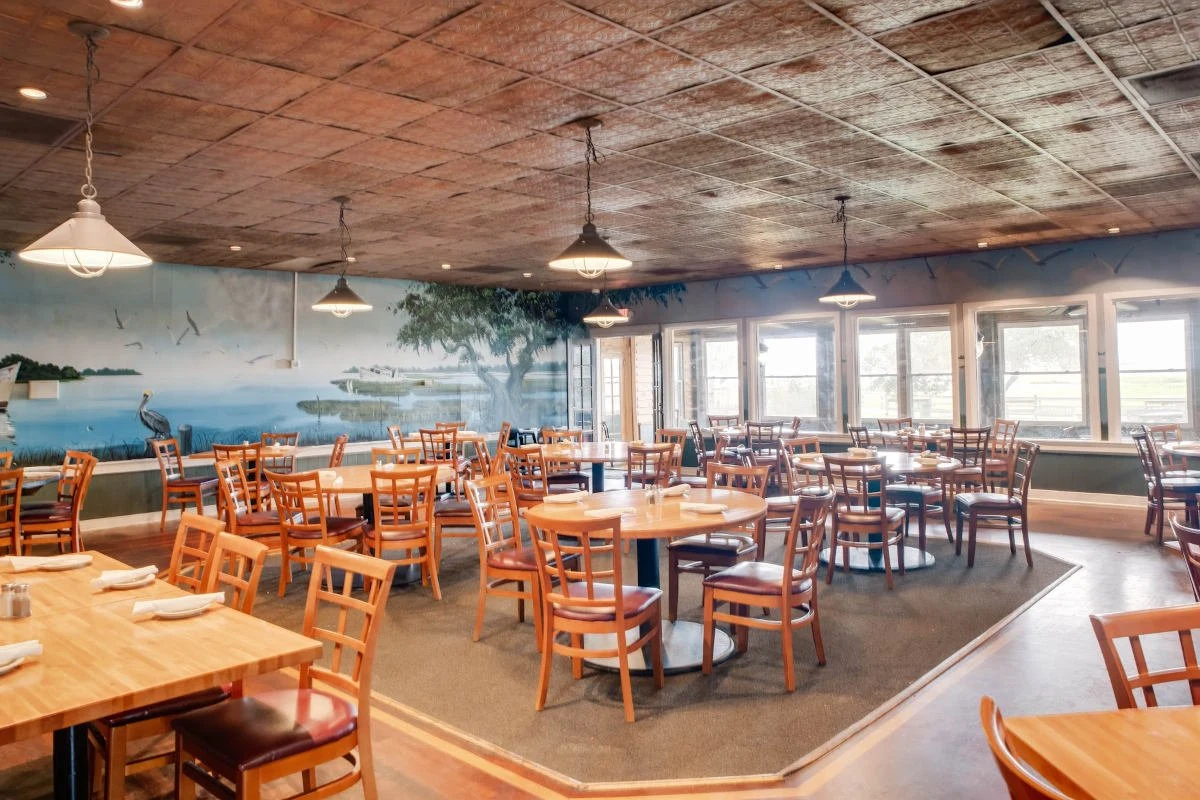
The room is lively by design. Murrells Inlet sits in the view, and the restaurant leans into that proximity with marsh-front sightlines, a live music gazebo, and décor drawn from the inlet’s natural forms. It is not a hushed dining room; the energy belongs to a large seafood house where the counter, the pass, and the tables all carry motion at once.
That setting changes how the craft is felt. The work has to cut through conversation, music, and the pull of the water outside. Upscale casual service gives the kitchen a broad field: composed dishes, shared seafood, and Lowcountry standards moving through the same evening. The room’s liveliness does not excuse looseness. It requires steadier hands.
A dish that still names the place
What holds this address together is the historic seafood house it has always been: a marsh-front room, a local catch, and a menu of forms guests already know how to order. The food can carry noise, marsh air, and appetite without losing its outline. End the evening on the lowcountry steampot at Hot Fish Club.
Questions
Frequently asked
What kind of food does Hot Fish Club serve?
Hot Fish Club serves Lowcountry seafood in Murrells Inlet. The menu is built around local catch and familiar forms such as lobster pot pie, hot fish sampler, and lowcountry steampot.
What is the dining room like?
The restaurant is set on the marsh and leans into that setting with marsh-front sightlines and a live music gazebo. The room is lively rather than hushed.
Do I need to book ahead?
Reservations are recommended, and booking is available through OpenTable.
What are the practical details for visiting?
Hot Fish Club is at 4911 US-17 BUS, Murrells Inlet, SC 29576. It has on-site lot parking, a casual dress code, and a price tier of $$, with an approximate spend of $30 per person.
When is Hot Fish Club open?
The restaurant is closed on Monday. It opens from 4 to 9 PM on Tuesday, Wednesday, Thursday, and Sunday, and from 4 PM to 1:30 AM on Friday and Saturday.
The field
How it compares
| Place | Cuisine | Notes | Awards |
|---|---|---|---|
| Hot Fish Club | Lowcountry Seafood | Murrells Inlet, $$ | · |
| Amber | Contemporary French Fine Dining | Hong Kong | Michelin 3 Stars, World's 50 Best |
| Atrio | Modern Spanish Fine Dining with Iberian Pork Focus | Cáceres | Michelin 3 Stars |
| Gabriel Kreuther | Modern Alsatian-French Fine Dining | New York City | Michelin 2 Stars |
| HAJIME | Avant-Garde Japanese Fine Dining | Osaka | Michelin 3 Stars, World's 50 Best |
| Moor Hall | Modern British Fine Dining | Aughton | Michelin 3 Stars |
| Zén | Neo-Nordic with Japanese Influences | Singapore | Michelin 3 Stars, World's 50 Best |
Similar places
Contemporary French Fine Dining
Amber
Hong Kong, Hong Kong
★★★ · 50 Best
Modern Spanish Fine Dining with Iberian Pork Focus
Atrio
Cáceres, Spain
★★★
Modern Alsatian-French Fine Dining
Gabriel Kreuther
New York City, United States
★★
Avant-Garde Japanese Fine Dining
HAJIME
Osaka, Japan
★★★ · 50 Best
Modern British Fine Dining
Moor Hall
Aughton, United Kingdom
★★★
Neo-Nordic with Japanese Influences
Zén
Singapore, Singapore
★★★ · 50 Best