Jardin des Sens
- 01CuisineModern Mediterranean Fine Dining
- 02CityMontpellier, France
- 03RecognitionOne Michelin Star
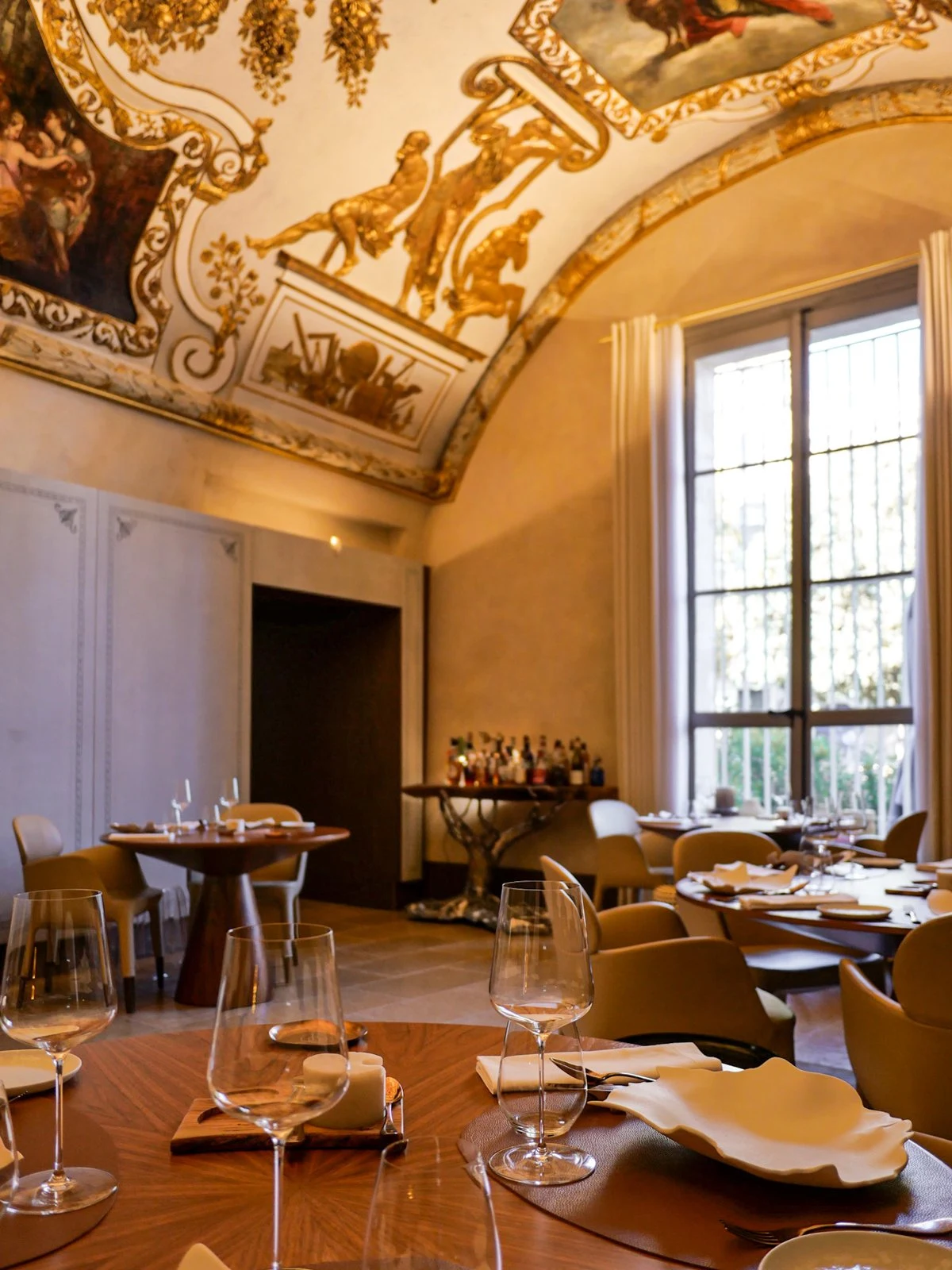
Mediterranean contrast under frescoed ceilings
- 1 Michelin Star · Michelin Guide
- World's 50 Best · #30 · World's 50 Best Restaurants
- Relais Chateaux Award · 2026
- Michelin 1 Star · 2026
- Michelin 1 Star · 2025
- Relais Chateaux Award · 2025
- Michelin 1 Star · 2024
- World's 50 Best Best Restaurants #33 · 2004
- World's 50 Best Best Restaurants #30 · 2002
A Mediterranean pass in Montpellier
The brief starts with product, then control. Jardin des Sens in Montpellier works a Mediterranean language that is already precise: fish, shellfish, local sourcing, and a taste for contrast. The house was founded in 1988 by the twin brothers Jacques and Laurent Pourcel, with their friend Olivier Château, when the brothers were 24. Born into a family in the viticulture industry on the Mediterranean shore, they took their first cues from their mother’s enthusiasm for regional cooking, and the name, garden of the senses, was meant to promise a multisensory meal rather than a single style. By 1998 the original site on Avenue Saint-Lazare held three Michelin stars. That history matters at this pass because the house asks for cooks who can read a place without flattening it. Montpellier brings the Languedoc, the Mediterranean shore, the market, the fishermen, the small farmer. The useful continuity is not a copied vocabulary, but a way of holding ingredients to account. A scallop, a blue lobster, or a fillet of sea bass can carry the room only if the hands leave it legible.
Contrasts kept inside the course
Jardin des Sens was founded in 1988 and later moved, in June 2021, to Place de la Canourgue within the Hôtel Richer de Belleval. The cooking keeps a Mediterranean structure: land and sea, hot and cold, smooth and crunchy, sweet and savory, sweet and sour. Those contrasts can easily become ornament. The discipline here is to make them behave like seasoning, not display. The house’s named dishes give the grammar: Noix de Saint-Jacques en duo, Homard bleu, Filet de bar au four. The menu architecture works through tasting menu and prix fixe formats, with seafood often carrying the sequence. Anchovy, mussels, scallops, razor clams, lobster, and bass have all belonged to the restaurant’s Mediterranean dialogues. The technique favors product quality and reasonable cooking times, with the aim of retaining natural flavor rather than forcing transformation for its own sake. The wine program sits close to that work. A beverage program built around wine has to follow the same line as the kitchen, enough structure for a formal room, enough restraint to let shellfish, fish, and regional produce remain the point.
Under the frescoed ceiling
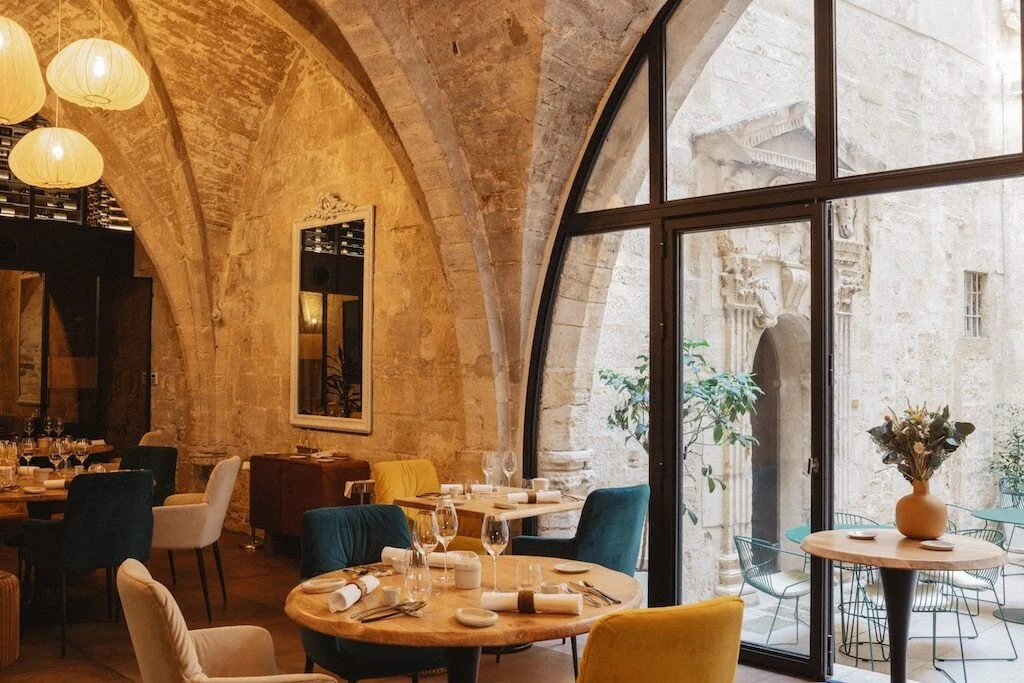
The room changes the tempo before the first plate reaches the pass. Jardin des Sens occupies classified spaces within a renovated mansion, with original frescoes by Jean de Roy, trompe-l'œil decoration, gypseries, gold-leaf plaster figures, and médaillons overhead. The setting could overwhelm a lesser service. Here it frames the work. Three vaulted dining rooms give the meal a measured pace; the atmosphere stays soft, refined, and quiet, with the courtyard and terrace holding a different register when the weather allows. Formal service suits this kind of cooking because the plates need time, space, and silence around them. The restaurant holds one Michelin star, and its place among the World’s 50 Best is recorded at number 30. Awards do not season the scallop. They do, however, show the level at which the pass is expected to repeat itself.
The house after the move
The move to the Hôtel Richer de Belleval gave Jardin des Sens a second architectural life without cutting it away from its first one. Its original site belonged to Avenue Saint-Lazare; its current rooms belong to Place de la Canourgue, and the restaurant is presented as a standalone gastronomic address rather than a hotel dining room. The task is to cook inside that continuity rather than explain it. The next plate still has to pass through the same narrow test: product, timing, contrast, and the hands that know when to stop. End the meal there, with Homard bleu under Jean de Roy’s ceiling.
Questions
Frequently asked
Who founded Jardin des Sens?
Jardin des Sens was founded in 1988 by the twin brothers Jacques and Laurent Pourcel, with their friend Olivier Château.
What kind of cooking does the restaurant serve?
The kitchen works in a modern Mediterranean register, with fish, shellfish, local sourcing, and a focus on contrasts such as land and sea, hot and cold, and sweet and savory.
What are some of the signature dishes?
Named dishes include Noix de Saint-Jacques en duo, Homard bleu, and Filet de bar au four.
Where is Jardin des Sens located?
The restaurant is on Place de la Canourgue in Montpellier, inside the Hôtel Richer de Belleval.
What recognition does it hold?
Jardin des Sens holds one Michelin star and is recorded at number 30 in the World's 50 Best.
The field
How it compares
| Place | Awards | Cuisine | Notes |
|---|---|---|---|
| Jardin des Sens | Michelin 1 Star, World's 50 Best #30 | Modern Mediterranean Fine Dining | Préfecture, $$$$ |
| BonAmb | Michelin 2 Stars | Modern Mediterranean Fine Dining | Xàbia |
| Céna | · | Modern French Gastronomic | Montpellier |
| La Table du Castellet | · | Modern Mediterranean Fine Dining | Le Castellet |
| La Vague d'Or - Cheval Blanc St-Tropez | Michelin 3 Stars | Modern Mediterranean Fine Dining | Saint-Tropez |
| Reflet d'Obione | Michelin 1 Star | Modern French Sustainable Gastronomy | Montpellier |
| Riff | Michelin 1 Star | Modern Mediterranean Fine Dining | València |
Similar places
Modern Mediterranean Fine Dining
BonAmb
Xàbia, Spain
★★
Modern French Gastronomic
Céna
Montpellier, France
Modern Mediterranean Fine Dining
La Table du Castellet
Le Castellet, France
Modern Mediterranean Fine Dining
La Vague d'Or - Cheval Blanc St-Tropez
Saint-Tropez, France
★★★
Modern French Sustainable Gastronomy
Reflet d'Obione
Montpellier, France
★
Modern Mediterranean Fine Dining
Riff
València, Spain
★