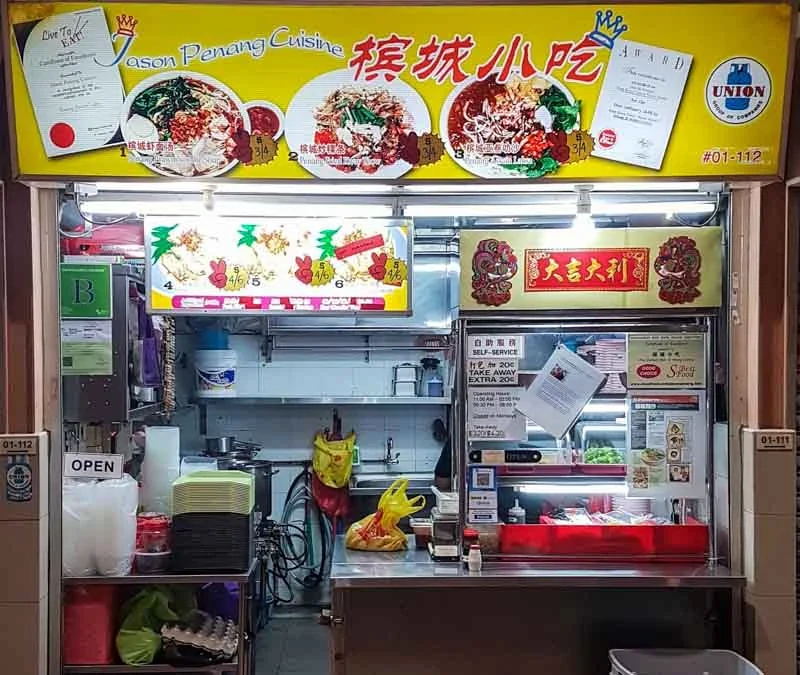
Jason Penang Cuisine
In Residence
Jason Khaw
Chef
- 01CuisineAuthentic Penang Hawker
- 02CitySingapore, Singapore
- Michelin Bib Gourmand · Michelin Guide
- Michelin Guide Bib Gourmand · 2026
- Michelin Bib Gourmand · 2025
- Michelin Bib Gourmand · 2024
Bukit Merah and the Penang Hawker Thread Running Through Singapore
The hawker centre at 6 Jalan Bukit Merah sits in a residential precinct that most visitors to Singapore's central core pass without stopping. Block 1, the older housing estate behind it, and the low concrete canopy of the food centre itself carry the functional architecture of 1970s public housing planning, no design statement, no curated signage, no queue management rope. What draws attention here is the smell and the rhythm of the morning crowd: older residents with trays, a table of construction workers, the sound of wok-fire and rapid Hokkien.
Singapore's hawker scene has increasingly split between two trajectories. One runs toward preservation and documentation, government-backed schemes, heritage stall listings, cultural status applications. The other, quieter one, involves hawkers from Penang or with Penang lineage bringing a different regional grammar to Singapore's stall ecosystem. Dishes from George Town's food culture carry their own internal logic: broth-building that takes hours, the use of pork lard at specific stages, prawn paste depth that differs from the sambal register more common in Singapore's own hawker tradition. Jason Penang Cuisine belongs to this second trajectory, and its back-to-back Michelin Bib Gourmand awards for 2024 and 2025 signal that the gap between Penang-style cooking and Singapore's own hawker canon is narrowing in terms of recognition, even if the flavour profiles remain distinct.
What Penang-Style Cooking Actually Means in This Context
The Bib Gourmand designation carries real significance in the hawker context. Across Singapore's street food tier, stalls earning this designation twice consecutively have demonstrated consistency under scrutiny, not just a good week during inspection season. For a single-chef operation at a hawker centre in Bukit Merah, that consistency signal matters.
Penang cuisine, in its hawker form, tends toward complexity of base rather than complexity of garnish. The stocks used in prawn-heavy dishes are typically reduced from heads and shells over extended periods; the char on Hokkien noodles requires controlled high heat at exact timing; char kway teow depends on wok hei, the brief caramelisation that happens at temperatures most domestic kitchens cannot reach. These are techniques that resist shortcuts, and in a city where hawker succession has become a documented problem, a younger operator maintaining this standard at the price point Bib Gourmand implies is worth registering.
For context on how the wider Singapore hawker scene maps at this level, the Bib Gourmand tier includes operations as varied as Hill Street Tai Hwa Pork Noodle and 545 Whampoa Prawn Noodles, each with its own regional and technique anchors. 91 Fried Kway Teow Mee and A Noodle Story show how noodle-centric formats have found recognition across very different interpretive registers. Adam Rd Noo Cheng Big Prawn Noodle works a prawn noodle format with its own loyal following. Jason Penang Cuisine occupies a specific niche within that cohort: Penang-origin technique, residential-neighbourhood address, and the kind of Google review profile (4.1 from 105 ratings) that reflects a regular local crowd more than an influx of destination diners.
The Sustainability Angle in Hawker Cooking
The sustainability framing applied to fine dining, sourcing declarations, zero-waste tasting menus, carbon-tracked supply chains, rarely translates directly to the hawker context. But the structural sustainability of hawker culture is worth examining on its own terms. A stall at a public hawker centre operates within a food system that is, by design, low-footprint: no air-conditioned dining room, shared infrastructure, minimal packaging at the point of service, and a pricing model that keeps cooked food accessible to the full income spectrum of the neighbourhood. Singapore's hawker centres were originally conceived as a public health and urban planning solution, consolidating street vendors into managed facilities. The environmental logic of that consolidation, shared utilities, reduced food miles within the estate system, cooking at scale without the overhead of a standalone restaurant, gives hawker food a structural sustainability argument that precedes the language of contemporary food ethics.
Within that frame, Penang-style cooking's reliance on whole-animal and whole-crustacean preparation (using prawn heads and shells that would otherwise be discarded, for instance) reflects a waste-reduction logic built into the cuisine rather than retrofitted onto it. The same applies to the use of pork lard and drippings across multiple preparations, a practice that maximises yield from a single ingredient. These are not sustainability marketing claims; they are the economic and culinary logic of a food tradition that developed under material constraint and has not abandoned those habits now that recognition has arrived.
Penang hawker stalls operating outside Malaysia, in Singapore, in Bangkok, in London's Chinese food enclaves, carry these same embedded efficiencies. For comparison on how the Penang hawker register translates across borders and formats, see 888 Hokkien Mee (Lebuh Presgrave) and Ah Boy Koay Teow Th'ng in George Town for the source-city versions of formats in Jason Penang Cuisine's repertoire. Air Itam Duck Rice and Air Itam Sister Curry Mee show how island-specific sub-traditions within Penang produce yet more differentiated flavour profiles. Further afield, A Pong Mae Sunee in Phuket, Ali Nasi Lemak Daun Pisang, Anuwat in Phang Nga, and Banana Boy in Hong Kong illustrate how Southeast Asian street food formats travel and adapt across the region's urban food economies.
Planning Your Visit
Jason Penang Cuisine is a hawker stall at a public food centre in Bukit Merah, which means the practical calculus is different from restaurant dining. The address is 6 Jalan Bukit Merah, #01-112.
| Venue | Format | Price Range | Michelin Recognition | Walk-in? |
|---|---|---|---|---|
| Jason Penang Cuisine | Hawker stall | $ | Bib Gourmand 2024, 2025 | Yes, queue expected at peak |
| Hill Street Tai Hwa Pork Noodle | Hawker stall | $ | Bib Gourmand / Star-tier recognition | Yes, long queues typical |
| A Noodle Story | Hawker stall | $ | Bib Gourmand | Yes, queue expected |
| Burnt Ends | Restaurant | $$$ | Michelin 1 Star | Limited, advance booking recommended |
| Zén | Fine dining | $$$$ | Michelin 3 Stars | No, reservation required well in advance |
The Sunday letter
Get new places like Jason Penang Cuisine every Sunday.
One email a week with the restaurants, bars and hotels we have just written up, and the people who run them.
One email a week. Unsubscribe from any issue.
Questions
Frequently asked
What recognition does Jason Penang Cuisine hold?
Jason Penang Cuisine holds a Michelin Bib Gourmand.
Who works at Jason Penang Cuisine?
Made By profiles Jason Khaw (Chef) at Jason Penang Cuisine.
How expensive is Jason Penang Cuisine?
Jason Penang Cuisine is listed at a price level of $.
Where is Jason Penang Cuisine and what does it serve?
Jason Penang Cuisine is in ALEXANDRA HILL, Singapore, serving Authentic Penang Hawker.
The field
How it compares
| Place | Cuisine | Notes | Awards |
|---|---|---|---|
| Jason Penang Cuisine | Authentic Penang Hawker | ALEXANDRA HILL, $ | · |
| Born | Contemporary Fusion Fine Dining | Singapore | Michelin 1 Star, World's 50 Best |
| Burnt Ends | Modern Australian Barbecue | Singapore | Michelin 1 Star, World's 50 Best |
| Jaan by Kirk Westaway | Modern British Fine Dining | Singapore | Michelin 2 Stars, World's 50 Best |
| Les Amis | Classic French Haute Cuisine | Singapore | Michelin 3 Stars, World's 50 Best |
| Odette | Modern French Fine Dining | Singapore | Michelin 3 Stars, World's 50 Best |
| Zén | Neo-Nordic with Japanese Influences | Singapore | Michelin 3 Stars, World's 50 Best |
In residence
Similar places
Contemporary Fusion Fine Dining
Born
Singapore, Singapore
★ · 50 Best
Modern Australian Barbecue
Burnt Ends
Singapore, Singapore
★ · 50 Best
Modern British Fine Dining
Jaan by Kirk Westaway
Singapore, Singapore
★★ · 50 Best
Classic French Haute Cuisine
Les Amis
Singapore, Singapore
★★★ · 50 Best
Modern French Fine Dining
Odette
Singapore, Singapore
★★★ · 50 Best
Neo-Nordic with Japanese Influences
Zén
Singapore, Singapore
★★★ · 50 Best
The Sunday letter
Get the next Made By story in your inbox.
We send one email every Sunday morning with the places and people we covered that week.
One email a week. Unsubscribe from any issue.