Landgasthaus Hirsch
- 01CuisineTraditional Swabian Cuisine
- 02CityWinterbach, Germany
- Michelin Bib Gourmand · Michelin Guide
- Michelin Bib Gourmand · 2026
- Michelin Bib Gourmand · 2025
- Michelin Bib Gourmand · 2024
Where the Supply Chain Is a Short Walk
Across southern Germany, a particular style of country inn has become harder to find: the kind where the sourcing story is not a marketing exercise but simply a description of how things have always been done. The bread comes from next door. The game was shot nearby. The schnapps was made in-house. At Landgasthaus Hirsch on Kaiserstraße in Winterbach, that description is literal. The Waldenmaier family, now in their fourth generation of running this traditional inn, have maintained supply relationships so short and local that the kitchen operates more like an extension of the surrounding landscape than a restaurant in any conventional sense.
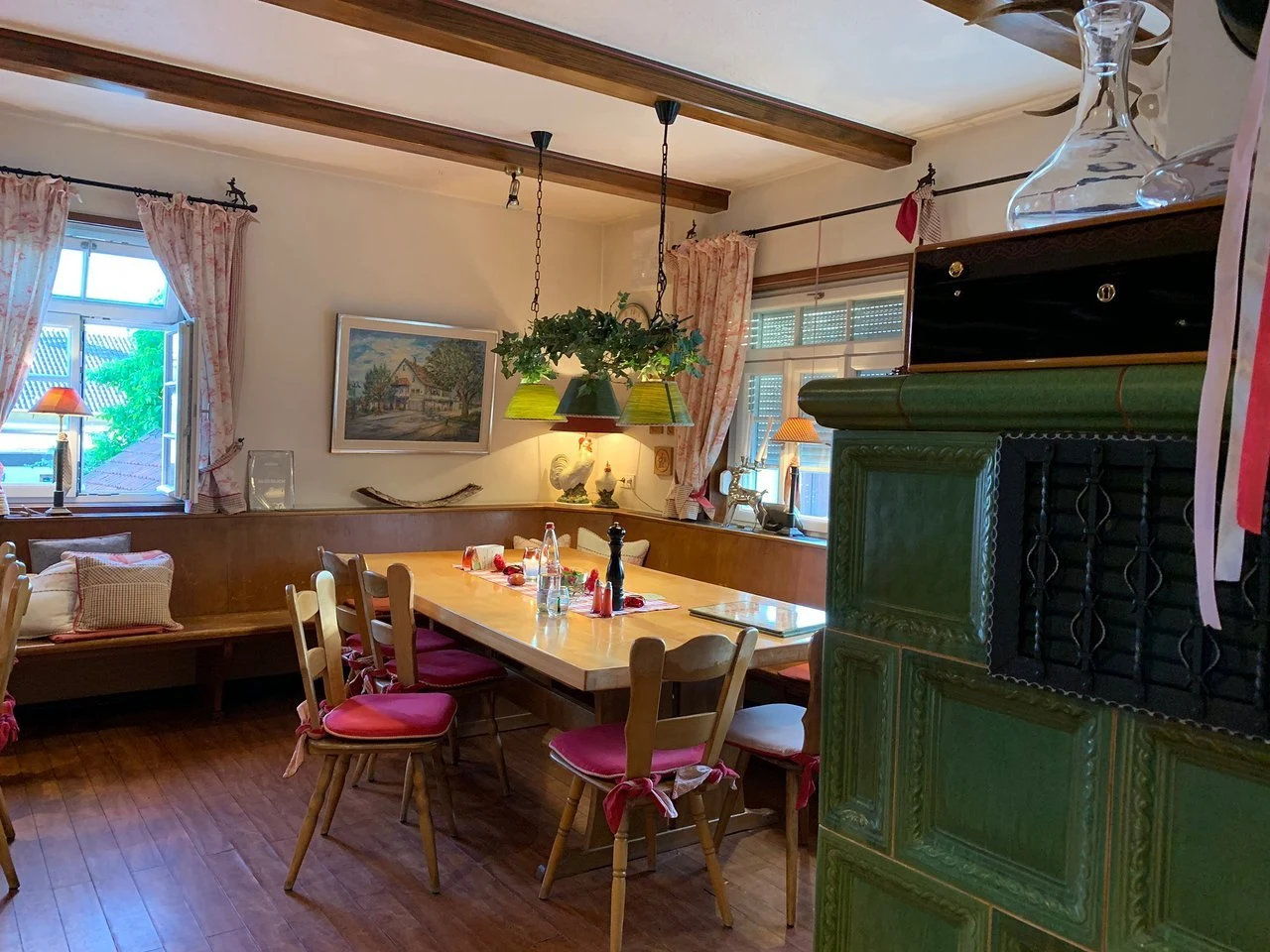
Approaching the inn, the architecture signals its register immediately: a traditional German Landgasthaus format, the kind of building that has housed travellers and fed locals for generations, with a first-floor terrace and a beer garden that earns the word rustic without apology. This is not the studied rusticity of a newly opened farm-to-table concept. The wear is genuine, the hospitality generational.
Four Generations, One Kitchen Logic
The Bib Gourmand that Michelin awarded Landgasthaus Hirsch in 2025 is the category's most honest signal: inspectors use it specifically for places that deliver cooking of real quality at prices that do not require a special occasion to justify. At the €€ price range, the Hirsch sits at about $35 per person. For context, restaurants like Schwarzwaldstube in Baiersbronn, Aqua in Wolfsburg, or Vendôme in Bergisch Gladbach operate at the €€€€ level, where the proposition is creative ambition and technical precision. The Hirsch's Bib recognition places it in an entirely different competitive tier, one where the measure is value, seasonal honesty, and regional coherence.
Chef Daniel Schröder works within a kitchen tradition shaped by the Waldenmaier family's accumulated knowledge of what this part of Swabia produces and when. That generational depth functions as a kind of informal culinary training that most young chefs cannot replicate: an inherited understanding of seasonal rhythm, of which local hunters supply the leading game, of when the bread from the neighbouring bakery is freshest. The result is cooking that does not need to announce its provenance credentials because those credentials are simply the operating reality of the kitchen.
Country cooking at this level in Germany occupies a distinct position from the creative contemporary German cuisine drawing international attention elsewhere. Places like CODA Dessert Dining in Berlin or JAN in Munich are working in a different register entirely, where the conversation is about technique and innovation. The Hirsch's register is seasonal, regional, and rooted, a cooking mode that requires discipline and consistency rather than invention, and that Michelin's Bib category exists precisely to surface and reward.
Game, Bread, and Schnapps: The Three-Point Sourcing Model
The sourcing structure at Landgasthaus Hirsch is worth examining as a model of what genuine regional cooking looks like in practice. Game that is locally hunted means the kitchen's protein supply varies with the season and the hunt, there is no importing or substituting when the local supply runs short. Bread from the neighbouring bakery creates a supply dependency on a single local producer, which is exactly the kind of relationship that keeps both businesses embedded in their community. Home-distilled schnapps closes the loop: the inn produces its own digestif, which means the meal can begin and end entirely within a radius of a few hundred metres.
This is not a romantic interpretation. It is a logistical reality that constrains and defines the menu in ways that a kitchen sourcing from national distributors simply does not experience. The seasonal and regional fare that Michelin's inspectors praise is, in part, a direct consequence of these supply constraints. You cook what is available, when it is available, and you have been doing so for four generations.
For comparable approaches elsewhere in European country cooking, the 21.9 in Piobesi d'Alba and Andrea Monesi - Locanda di Orta in Orta San Giulio operate in a similar tradition of rooted, produce-led country cooking, each within their own regional idiom.
The Terrace and the Beer Garden
The physical setting extends the kitchen's logic. The first-floor terrace and the beer garden are not decorative additions to a restaurant that happens to be in the countryside. They are the natural outdoor expression of a Landgasthaus that has always served a community that eats and drinks outside when the weather permits. In the warmer months, the beer garden becomes the primary draw for many visitors, with the rustic character of the space reinforcing rather than contradicting the cooking's register.
Southern Germany's inn culture has historically centred on exactly this format: a covered indoor space for colder months, an outdoor garden for summer, and a menu that moves with the season. Landgasthaus Hirsch does not depart from this model. It is the model, maintained across four generations.
Planning Your Visit
Landgasthaus Hirsch is located at Kaiserstraße 8, 73650 Winterbach. At about $35 per person and with a Google rating of 4.4 from 297 reviews, it draws a consistent local and regional audience. Winterbach sits in the Stuttgart metropolitan area, making it accessible from the city as a day trip or short excursion. For those building a longer itinerary across the region, Given the inn's format and community standing, advance planning during game season, typically autumn through early winter, is worth considering, as demand for locally hunted game dishes tends to concentrate in those months.
For reference against the wider German dining spectrum, the Bib Gourmand positioning of the Hirsch sits several tiers below starred operations like Restaurant Haerlin in Hamburg, Schanz in Piesport, Waldhotel Sonnora in Dreis, Victor's Fine Dining by christian bau in Perl, Bagatelle in Trier, or ES:SENZ in Grassau. It is doing something else entirely, and Michelin's 2025 Bib recognition confirms that it is doing it well.
Questions
Frequently asked
What recognition does Landgasthaus Hirsch hold?
Landgasthaus Hirsch holds a Michelin Bib Gourmand.
How expensive is Landgasthaus Hirsch?
Landgasthaus Hirsch is listed at a price level of $$.
Where is Landgasthaus Hirsch and what does it serve?
Landgasthaus Hirsch is in Winterbach, Baden-Württemberg, Winterbach, serving Traditional Swabian Cuisine.
The field
How it compares
| Place | Cuisine | Notes | Awards |
|---|---|---|---|
| Landgasthaus Hirsch | Traditional Swabian Cuisine | Winterbach, Baden-Württemberg, $$ | · |
| ESqUISSE | Modern French with Japanese Influences | Tokyo | Michelin 2 Stars, World's 50 Best |
| Frantzén | Modern Nordic Fusion with Japanese Influences | Stockholm | Michelin 3 Stars, World's 50 Best |
| Piazza Duomo | Modern Piedmontese Fine Dining | Alba | Michelin 3 Stars, World's 50 Best |
| The Glenturret Lalique Restaurant | Modern Scottish Fine Dining | Crieff | Michelin 2 Stars |
| Vea | Modern Chinese-French Fusion | Hong Kong | Michelin 1 Star, World's 50 Best |
| Ynyshir Hall | Modern Fusion Fine Dining | Machynlleth | Michelin 2 Stars |
Similar places
Modern French with Japanese Influences
ESqUISSE
Tokyo, Japan
★★ · 50 Best
Modern Nordic Fusion with Japanese Influences
Frantzén
Stockholm, Sweden
★★★ · 50 Best
Modern Piedmontese Fine Dining
Piazza Duomo
Alba, Italy
★★★ · 50 Best
Modern Scottish Fine Dining
The Glenturret Lalique Restaurant
Crieff, United Kingdom
★★
Modern Chinese-French Fusion
Vea
Hong Kong, Hong Kong
★ · 50 Best
Modern Fusion Fine Dining
Ynyshir Hall
Machynlleth, United Kingdom
★★